Completing the Square (SQA National 5 Maths): Revision Note
Exam code: X847 75

Completing the square in a quadratic expression
How can I rewrite the first two terms of a quadratic expression as the difference of two squares?
Look at the quadratic expression
The first two terms can be written as the difference of two squares using the following rule
is the same as
Check this is true by expanding the right-hand side
Is the same as ?
Yes:
This works for negative values of too
can be written as which is
A negative does not change the sign at the end
How do I complete the square?
Completing the square is a way to rewrite a quadratic expression into a form containing a squared bracket
To complete the square on x2 + 10x + 9
Use the rule above to replace the first two terms, x2 + 10x, with (x + 5)2 - 52
Substitute back into the original expression: (x + 5)2 - 52 + 9
simplify the numbers: (x + 5)2 - 25 + 9
answer: (x + 5)2 - 16
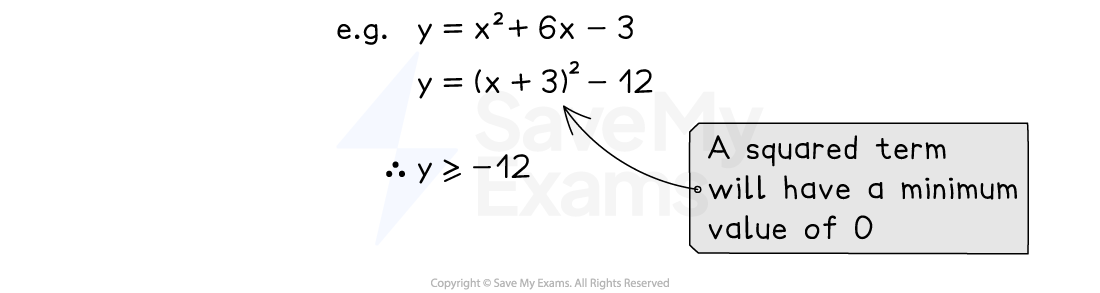
Completing the square can also be used to prove or show results using the fact that any squared term, such as the squared bracket (x ± a)2, will always be greater than or equal to 0
You cannot square a number and get a negative value
The smallest a squared term can be is 0
Examiner Tips and Tricks
To know if you have completed the square correctly, expand your answer to check that it gets you back to the original form.
Worked Example
Express in the form .
Answer:
Use to rewrite
Here , so
Substitute that back into the original expression
Simplify the numbers at the end

Unlock more, it's free!
Join the 100,000+ Students that ❤️ Save My Exams
the (exam) results speak for themselves:

Was this revision note helpful?
Build on this topic