Surface Area to Volume Ratios (Cambridge (CIE) A Level Biology): Revision Note
Exam code: 9700

Principles of SA:V
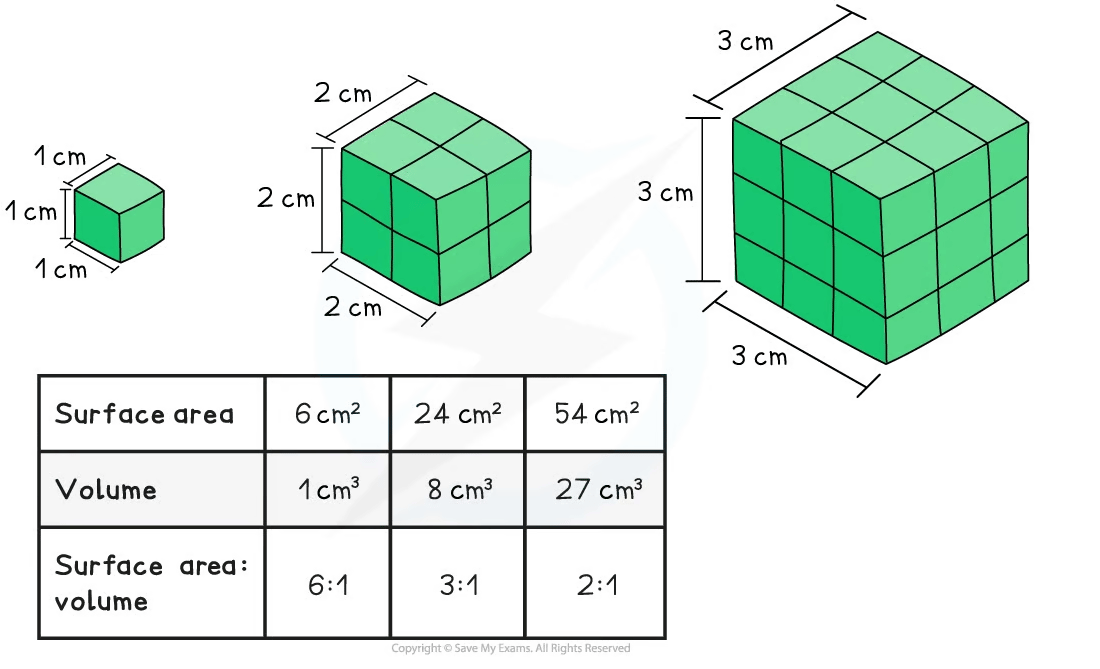
Surface area and volume are both very important factors in the exchange of materials in organisms
As the surface area and volume of an organism increase (and therefore the overall ‘size’ of the organism increases), the surface area : volume ratio decreases
This is because volume increases more rapidly than surface area as size increases
Importance of a high surface area to volume ratio
Having a high surface area to volume ratio increases the ability of a biological system to perform the following important functions
Obtaining necessary resources eg, oxygen, glucose, amino acids
Eliminating waste products eg. carbon dioxide, urea
Acquiring or dissipating thermal energy (heat)
Otherwise exchanging chemicals and energy with the surroundings eg. absorbing hormones at the cell surface in the hormone's target organ
| Cube | Cuboid | Cylinder |
|---|---|---|---|
Diagram |  |  |  |
Surface Area | 6s2 | 2lh + 2lw + 2wh | 1x rectangle = 2πrh 2x circular ends = 2πr2 SA = 2πrh + 2πr2 |
Volume | s3 | l × w × h | πr2h |
Example | If s = 1 cm then SA = (1×1)×6 SA = 6cm2 V = s3 = 13 =1cm3 ∴ SA:V ratio = 6:1 | If l = 4cm, w = 2cm, h = 1cm, then SA = 2((4×1)+(4×2)+(2×1)) = 28cm2 V = 4 × 2 × 1 = 8cm3 ∴ SA:V ratio = 28:8 = 3.5:1 | If r = 2 cm and h = 6cm, then SA = 2πrh + 2πr2 = 8π +24π = 32π cm2 V = π(2)2 × 6 = 24π cm3 ∴ SA : V ratio = 32 : 24 = 1.33:1 |
Worked Example
Calculate the surface area-to-volume ratios of the two following microorganisms:
A bacterial cell from the species Staphylococcus aureus; you can assume that each cell is a cube with side length of 800 nm (8 × 10⁻⁷ m)
A bacterial cell from the species Bacillus subtilis; these are rod-shaped cells which you can assume to be cylindrical in shape. They are 5 µm long and 1 µm in diameter
Comment on your calculated answers.
Solution
1. For the Staphylococcus aureus cell: side length = 800 nm
Convert this value into µm by dividing by 1000
Surface area of cube = 6(s2)
= 6 × (0.8 × 0.8) = 3.84 µm2
Volume = 0.8 × 0.8 × 0.8
= 0.512 µm3
The SA:V ratio is the surface area divided by the volume, so
___________
2. For the Bacillus subtilis cell: radius = 0.5 µm (half of diameter 1µm)
Surface area of a cylinder = 2πrh + 2πr2
= (2π × 0.5 × 5) + (2π × 0.52)
= 15.708 + 1.571 µm2
= 17.278 µm2
Volume of a cylinder: formula is πr2h
= π × 0.52 × 5
= 3.927 µm3
The cuboid cell of Staphylococcus aureus has a surface area-to-volume ratio of 7.5 : 1
The cylindrical cell of Bacillus subtilis has a surface area-to-volume ratio of 4.4 : 1
The smaller cell has the largest surface area-to-volume ratio of the two shapes. This allows efficient diffusion into / out of the cell. The larger the surface area to volume ratio, the more membrane there is per unit volume, so exchange by diffusion can keep up with the needs of the whole cell. So the larger the surface area to volume ratio, the better adapted to simple diffusion that organism is.
Examiner Tips and Tricks
This worked example assumes that Staphylococcus aureus is a cuboid shaped cell; in fact it is a spherical cell.
You are not required to know how to calculate the surface area and volume of a sphere for this exam. For a given volume, a sphere has the smallest surface area of any shape, so cells that rely on diffusion stay small, or are flattened or elongated, to keep a large surface area to volume ratio.
However, you are expected to be able to calculate the SA:V ratio for a cube, cuboid or cylinder and explain how the increasing size of an organism affects the SA:V ratio.

Unlock more, it's free!
Join the 100,000+ Students that ❤️ Save My Exams
the (exam) results speak for themselves:

Was this revision note helpful?
Build on this topic