Electromagnetic Induction & Alternating Currents (Edexcel A Level Physics): Exam Questions

Exam code: 9PH0

1 hour10 questions
1a
Sme Calculator
8 marks

A student connected the output from a source of alternating potential difference (p.d.) to a series resistor combination.

She connected an oscilloscope across the 150 Ω resistor as shown.

q7-nov-2021-9ph0-03-edexcel-as-a-level-phy

The trace obtained on the oscilloscope is shown below.

q7a-nov-2021-9ph0-03-edexcel-as-a-level-phy

i) Determine the peak p.d. across the 150 Ω resistor. 

y-sensitivity of oscilloscope = 2.0 V per division

Peak p.d. across 150 Ω resistor = .........................................(2)

ii) Calculate the root mean square (r.m.s.) value of the current in the circuit.

r.m.s. value of current = ..................................................(3)

iii) Calculate the power dissipated in the circuit.

Power dissipated in circuit = ...............................................(3)

1b
Sme Calculator
3 marks

Another student suggested that a voltmeter would be more accurate than using an oscilloscope to determine the magnitude of the p.d.

Comment on this suggestion.

2a
Sme Calculator
6 marks

Hybrid electric vehicles (HEV) use the same device both as a generator to charge the car battery and as an electric motor to support the propulsion system. A simplified diagram of the device is shown. The coil can rotate freely around the axis.

q17-nov-2020-9ph0-01-edexcel-as-a-level-phy

Describe how the device can be used as both a generator and an electric motor.

2b
Sme Calculator
5 marks

The circuit diagram shows a car battery connected to an electric motor for a HEV.

The battery has an electromotive force (e.m.f.) 180 V and internal resistance 0.036 Ω.

q17b-nov-2020-9ph0-01-edexcel-as-a-level-phy

The motor has a maximum power of 88 kW.

i) Show that the current I drawn by the electric motor when operating at this power would be given by the equation

0.036I2 − 180I + 88 000 = 0

(3)

ii) Solving the equation above produces an answer of I = 550 A. At maximum power, the car can accelerate from rest to sixty miles per hour in under 7 s.

The maximum charge capacity of the battery within this HEV is 6.1 amp-hour.

Deduce whether the battery could maintain this current for up to 7 s.

(2)

3a
Sme Calculator
5 marks

The Shanghai Maglev Train is the first commercially operated high-speed magnetic levitation train in the world, connecting the airport and central Shanghai.

q10-june-2018-9ph0-03-edexcel-as-a-level-phy

The total distance travelled is 29.9 km and the total journey time is 440 s. The train starts from rest and reaches a speed of 97 m s–1 in 120 s.

i) Calculate the average acceleration of the train during the first 120 s.

Average acceleration of train = ..............................(2)

ii) Calculate the average speed of the train for the period following the 120 s acceleration.

Average speed of train = .............................(3)

3b
Sme Calculator
2 marks

Electromagnetic forces enable the train to levitate above a steel rail.

Explain why magnetic levitation is an advantage for a high-speed transport system.

3c
Sme Calculator
6 marks

A linear induction motor provides the force to accelerate the train forwards. A current flows in sequence through coils of wire mounted in the track. The train is dragged along as the magnetic field progresses along the coils of wire in the track. This is similar to moving a permanent magnetic field away from a conductor.

A teacher demonstrates this effect by quickly removing one end of a bar magnet from a suspended aluminum ring.

q10c-june-2018-9ph0-03-edexcel-as-a-level-phy

When the magnet is removed from the ring, the ring moves in the same direction as the magnet.

Explain, using the laws of electromagnetic induction, why the ring moves in the direction of the magnet.

4
Sme Calculator
6 marks

A simple electric motor consists of a coil that is free to rotate in a magnetic field.

A student connects the motor to an ammeter and a battery.

q12-june-2018-9ph0-01-edexcel-as-a-level-phy

The graph shows how the current I in the coil varies with time t. The switch is closed at time T.

q12-1-june-2018-9ph0-01-edexcel-as-a-level-phy

Explain why the current rises to a maximum then decreases.

Your answer should include a reference to Faraday and Lenz’s laws.

1a
Sme Calculator
6 marks

The diagrams show the plan view and side view of a moving coil ammeter.

q17-nov-2021-9ph0-01-edexcel-as-a-level-phy

The fixed soft iron cylinder and magnets produce a uniform magnetic field of magnetic flux density B. The coil is able to rotate within this magnetic field. The coil has width w and length l. There is a current I in the coil in the direction shown in the side view diagram.

i) Explain which way the coil will rotate.

(2)

ii) Show that the moment M on the coil about the pivot, due to the magnetic field, is given by

M = BAIN

where

A is the cross-sectional area of the coil

N is the number of turns of wire on the coil.

(4)

1b
Sme Calculator
3 marks

An ammeter of this type has a resistance of 625 Ω and will measure a maximum current of 1.6 mA.

The ammeter can be adapted to measure potential difference by adding a resistor in series with the ammeter. This  resistor is known as a multiplier.

The ammeter is adapted so that it can measure potential differences up to 5.0 V as shown.

q17b-nov-2021-9ph0-01-edexcel-as-a-level-phy

The following multipliers are available:

200 Ω

2500 Ω

3125 Ω

3750 Ω

Deduce which multiplier should be used.

1c
Sme Calculator
4 marks

The coil within a very sensitive moving coil ammeter can be damaged when the ammeter is transported. The two ends of the coil are connected together when the ammeter is transported. This reduces the movement of the coil and makes it less likely to be damaged.

A student suggests that this is due to Faraday’s law and Lenz’s law.

Explain how these laws apply to this situation.

2a
5 marks

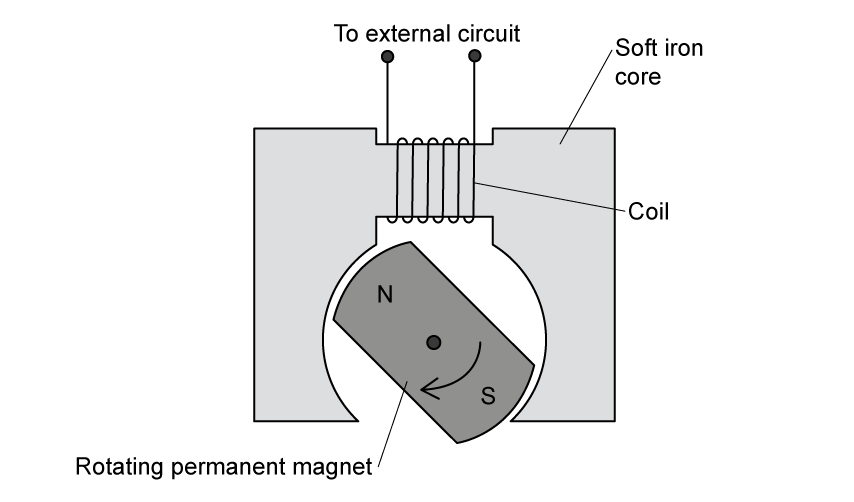
The diagram shows a generator used in a small wind turbine. It consists of a magnet on the shaft of the turbine's rotor, which is rotated inside a cavity in a soft iron core.

A permanent magnet rotating clockwise in a soft iron core. A coil wrapped around the iron core is connected to an external circuit.

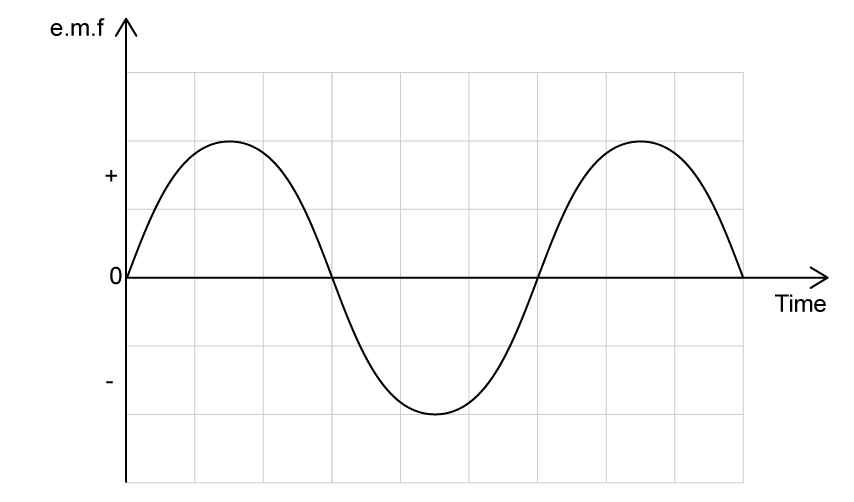
A coil wrapped around the iron core is connected to an external circuit. The graph shows how the output e.m.f. across the coil varies with time.

Graph of a sinusoidal e.m.f. waveform versus time, starting at zero and alternating smoothly between positive and negative peaks on a grid.

(i) Use Faraday's law to explain the shape of the graph.

[3]

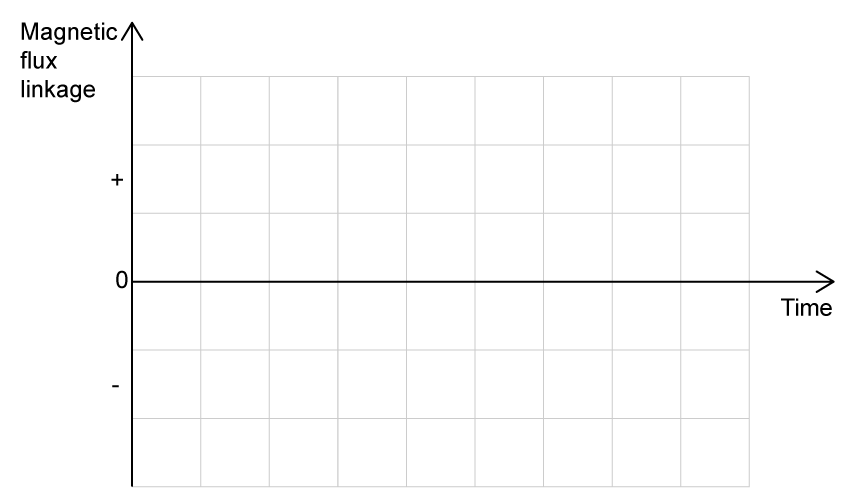
(ii) Sketch a graph to show how the magnetic flux linkage of the coil varies with time.

[2]

Blank grid with magnetic flux linkage on the vertical axis and time on the horizontal axis
2b
Sme Calculator
2 marks

The coil has 150 turns. The maximum magnetic flux through the coil is 2.1×10² Wb when the magnet is rotated at a constant rate of 6.0 revolutions per second.

Show that the maximum induced e.m.f. across the coil is approximately 120 V.

2c
Sme Calculator
3 marks

The coil has total internal resistance 1.0 Ω. The output of the generator is connected to a load resistor of resistance 9.0 Ω.

Calculate the average power dissipated in the load resistor.

2d
Sme Calculator
3 marks

The maximum input power from the wind is given by

P = 12ρAv3

where A is the area swept out by the rotating blades, ρ is the density of air and v is the speed of the wind.

The wind turbine has blades of length 1.5 m. The density of air is 1.2 kg m3.

The manufacturer claims that the efficiency of the wind turbine is at least 35% when the wind speed is 8.0 m s1.

Deduce whether the manufacturer's claim is valid.

3
4 marks

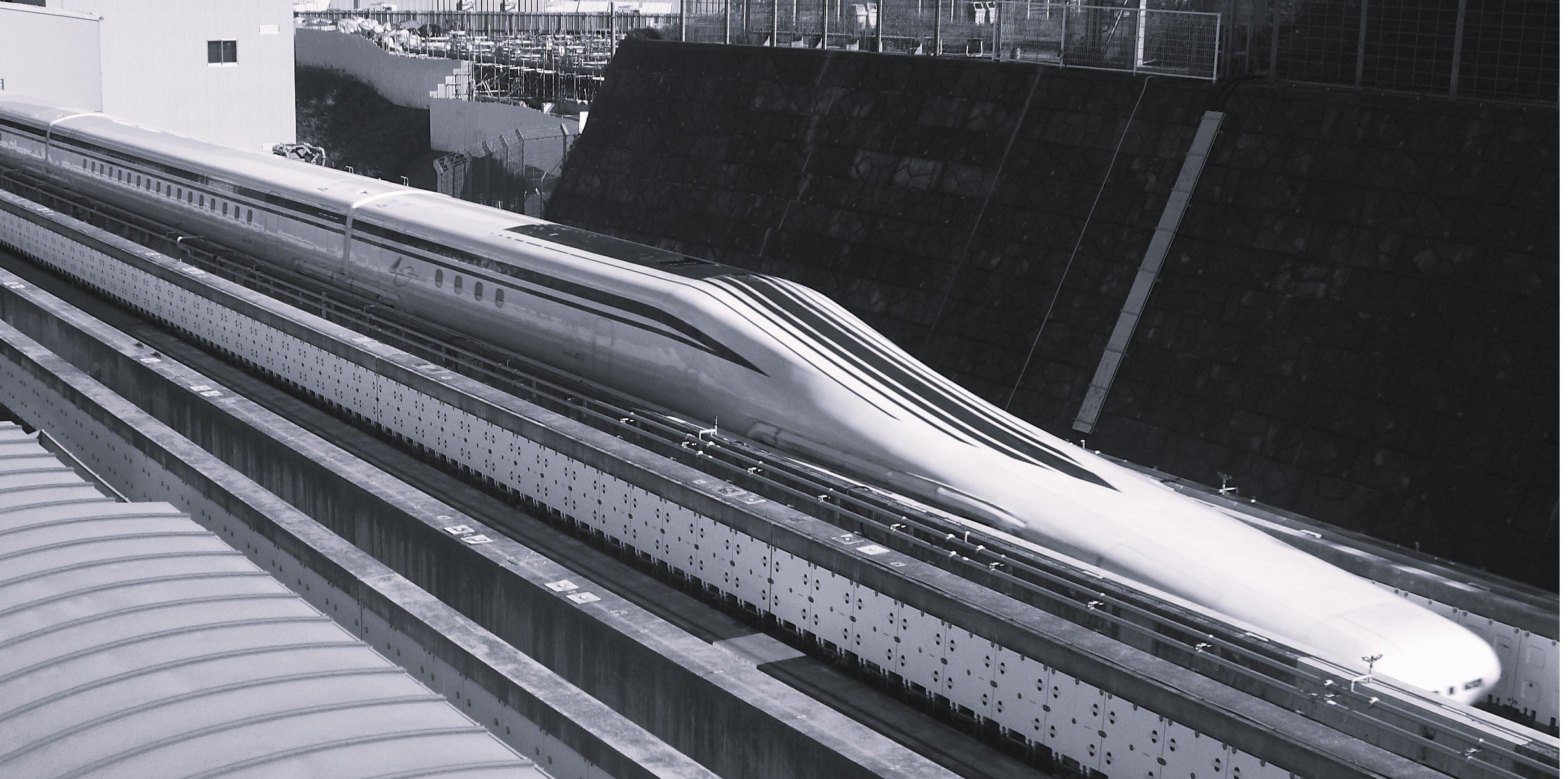
The Superconducting Maglev, or SCMaglev, is a Japanese high-speed magnetic levitation train system currently under construction between Tokyo and Nagoya.

The Series L0 maglev high-speed train undergoing a test run on the Yamanashi Test Track in Japan.

Photo: Saruno Hirobano (opens in a new tab)

Powerful superconducting electromagnets are built into the sides of the train. As the train moves forward, these magnets pass metallic coils mounted in the walls of the track.

Explain, using the laws of electromagnetic induction, how this produces an upward levitation force.