Interference & Stationary Waves (Edexcel A Level Physics): Exam Questions

Exam code: 9PH0

57 mins6 questions
1a
Sme Calculator
2 marks

The photograph shows an ultrasonic mouse repeller used in a house.  

q15-june-2019-9ph0-02-edexcel-as-a-level-phy

The mouse repeller produces ultrasound that repels mice but cannot be heard by humans.

The mouse hears ultrasound directly and by reflection from the walls.

The mouse repeller produces ultrasound of frequency 26.0 kHz.

speed of sound = 340 ms-1

Calculate the wavelength of the ultrasound produced.  

Wavelength = ..........................................................

1b
Sme Calculator
2 marks

State what is meant by superposition of waves.

1c
Sme Calculator
6 marks

A student makes the following suggestion.

“If the ultrasound reflects off a wall directly opposite the mouse repeller a standing wave is formed, so there will be areas in the room where the mice will not hear the ultrasound.”

Evaluate this suggestion. 

2a
1 mark

The interference of microwaves can be investigated in the laboratory using a microwave transmitter and receiver. A coherent beam of microwaves is directed at two slits, S1 and S2, formed between metal plates, as shown.

A microwave transmitter, two slits in metal plates, and a receiver moving vertically along screen AB at points O, P and Q to detect transmitted waves

Describe what is meant by a coherent beam.

2b
3 marks

As the receiver is moved along line AB, alternate points of maximum and minimum readings are detected.

Explain why maximum and minimum readings are detected.

2c
Sme Calculator
3 marks

The receiver detects a maximum reading at point O, which is equidistant from the two slits.

The next two maximum readings are detected at P and Q.

Point Q is 85 cm from S1 and 75 cm from S2.

Three common microwave bands and their corresponding frequencies are given in the table.

Band

Frequency / GHz

S

2–4

C

4–8

X

8–12

Deduce the band of the microwaves used in this experiment.

1a
Sme Calculator
3 marks

The photograph shows a guitar.

q15-nov-2020-9ph0-02-edexcel-as-a-level-phy

When a guitar string is plucked, a standing wave is created.

Explain how a standing wave is created on the string.

1b
Sme Calculator
4 marks

The diagram shows a standing wave on a guitar string.

q15b-nov-2020-9ph0-02-edexcel-as-a-level-phy

The oscillating length of the guitar string is 66 cm.

i) State the wavelength for this standing wave.

Wavelength = .............................................................(1)

ii) Calculate the frequency of vibration for this standing wave.

tension in guitar string = 88.6 N

mass per unit length of guitar string = 4.47 × 10⁻³ kg m−1

Frequency = ................................................(3)

1c
Sme Calculator
6 marks

One end of the guitar string is wrapped around a cylindrical tuning peg. Turning the peg changes the total length of the string and hence changes the tension in the string. This changes the frequency of vibration of the string.

i) The length of one string is 68 cm.

Calculate the extension required to produce a tension of 93.4 N in the string.

Young modulus of string material = 1.8 × 10⁹ N m−2

cross-sectional area of string = 6.6 × 10⁻⁷ m2

Extension = ...........................................(4)

ii) The vibrating length of string is unchanged by turning the tuning peg.

Explain the effect that tightening the string has on the frequency of the sound produced.

(2)

2a
Sme Calculator
6 marks

A simple loudspeaker consists of a cone, a coil of wire and a magnet. The cone and coil are attached to each other and are free to move. An alternating current in the coil causes the cone to oscillate. The loudspeaker is mounted in a wooden box. A cross-section through the loudspeaker is shown.

q9-nov-2020-9ph0-03-edexcel-as-a-level-phy

A student made the following observations:

  • when an alternating potential difference (p.d.) is applied to the coil, the cone oscillates

  • the frequency of oscillation is the same as the frequency of the p.d.

  • at particular frequencies, the box vibrates with a large amplitude.

Explain these observations.

2b
Sme Calculator
10 marks

The student connected a signal generator to the loudspeaker, and placed the loudspeaker near to one end of a long tube containing sand. The student adjusted the signal generator until the sand collected in small heaps as shown.

q9b-nov-2020-9ph0-03-edexcel-as-a-level-phy

i) Explain why the sand collects in heaps.

(4)

ii) The student determined the distance d between the centres of adjacent heaps.

Describe the procedure she should follow to determine an accurate value for d.

(3)

iii) Assess whether the experimental data is consistent with a value for the speed of sound of 340 m s−1.

signal generator frequency = 3.25 kHz.

d = 5.1 cm

(3)

3a
6 marks

A student uses a microwave oven to investigate standing waves. They remove the rotating turntable from the oven and place a bar of chocolate inside, so it lies flat and remains stationary, as shown.

A microwave oven showing the oven wall, a bar of chocolate on the base, and a microwave source on the right side.

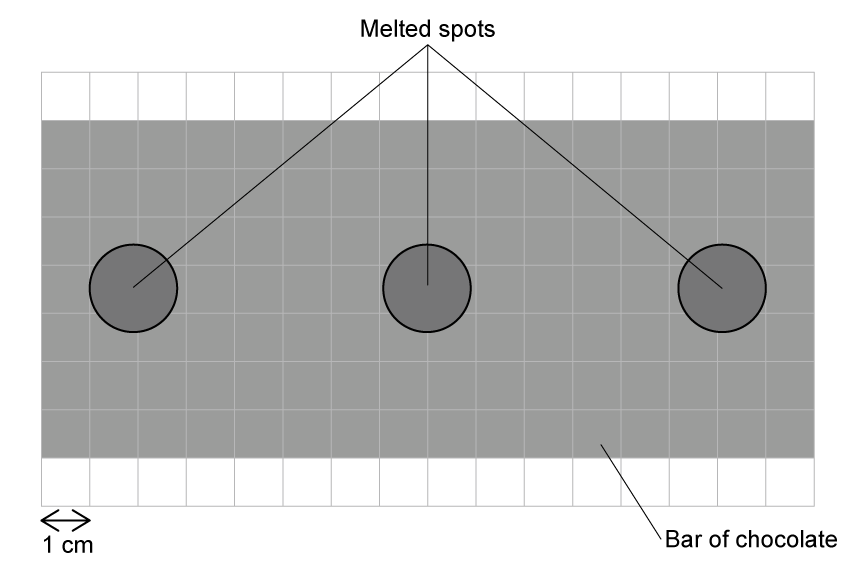
The microwaves are switched on until a pattern of melted spots forms on the chocolate, as shown.

A rectangular chocolate bar grid with three dark circular melted spots in a row, each separated by 6 small grid squares. Each square has a length of 1 cm.

Explain how the standing wave pattern of melted spots forms.

3b
Sme Calculator
3 marks

Determine the frequency of the microwaves used by the oven.

3c
1 mark

Explain why it was necessary for the student to remove the rotating turntable before switching on the microwave oven.