Working as a Physicist (Edexcel A Level Physics): Exam Questions

Exam code: 9PH0

4 hours24 questions
1
4 marks

A teacher is explaining the differences between accuracy and precision to her students. She draws the following diagram, which shows different degrees of accuracy and precision. The circles represent targets A, B, C and D and the dots represent arrows hitting the targets.

q1-nov-2020-9ph0-03-edexcel-as-a-level-phy

Explain how targets A, B, C and D represent differing degrees of accuracy and precision.

2a
2 marks

A practical physics textbook states that “measurements may give a precise value for the quantity being determined but this may not necessarily be an accurate value”.

Describe what physicists mean by the terms accuracy and precision.

2b
2 marks

The temperature of the air in a room is measured using a mercury-in-glass thermometer.

Describe how the value for the temperature may be precise but not accurate.

1a
5 marks

A student measured the height h of a liquid column in a capillary tube. She used a travelling microscope to make measurements of the positions of the top and bottom of the liquid column.

The travelling microscope consists of a simple microscope that can be moved vertically along a vernier scale.

q5-nov-2021-9ph0-03-edexcel-as-a-level-phy

The student used a capillary tube with an internal radius r equal to 0.10 mm and recorded the following readings from the vernier scale.

Bottom of liquid column / cm

Top of liquid column / cm

12.00

27.10

i) State the uncertainty in each of these readings.

(1)

ii) Calculate the percentage uncertainty in the student’s value of h.

Percentage uncertainty in h = .................................................(2)

iii) The student repeated the measurement of h for capillary tubes of different radii.

The table shows the student’s final data.

r / mm

1 / r

h / cm

0.09

11.1

16.56

0.10

10.0

15.1

0.12

8.3

12.6

0.15

6.7

10.33

Criticise the student’s recording of the data.

(2)

1b
7 marks

The student plotted the following graph.

q5b-nov-2021-9ph0-03-edexcel-as-a-level-phy

i) Determine the height of the liquid column that the student could expect for a tube with an internal radius of 0.11 mm.

Height of liquid column = ..................................................(3)

ii) In her notes it stated that

h=kr where k is constant

Assess the extent to which the student’s data supports this relationship.

(4)

2a
1 mark

An engineer was checking the dimensions of a steel tube. The tube had a length of about 45 mm and an external diameter of about 15 mm as shown.

q1-june-2019-9ph0-03-edexcel-as-a-level-phy

She used a digital micrometer to measure the diameter of the tube. Before taking the reading she closed the jaws of the micrometer to check for a zero error.

State the type of error she avoided by doing this.

2b
3 marks

Describe the procedure she should follow to determine an accurate value for the external diameter of the tube.

2c
1 mark

The engineer determined the length of the tube using the micrometer. The reading on the micrometer scale was 45.043 mm. She recorded the reading as 45.0 mm.

State why recording a reading of 45.043 mm could not be justified.

3a
3 marks

A student was investigating the forces involved in circular motion.

He placed a small coin on a horizontal turntable as shown. The turntable was connected to a driver unit so that it could be rotated at a constant rate.

q3-june-2019-9ph0-03-edexcel-as-a-level-phy

The student measured the distance r between the centre of the turntable and the centre of the coin, with a metre rule as shown.

q3a-june-2019-9ph0-03-edexcel-as-a-level-phy


Explain why the percentage uncertainty in the value of r is about 1%.

Your answer should include a calculation.

3b
7 marks

The student switched on the driver unit and increased the rate of rotation until the coin slid off the turntable. 

He read the angular velocity ω of the turntable from a digital display on the driver unit. He then replaced the coin in the original position on the turntable and repeated the procedure.

His results are shown.

ω / rad s-1

0.125

0.112

0.118

0.123

0.116

i) The student used the results to calculate a mean value of ω.

State the purpose of calculating a mean.

(1)

ii) Calculate the percentage uncertainty in the mean value of ω.

Percentage uncertainty = .................................................(3)

iii) The student used ω and r to calculate the centripetal acceleration of the coin at the instant it started to slide.

Calculate the percentage uncertainty in this centripetal acceleration.

Percentage uncertainty = ..................................................(3)

3c
3 marks

The student repeated the procedure with different values of r. Explain how the value of ω at which the coin started to slide varied as r increased.

4a
4 marks

A student is using a simple pendulum to determine a value for the acceleration of free fall g.

q5-june-2018-9ph0-03-edexcel-as-a-level-phy

She measures the length l of the pendulum four times with a metre rule and records the following values.

l / cm

l1

l2

l3

l4

85.5

86.0

87.5

85.5

She calculates the mean length lm of the pendulum using the following method:

lm=85.5+86.0+87.5+85.54=86.1 cm

i) Calculate a more accurate value for lm.

lm = ..................................(2)

ii) Determine the time period of the oscillations of this pendulum, using your calculated value for lm.

Time period of oscillations = ...............................(2)

4b
4 marks

She sets the pendulum into oscillations with small amplitude and uses a stopwatch to determine the time period.

q5b-june-2018-9ph0-03-edexcel-as-a-level-phy

The student releases the pendulum at A and simultaneously starts the stopwatch. She measures the time taken for 5 oscillations and divides the value by 5. She repeats the procedure twice and calculates a mean time period.

Explain two modifications to the student’s method that would improve the value obtained for the time period.

5a
2 marks

The Beaufort scale is used to describe wind intensity. On this scale the average wind speed v increases with the Beaufort scale value B.

The relationship between v and B is given by

v = kBp

where k and p are constants.

Explain why a graph of log v against log B should give a straight line.

5b
8 marks

The table gives some values of v and corresponding values of B.

v / m s–1

B


2.00

1


10.0

3


21.5

5


36.0

7


50.5

9


68.0

11


i) Plot a graph of log v against log B on the grid opposite. 

Use the columns provided to show any processed data.

(5)

q9bi-june-2019-9ph0-03-edexcel-as-a-level-phy

ii) Determine the values of p and k.

p = .......................................................

k = .......................................................

(3)

6a
9 marks

A student investigated how the volume of a fixed mass of air varies with the temperature of the air. She used the apparatus shown.

q11-june-2019-9ph0-03-edexcel-as-a-level-phy

A glass tube was sealed at one end. A plug of oil trapped a length l of air in the tube.

The water in the beaker was heated to a temperature θ. The corresponding value of lwas measured. This was repeated for a range of temperatures.

The thermometer had a resolution of 0.5 °C. The scale had mm divisions.

The student’s results are shown in the table.

θ / °C

l / cm

24

8.8

60

9.8

78.5

10.3

95.5

10.9

i) Criticise the student’s results.

(3)

ii) Explain two possible sources of error in this investigation.

(4)

iii) Describe two improvements that would increase the accuracy of measurements obtained in this investigation.

(2)

6b
7 marks

The student plotted a graph of l against θ as shown.

q11b-june-2019-9ph0-03-edexcel-as-a-level-phy

i) Explain the significance of the intercept on the x-axis.

(3)

ii) The student wrote a report of the investigation in her lab book. In the conclusion she wrote:

“In this investigation uncertainties were minimised by selecting measuring instruments with a high resolution. The points lie on a perfect straight line, indicating that the investigation is accurate.”

Discuss the student’s conclusion.

(4)

7a
1 mark

A student carried out an experiment to determine the density of an aluminium cube.

The student measured the length L of one side of the cube using Vernier calipers with a resolution of 0.02 mm.

They obtained the following values for L.

L / mm

25.06

25.04

25.1

25.06

25.04

Criticise the student's recording of these values.

7b
4 marks

Calculate the volume V of the cube, and the percentage uncertainty in V.

7c
3 marks

The mass of the cube was measured to be 43.7 g using an electronic balance. The balance had a resolution of 0.1 g.

Determine whether the data collected leads to a value for the density of aluminium in agreement with the standard value.

density of aluminium = 2700 kg m−3

8a
3 marks

A student determined a value for the density of the metal in a small rectangular plate.

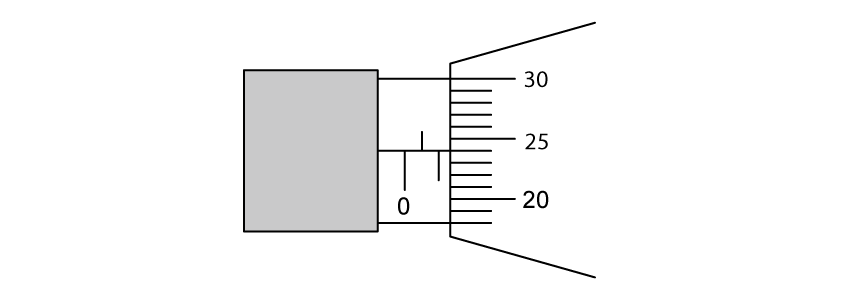
She measured the thickness t of the plate using a micrometer screw gauge. The diagram shows the reading on the micrometer.

Close-up of a micrometer screw gauge sleeve and thimble. On the sleeve, whole-millimetre marks sit above the horizontal datum line and are numbered 0 and 1, and half-millimetre marks sit below the line, one of them midway between 0 and 1. Two sleeve marks are uncovered beyond 0 — the half-millimetre mark and the 1 mark — and the next sleeve mark is hidden by the edge of the thimble. The thimble scale is numbered 20, 25 and 30, with five divisions from one number to the next. The thimble division level with the datum line is the first one below 25.

(i) State the value of t shown on the micrometer.

[1]

(ii) Calculate the percentage uncertainty in this measurement of t.

[2]

8b
2 marks

Explain one technique the student should use to ensure the value of t is accurate.

8c
4 marks

The student measured the length of the plate as 49.2 mm and the width as 31.4 mm using vernier calipers. She measured the mass of the plate as 5.32 g using a balance.

Show that the density of the metal in the plate is about 2800 kg m−3.

8d
3 marks

The student wants to determine whether the plate is made from pure aluminium or one of its alloys, duralumin or magnalium.

The table shows the densities of these metals.

Metal

Density / kg m-3

pure aluminium

2710

duralumin

2790

magnalium

2640

The student estimated the percentage uncertainty in her value of density to be 1%.

Deduce which metal the plate is made from.

9a
2 marks

A student investigated how the current needed to melt a fuse wire depends on the diameter of the wire.

He connected each sample of fuse wire between two terminals separated by a fixed distance. The circuit contained a fixed power supply and additional components that enabled the student to vary and measure the current in the fuse wire.

Complete the diagram to show the circuit that the student should use.

Partial circuit diagram showing a fuse wire held horizontally between two terminals
9b
2 marks

Identify one safety issue with this investigation and how it may be dealt with.

9c
3 marks

The student needs to determine the current that melts the wire as precisely as possible.

Describe how the student should collect his data for one diameter of fuse wire.

9d
3 marks

For each diameter of fuse wire, the student repeated the procedure and recorded the mean melting current in a table.

Diameter of fuse wire / mm

Mean melting current / A

0.15

2.9

0.20

4.5

0.25

6

Criticise the recording of the data.

10a
3 marks

A student investigated the motion of a paper cone falling through air.

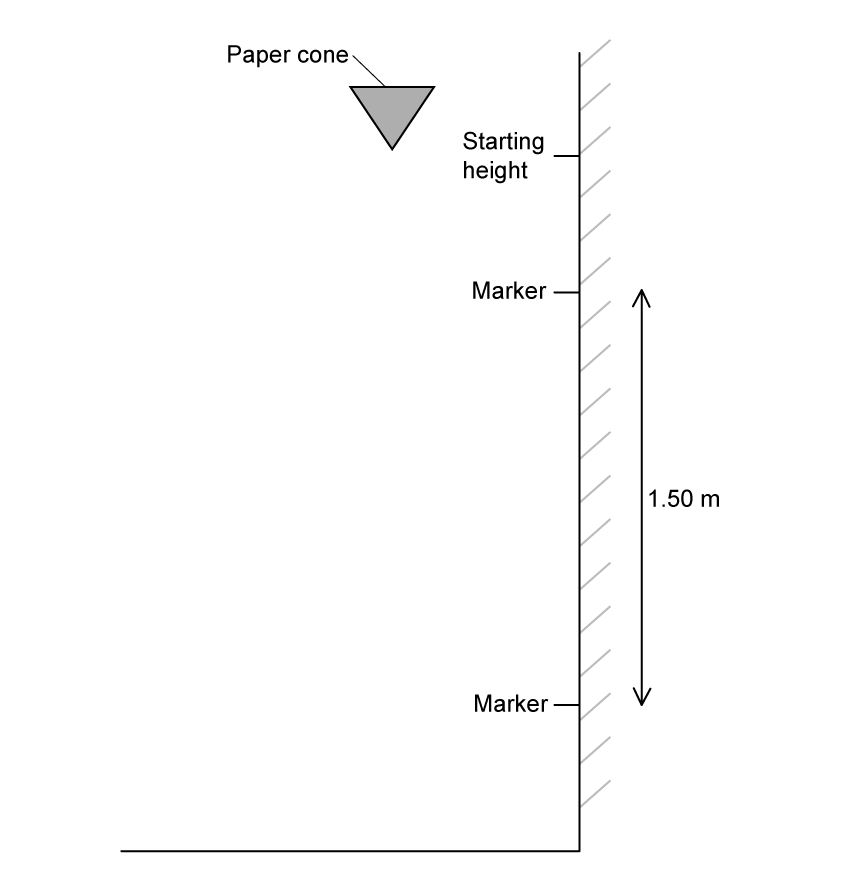
The student released the cone from the same starting height and measured the time t for the cone to fall between two markers. The markers were placed 1.50 m apart, as shown.

A paper cone above the floor at a point marked "starting height" beside a hatched wall. Two markers on the wall are separated by 1.50 metres.

Describe how the student could use a metre rule to position the two markers on the wall 1.50 m apart as accurately as possible.

You may include additional apparatus.

10b
2 marks

The student assumed the cone was travelling at terminal velocity as it passed between the two markers.

Explain how the student could check this assumption.

10c
4 marks

The student repeated the measurement of t, as shown in the table.

t / s

1.32

1.28

1.36

1.30

1.34

(i) Determine the mean value of t.

[2]

(ii) Determine the percentage uncertainty in the mean value of t.

[2]

10d
3 marks

Another student suggests that using light gates connected to a data logger would give a more accurate value of t.

Discuss whether this suggestion is correct.

11a
4 marks

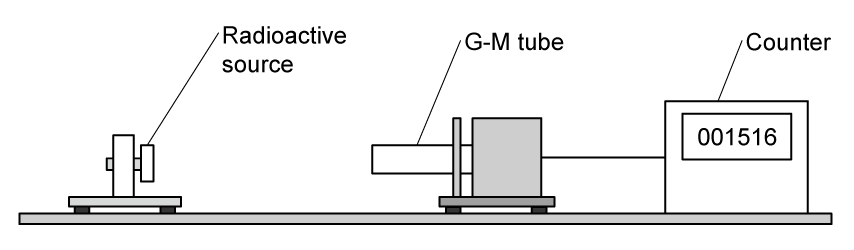
A student used a Geiger–Müller (GM) tube connected to a counter to investigate the count rate from a sealed radioactive source, as shown. The source emits beta and gamma radiation.

A sealed radioactive source in a holder on a bench, facing a GM tube held in a clamp at a fixed distance from the source. The GM tube is connected by a lead to a counter, shown as a box with a digital display. Labelled "radioactive source", "G-M tube" and "counter".

The G-M tube was placed at a fixed distance from the source.

The student recorded the count for 120 s and repeated this measurement four more times.

The data is recorded in the table below.

Count

1467

1547

1516

1533

1489

Count rate / s-1

12.2

12.9

12.63

12.8

12.4

(i) One of the values in the table has been recorded incorrectly.

Identify this value and state the value that should have been recorded.

[2]

(ii) Calculate the mean count rate recorded by the counter.

[2]

11b
2 marks

The student stated that the mean count rate is the count rate due to radiation from the source.

Explain why the student's statement is not correct and what the student should have done.

11c
4 marks

The student then wanted to determine the count rate due to gamma radiation only.

The G-M tube is made from steel that is a few millimetres thick. The tube has a thin mica window at one end that allows all types of ionising radiation to enter. Ionising radiation may be detected anywhere inside the tube.

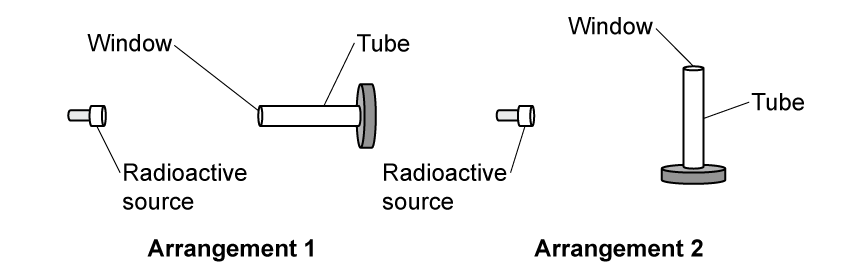
The student could position the G-M tube in either of the two arrangements shown.

Two side-by-side arrangements. Arrangement 1 (left): the GM tube drawn horizontally with its window (the flat end) facing the source. Arrangement 2 (right): the GM tube standing vertically on its base so that the side wall faces the source and the window points upward. The source is the same distance from the tube in both arrangements.

Explain which arrangement the student should use.

12a
2 marks

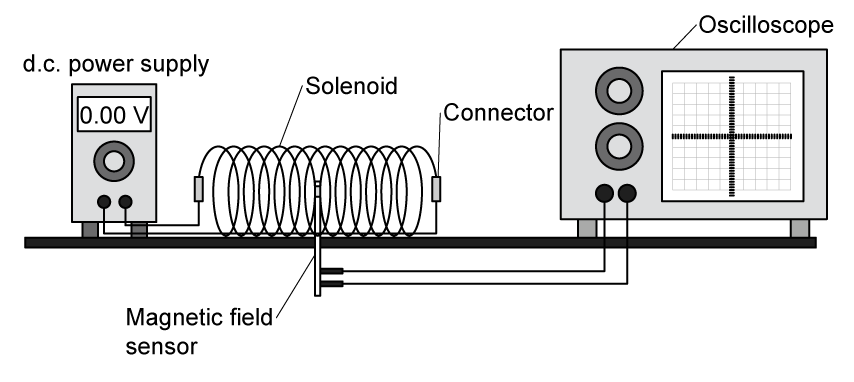
A student investigated the magnetic flux density at the centre of a solenoid using the apparatus shown.

A d.c. power supply connected to a solenoid, with a magnetic field sensor at its centre connected to an oscilloscope.

The magnetic flux density B at the centre of the solenoid is given by

B=μ0NIL

where μ0 is a constant, N is the number of turns, I is the current in the solenoid and L is the length of the solenoid.

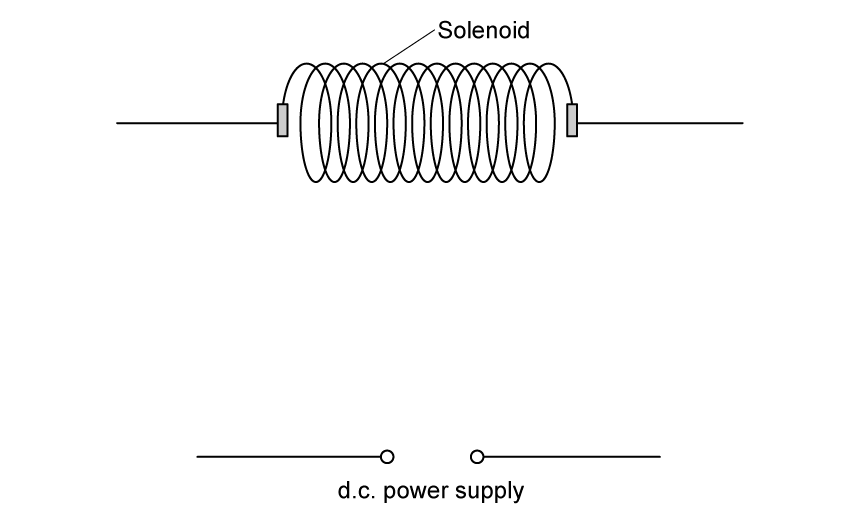
Complete the circuit diagram to show how the student could vary and measure the current in the solenoid.

Incomplete circuit diagram showing a labelled solenoid with two terminals above a labelled d.c. power supply with two terminals; the space between them is blank for adding components to vary and measure current.
12b
6 marks

Devise a method the student could use to determine a value for μ0.

Your method should include the use of a suitable graph.

13a
2 marks

A student investigated how the pressure of a fixed mass of air varies with its volume.

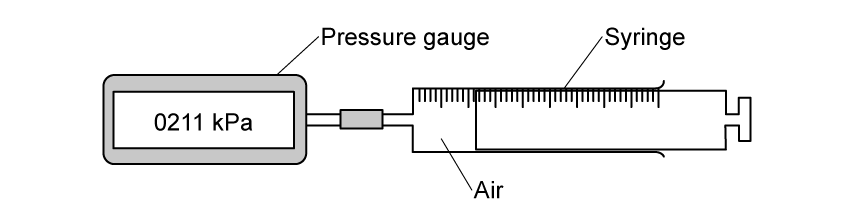
The student used air trapped in a sealed syringe connected to a pressure sensor, as shown.

A horizontal sealed syringe with its plunger partly withdrawn and the trapped air column visible in the barrel. The nozzle is connected by tubing to a pressure gauge, shown as a box with a digital display.

The student changed the volume V of the trapped air slowly, so that the temperature of the air remained constant, and recorded the pressure p for each volume.

The student suggested that the relationship between p and V is given by

p=kVn

where k and n are constants.

Explain how a graph of log p against log V can be used to determine the value of n.

13b
6 marks

The student recorded the following data.

V / cm3

p / kPa

‎

‎

12.0

211

‎

‎

16.0

156

‎

‎

20.0

126

‎

‎

24.0

104

‎

‎

28.0

90

‎

‎

32.0

78

‎

‎

Plot a graph of log p against log V on the grid provided.

Use the additional columns for your processed data.

You should not convert the values of p and V.

Blank graph grid, 2 mm squares, portrait orientation
13c
3 marks

Determine the gradient of the graph.

13d
3 marks

Determine the value of k using your graph.

13e
2 marks

Explain whether the results support the suggestion that pV is constant for a fixed mass of gas at constant temperature.

14a
2 marks

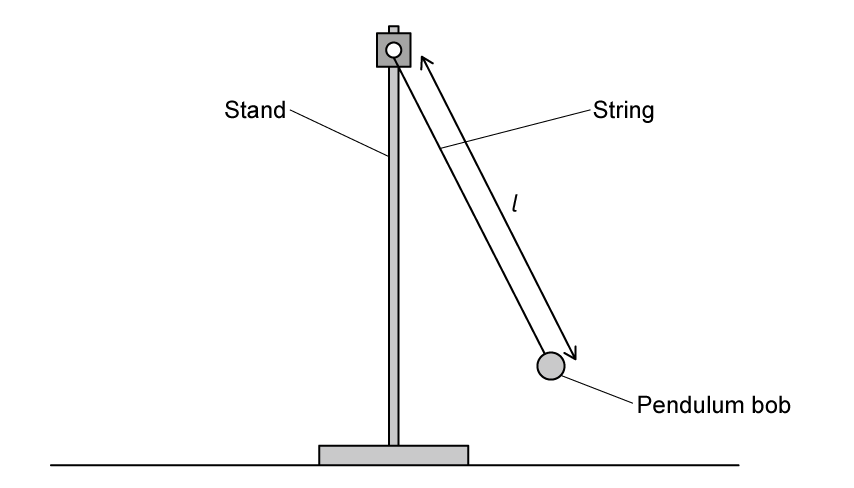
A student investigated the oscillations of a pendulum to determine a value for the acceleration of free fall g using the apparatus shown.

A simple pendulum with a stand and clamp support a string with a pendulum bob at its lower end. A double-headed arrow labelled l shows the length from the suspension point to the centre of the bob.

The student measured the length l of the pendulum as 850 mm using a metre rule.

For small oscillations, the time period T is given by

T=2πlg

The student timed multiple oscillations to determine T.

Explain one further technique the student should use to obtain an accurate value for T.

14b
3 marks

The sphere has a diameter of about 2 cm.

Describe how the student should determine an accurate value of l. You may include additional apparatus.

14c
6 marks

The student measured the time for 20 oscillations three times.

Time for 20 oscillations / s

36.7

37.0

37.4

(i) Show that the student's value of g is about 9.8 m s-2

[2]

(ii) Show that the percentage uncertainty in the student's value of g is about 2%

[4]

14d
3 marks

The student repeated the experiment using a longer string.

Explain why the percentage uncertainty in the value of g would be reduced.

14e
2 marks

The accepted value of g is 9.81 m s-2

Deduce whether the student's value of g is accurate.

1a
7 marks

A spring is made from loops of thick steel wire as shown.

q10-nov-2020-9ph0-03-edexcel-as-a-level-phy

There are two extra loops, one on each end of the spring.

A student determined the length of steel used to make the spring by using vernier calipers to measure the width w of the spring. The length of wire l on each loop is given by l = πw

The student obtained the following values for w.

w / mm

15.3

15.2

15.4

15.3

i) Calculate l.

l = ........................................(3)

ii) Estimate the percentage uncertainty in your value for l.

% uncertainty in l = ..................................(2)

iii) Calculate the total length L of wire used to make the spring.

L = .................................(2)

1b
9 marks

The student measured the diameter d of the steel wire and obtained a value of 2.52 mm.

i) Explain which instrument he used to measure the diameter.

(2)

ii) Estimate the percentage uncertainty in the student’s value for d.

% uncertainty in d = .................................(1)

iii) The student used a balance to measure the mass m of the spring.

He obtained a value of 32.0 ± 0.5 g.

Estimate the percentage uncertainty in the mass of the spring.

% uncertainty in m = ...................................(1)

iv) The student calculated the density ρ of the steel using the equation

ρ =mV 

Calculate the percentage uncertainty in his value for the density of steel.

% uncertainty in value for density of steel = ...........................(1)

v) Determine whether the data collected leads to a value for the density of steel in agreement with the standard value.

density of steel = 7 800 kg m−3

(4)

2a
1 mark

A student is investigating the properties of steel. He has fifty steel discs available.

q3-june-2018-9ph0-03-edexcel-as-a-level-phy

Each disc has a diameter d ≅ 1.3 cm and a thickness t ≅ 2 mm.

State a suitable measuring instrument that could be used with a single disc to measure t.

2b
4 marks

A balance which can measure mass with a resolution of 0.2 g is available.

Determine the minimum number of discs that should be placed on the balance together if the percentage uncertainty in the measurement of the mass is to be less than 0.5%.

density of steel = 7900 kg m–3

Minimum number of discs = ...............................

2c
3 marks

The measured uncertainty in d is ±0.1 mm and the measured uncertainty for t is ±0.05 mm.

Determine the percentage uncertainty in the calculated volume of the disc.

Percentage uncertainty in volume = ...............................

3a
8 marks

A method to determine the wavelength of light using a converging lens was first proposed by Sir Isaac Newton.

A converging lens is placed on a plane glass plate. The lens is illuminated from above with a parallel beam of monochromatic light, as shown.

Some of the light is reflected from the upper surface of the lower glass plate and some from the lower surface of the lens. Interference between these two reflected waves produces circular fringes. The pattern is viewed through a microscope.

q13-june-2018-9ph0-03-edexcel-as-a-level-phy

The diameter D of each circular fringe, numbered N from the centre, is measured using the microscope. The data obtained from such an experiment is shown.

N

D / mm


1

5.13


2

7.08


3

8.71


4

10.23


5

11.48


The relationship between N and D is of the form D = pNq where p and q are constants.

Determine p and q for this data using a graphical method. Use the additional columns for your processed data.

p = ...............................

q = ................................

P~lJkXpn_image
3b
3 marks

The table below shows the readings from which the diameter of the first dark circle was calculated.

Position of left-hand side of circle / mm

Position of right-handside of circle / mm

Diameter / mm

54.79

49.66

5.13

i) Use these readings to estimate the percentage uncertainty in the diameter due to the resolution of the instrument.

Percentage uncertainty = .................................(2)

ii) State why the actual percentage uncertainty would have been greater than the value calculated in (b)(i).

(1)

3c
4 marks

When considering the principles of this experiment, a student suggests that interference fringes would only be produced with monochromatic light. This is because interference requires coherent light waves.

Discuss the validity of the student’s suggestion.

4a
4 marks

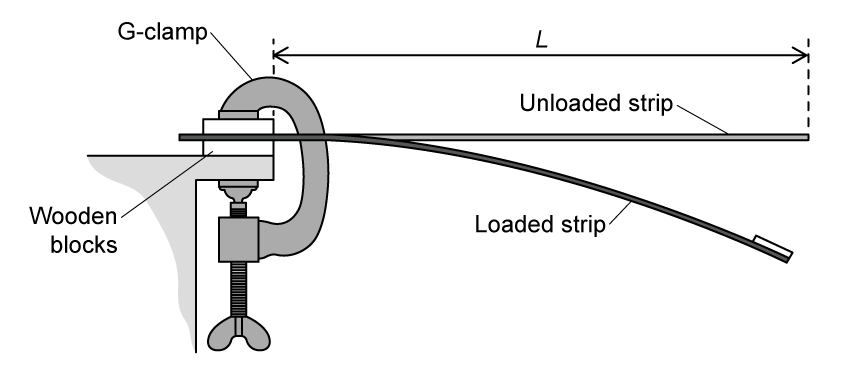
A student made a cantilever by clamping one end of a metal strip to a bench and attaching a mass to the free end, as shown.

The length L of the strip from the bench to the centre of the mass is measured.

A bench with a G-clamp securing a strip to the bench edge. When unloaded, the strip extends horizontally beyond the bench edge by a length L. When loaded, the free end of the strip sags below the horizontal.

The student displaced the mass downwards and released it, causing the cantilever to oscillate with simple harmonic motion of period T.

The student used a stopwatch to measure the time for 5 oscillations. This was repeated twice.

(i) Explain one modification to the apparatus which would improve the accuracy of the data obtained by the student.

[2]

(ii) Explain one modification to the method which would reduce the percentage uncertainty in the measurement of T.

[2]

4b
2 marks

It is suggested that the relationship between time period T and length L is

T = kLn

where k and n are constants.

Explain why a graph of log T against log L would give a straight line.

4c
5 marks

The student’s data is shown in the table below.

L / cm

T / s

‎ ‎ ‎ ‎ ‎ ‎ ‎ ‎ ‎ ‎ ‎ ‎ ‎ ‎ ‎ ‎ ‎ ‎ ‎ ‎ ‎ ‎ ‎ ‎ ‎ ‎ ‎ ‎ ‎ ‎ ‎ ‎ ‎ ‎ ‎ ‎ ‎ ‎ ‎ ‎ ‎ ‎ ‎ ‎ ‎ ‎ ‎ ‎ ‎ ‎ ‎ ‎ ‎

‎ ‎ ‎ ‎ ‎ ‎ ‎ ‎ ‎ ‎ ‎ ‎ ‎ ‎ ‎ ‎ ‎ ‎ ‎ ‎ ‎ ‎ ‎ ‎ ‎ ‎ ‎ ‎ ‎ ‎ ‎ ‎ ‎ ‎ ‎ ‎ ‎ ‎ ‎ ‎ ‎ ‎ ‎ ‎ ‎ ‎ ‎ ‎ ‎ ‎ ‎ ‎ ‎

85.0

1.789

‎ ‎ ‎ ‎ ‎ ‎ ‎ ‎ ‎ ‎ ‎ ‎ ‎ ‎ ‎ ‎ ‎ ‎ ‎ ‎ ‎ ‎ ‎ ‎ ‎ ‎ ‎ ‎ ‎ ‎ ‎ ‎ ‎ ‎ ‎ ‎ ‎ ‎ ‎ ‎ ‎ ‎ ‎ ‎ ‎ ‎ ‎ ‎ ‎ ‎ ‎ ‎ ‎

‎ ‎ ‎ ‎ ‎ ‎ ‎ ‎ ‎ ‎ ‎ ‎ ‎ ‎ ‎ ‎ ‎ ‎ ‎ ‎ ‎ ‎ ‎ ‎ ‎ ‎ ‎ ‎ ‎ ‎ ‎ ‎ ‎ ‎ ‎ ‎ ‎ ‎ ‎ ‎ ‎ ‎ ‎ ‎ ‎ ‎ ‎ ‎ ‎ ‎ ‎ ‎ ‎

75.0

1.473

‎ ‎ ‎ ‎ ‎ ‎ ‎ ‎ ‎ ‎ ‎ ‎ ‎ ‎ ‎ ‎ ‎ ‎ ‎ ‎ ‎ ‎ ‎ ‎ ‎ ‎ ‎ ‎ ‎ ‎ ‎ ‎ ‎ ‎ ‎ ‎ ‎ ‎ ‎ ‎ ‎ ‎ ‎ ‎ ‎ ‎ ‎ ‎ ‎ ‎ ‎ ‎ ‎

‎ ‎ ‎ ‎ ‎ ‎ ‎ ‎ ‎ ‎ ‎ ‎ ‎ ‎ ‎ ‎ ‎ ‎ ‎ ‎ ‎ ‎ ‎ ‎ ‎ ‎ ‎ ‎ ‎ ‎ ‎ ‎ ‎ ‎ ‎ ‎ ‎ ‎ ‎ ‎ ‎ ‎ ‎ ‎ ‎ ‎ ‎ ‎ ‎ ‎ ‎ ‎ ‎

65.0

1.171

‎ ‎ ‎ ‎ ‎ ‎ ‎ ‎ ‎ ‎ ‎ ‎ ‎ ‎ ‎ ‎ ‎ ‎ ‎ ‎ ‎ ‎ ‎ ‎ ‎ ‎ ‎ ‎ ‎ ‎ ‎ ‎ ‎ ‎ ‎ ‎ ‎ ‎ ‎ ‎ ‎ ‎ ‎ ‎ ‎ ‎ ‎ ‎ ‎ ‎ ‎ ‎ ‎

‎ ‎ ‎ ‎ ‎ ‎ ‎ ‎ ‎ ‎ ‎ ‎ ‎ ‎ ‎ ‎ ‎ ‎ ‎ ‎ ‎ ‎ ‎ ‎ ‎ ‎ ‎ ‎ ‎ ‎ ‎ ‎ ‎ ‎ ‎ ‎ ‎ ‎ ‎ ‎ ‎ ‎ ‎ ‎ ‎ ‎ ‎ ‎ ‎ ‎ ‎ ‎ ‎

55.0

0.894

‎ ‎ ‎ ‎ ‎ ‎ ‎ ‎ ‎ ‎ ‎ ‎ ‎ ‎ ‎ ‎ ‎ ‎ ‎ ‎ ‎ ‎ ‎ ‎ ‎ ‎ ‎ ‎ ‎ ‎ ‎ ‎ ‎ ‎ ‎ ‎ ‎ ‎ ‎ ‎ ‎ ‎ ‎ ‎ ‎ ‎ ‎ ‎ ‎ ‎ ‎ ‎ ‎

‎ ‎ ‎ ‎ ‎ ‎ ‎ ‎ ‎ ‎ ‎ ‎ ‎ ‎ ‎ ‎ ‎ ‎ ‎ ‎ ‎ ‎ ‎ ‎ ‎ ‎ ‎ ‎ ‎ ‎ ‎ ‎ ‎ ‎ ‎ ‎ ‎ ‎ ‎ ‎ ‎ ‎ ‎ ‎ ‎ ‎ ‎ ‎ ‎ ‎ ‎ ‎ ‎

45.0

0.642

‎ ‎ ‎ ‎ ‎ ‎ ‎ ‎ ‎ ‎ ‎ ‎ ‎ ‎ ‎ ‎ ‎ ‎ ‎ ‎ ‎ ‎ ‎ ‎ ‎ ‎ ‎ ‎ ‎ ‎ ‎ ‎ ‎ ‎ ‎ ‎ ‎ ‎ ‎ ‎ ‎ ‎ ‎ ‎ ‎ ‎ ‎ ‎ ‎ ‎ ‎ ‎ ‎

‎ ‎ ‎ ‎ ‎ ‎ ‎ ‎ ‎ ‎ ‎ ‎ ‎ ‎ ‎ ‎ ‎ ‎ ‎ ‎ ‎ ‎ ‎ ‎ ‎ ‎ ‎ ‎ ‎ ‎ ‎ ‎ ‎ ‎ ‎ ‎ ‎ ‎ ‎ ‎ ‎ ‎ ‎ ‎ ‎ ‎ ‎ ‎ ‎ ‎ ‎ ‎ ‎

Plot a graph of log T against log L on the grid provided. Use the columns provided to show any processed data.

Blank graph grid for plotting. 12 by 8 large squares containing 10 by 10 small squares.
4d
4 marks

Determine values for k and n.

5a
2 marks

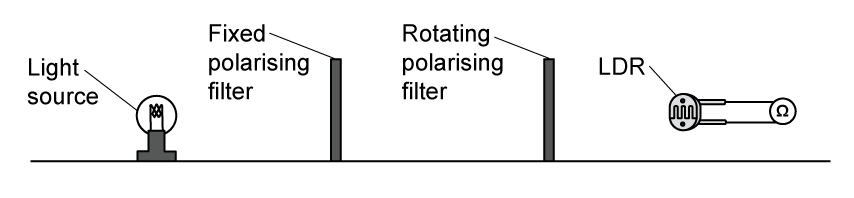
A student investigated how the resistance of a light-dependent resistor (LDR) varied with the angle between the transmission axes of two polarising filters, using the apparatus shown.

From left to right: a light source, a fixed polarising filter, a rotating polarising filter, and an LDR connected to an ohmmeter.

Light is incident on the LDR after passing through the two polarising filters. The student rotated the second filter by different angles θ and measured the resistance R of the LDR using an ohmmeter.

The relationship between R and θ is given by

1R=1R0cos2θ

where R0 is the resistance of the LDR measured with the transmission axes of the two filters parallel.

Explain why a graph of 1R against cos2θ should be a straight line through the origin.

5b
2 marks

The student's results are shown in the table.

1R / kΩ-1

θ / °

‎ ‎ ‎ ‎ ‎ ‎ ‎ ‎ ‎ ‎ ‎ ‎ ‎ ‎ ‎ ‎ ‎ ‎ ‎ ‎ ‎ ‎ ‎ ‎ ‎ ‎ ‎ ‎ ‎ ‎ ‎ ‎ ‎ ‎ ‎ ‎ ‎ ‎ ‎ ‎ ‎ ‎ ‎ ‎ ‎ ‎ ‎ ‎ ‎ ‎ ‎ ‎ ‎

0.780

30.0

‎ ‎ ‎ ‎ ‎ ‎ ‎ ‎ ‎ ‎ ‎ ‎ ‎ ‎ ‎ ‎ ‎ ‎ ‎ ‎ ‎ ‎ ‎ ‎ ‎ ‎ ‎ ‎ ‎ ‎ ‎ ‎ ‎ ‎ ‎ ‎ ‎ ‎ ‎ ‎ ‎ ‎ ‎ ‎ ‎ ‎ ‎ ‎ ‎ ‎ ‎ ‎ ‎

0.709

35.0

‎ ‎ ‎ ‎ ‎ ‎ ‎ ‎ ‎ ‎ ‎ ‎ ‎ ‎ ‎ ‎ ‎ ‎ ‎ ‎ ‎ ‎ ‎ ‎ ‎ ‎ ‎ ‎ ‎ ‎ ‎ ‎ ‎ ‎ ‎ ‎ ‎ ‎ ‎ ‎ ‎ ‎ ‎ ‎ ‎ ‎ ‎ ‎ ‎ ‎ ‎ ‎ ‎

0.623

40.0

‎ ‎ ‎ ‎ ‎ ‎ ‎ ‎ ‎ ‎ ‎ ‎ ‎ ‎ ‎ ‎ ‎ ‎ ‎ ‎ ‎ ‎ ‎ ‎ ‎ ‎ ‎ ‎ ‎ ‎ ‎ ‎ ‎ ‎ ‎ ‎ ‎ ‎ ‎ ‎ ‎ ‎ ‎ ‎ ‎ ‎ ‎ ‎ ‎ ‎ ‎ ‎ ‎

0.456

50.0

‎ ‎ ‎ ‎ ‎ ‎ ‎ ‎ ‎ ‎ ‎ ‎ ‎ ‎ ‎ ‎ ‎ ‎ ‎ ‎ ‎ ‎ ‎ ‎ ‎ ‎ ‎ ‎ ‎ ‎ ‎ ‎ ‎ ‎ ‎ ‎ ‎ ‎ ‎ ‎ ‎ ‎ ‎ ‎ ‎ ‎ ‎ ‎ ‎ ‎ ‎ ‎ ‎

0.305

60.0

‎ ‎ ‎ ‎ ‎ ‎ ‎ ‎ ‎ ‎ ‎ ‎ ‎ ‎ ‎ ‎ ‎ ‎ ‎ ‎ ‎ ‎ ‎ ‎ ‎ ‎ ‎ ‎ ‎ ‎ ‎ ‎ ‎ ‎ ‎ ‎ ‎ ‎ ‎ ‎ ‎ ‎ ‎ ‎ ‎ ‎ ‎ ‎ ‎ ‎ ‎ ‎ ‎

0.170

70.0

‎ ‎ ‎ ‎ ‎ ‎ ‎ ‎ ‎ ‎ ‎ ‎ ‎ ‎ ‎ ‎ ‎ ‎ ‎ ‎ ‎ ‎ ‎ ‎ ‎ ‎ ‎ ‎ ‎ ‎ ‎ ‎ ‎ ‎ ‎ ‎ ‎ ‎ ‎ ‎ ‎ ‎ ‎ ‎ ‎ ‎ ‎ ‎ ‎ ‎ ‎ ‎ ‎

Complete the table with corresponding values of cos2θ.

5c
5 marks

Plot a graph of 1R on the y-axis against cos2θ on the x-axis on the grid.

Blank graph grid for plotting. 12 by 8 large squares containing 10 by 10 small squares.
5d
3 marks

Determine the gradient of the graph.

5e
2 marks

The student expected the line to pass through the origin.

Explain why the line has a small positive intercept, and how the student could reduce this effect.

5f
2 marks

In a preliminary experiment, the student set the transmission axes of the two filters parallel and determined the resistance of the LDR as R0=1.02 kΩ.

The student estimated the percentage uncertainty in the gradient to be 4%.

Determine whether the gradient of the graph is consistent with the value of R0 from the preliminary experiment.