Momentum & Impulse (Edexcel A Level Physics): Exam Questions

Exam code: 9PH0

22 mins5 questions
1a
3 marks

A student investigated impulse using a trolley fitted with a force sensor. The trolley was pushed towards a fixed spring buffer on a horizontal track. The trolley collided with the buffer and rebounded.

The force sensor recorded the force acting on the trolley during the collision. The graph shows the variation of force with time.
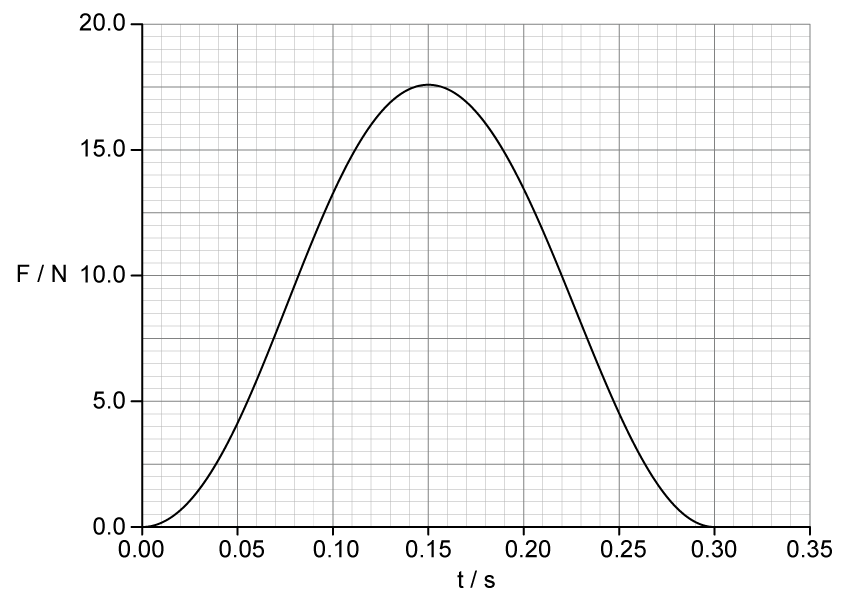
Force in newtons on the vertical axis from 0 to 20 and time in seconds on the horizontal axis from 0 to 0.35. The force rises smoothly from zero at t = 0 to a single peak of 17.5 N at t = 0.15 s, then falls symmetrically back to zero at t = 0.30 s.

Determine the impulse of the force acting on the trolley during the collision.

1b
2 marks

Show that the change in velocity of the trolley due to this impulse is about 3 m s−1.

mass of trolley = 0.85 kg

1c
2 marks

Light gates were used to measure the speed of the trolley before and after the collision.

Deduce whether the light-gate measurements are consistent with the change in velocity shown in (b).

speed of trolley before the collision = 2.60 m s−1

speed of trolley after the collision = 0.55 m s−1

1d
2 marks

The student replaced the spring buffer with a stiffer spring and repeated the experiment. The impulse of the force on the trolley was unchanged.

Explain the effect on the maximum force acting on the trolley.

2a
2 marks

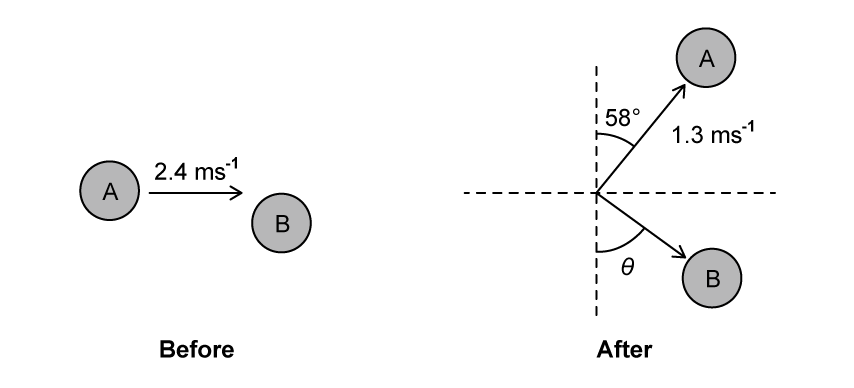
In a game of croquet, a wooden ball A moves across the grass at 2.4 m s−1. It collides with an identical stationary ball B.

After the collision, ball A moves at 1.3 m s−1 at an angle of 58° to the dashed line, and ball B moves off at an angle θ on the other side of ball A's original direction, as shown. The dashed line is perpendicular to ball A's original direction.

Plan-view diagrams before and after a collision. Before: ball A moves right at 2.4 m s⁻¹ towards stationary ball B. After: measured from a dashed line perpendicular to ball A's original direction, ball A moves at 1.3 m s⁻¹ at 58° on one side, and ball B moves off at an unlabelled angle θ on the other side; the original direction is shown as a horizontal dashed line.

State the principle of conservation of momentum.

2b
5 marks

Calculate the magnitude of the velocity of ball B after the collision and the angle θ.

mass of each ball = 0.45 kg

2c
3 marks

Deduce whether the collision is elastic.