Exploring the Structure of Matter (Edexcel A Level Physics): Exam Questions

Exam code: 9PH0

2 hours16 questions
1a
2 marks

A positron emission tomography (PET) scan is a medical imaging technique that involves annihilation.

When a low-energy positron collides with an electron, they annihilate and produce two photons travelling in opposite directions.

Explain why the annihilation cannot produce a single photon.

1b
4 marks

Gamma rays have frequencies above 3×10¹⁹ Hz.

Deduce whether the photons produced in the annihilation are gamma photons.

1a
3 marks

The diagram shows a model used to demonstrate alpha particle scattering. A ball bearing is set rolling on a wooden track. The track is positioned so that the ball bearing rolls onto a metal sheet with a curved surface known as a ʻhillʼ.

q14-nov-2020-9ph0-01-edexcel-as-a-level-phy

The diagram shows a vertical cross-section through the hill. The surface is curved so that the height of a point h on the curved surface is inversely proportional to the distance r from the centre of the hill.

q14-1-nov-2020-9ph0-01-edexcel-as-a-level-phy

Explain why the hill is suitable as a model for the electric field surrounding the nucleus of an atom.

1b
4 marks

A plan view of the arrangement is shown.

q14b-nov-2020-9ph0-01-edexcel-as-a-level-phy

The wooden track is moved to different positions and the ball bearing is released.

Describe the results of the alpha particle scattering experiment and how these can be demonstrated by moving the wooden track to different positions.

2a
4 marks

At the beginning of the 20th century, Rutherford carried out large-angle alpha particle scattering experiments using gold (Au79197) foil.

The vast majority of the alpha particles went straight through the foil whilst a few were deflected straight back.

Describe how the model of the atom changed, as a consequence of these experiments.

2b
4 marks

In one experiment the alpha particles had an initial energy of 7.7 MeV.

Calculate the distance of closest approach of the alpha particles to the nucleus of a gold atom. Assume that the gold nucleus remains at rest.

Distance of closest approach = ............................................

2c
4 marks

Rutherford also carried out the experiment with aluminium (Al1327) foil.

The aluminium foil had the same thickness as the gold foil and the alpha particles had the same initial kinetic energy.

The following observations were made.

Observation 1:

The fraction of alpha particles scattered at any particular angle for aluminium foil was always much less than for gold foil.

Observation 2:

The alpha particles scattered from aluminium foil had less kinetic energy than the alpha particles scattered from gold foil.

Explain how these observations can be used to deduce how an aluminium nucleus compares to a gold nucleus.

3a
6 marks

The bubble chamber photograph shows tracks made by a proton and a pion. The proton and pion were both created by the decay of a lambda particle. No other particles were produced.

Bubble chamber photograph: two white tracks on a black background start from the same point near the bottom of the picture. One track curves strongly upwards to the upper right. The other track is almost straight and runs to the right, bending slightly downwards. A short, thin loop extends to the left of the point where the tracks start. No track leads into that point.

Explain how observations and measurements from the photograph can be used to establish information about the lambda particle.

3b
3 marks

The lambda particle consists of up, down and strange quarks.

Explain how the conservation of charge, baryon number and lepton number apply to the decay of the lambda particle.

3c
1 mark

Write an equation to represent the decay of the lambda (Λ) particle.

3d
6 marks

The rest mass of the lambda particle is 1115 MeV/c2.

(i) Calculate this mass in kg.

Mass = ....................................................... kg

[3]

(ii) The rest mass of a proton is 940 MeV/c2. The rest mass of a pion is 140 MeV/c2.

The kinetic energy of the lambda particle just before decay is 4.95 GeV.

Calculate the total kinetic energy of the proton and pion in MeV.

Total kinetic energy = ....................................................... MeV

[3]

4a
5 marks

The discovery of the Higgs particle was an important contribution to our understanding of particle physics.

Describe the standard model for subatomic particles. You should identify the fundamental particles and the composition of the particles we can observe.

4b
3 marks

The mass of the Higgs particle is 2.2× 10⁻²⁵ kg.

Calculate this mass in GeV/c2

Mass = ........................................... GeV/c2

4c
7 marks

The Higgs particle was discovered using the Large Hadron Collider (LHC) in 2012.

Two beams of very high energy protons, moving in opposite directions, were made to collide.

i) Explain the need for such high energy collisions.

(3)

ii) The beams of protons are contained within a ring of superconducting magnets.

Calculate the momentum of a proton in a beam.

magnetic field strength = 8.3 T

circumference of the ring = 27 km

Momentum = ........................................(3)

iii) State the total momentum of the products of the collision between the two beams of protons.

Total momentum = .....................................(1)

4d
2 marks

The LHC accelerates protons until they gain energies of about 7 TeV.

A student used the equation Ek =p22m to predict the energy of a proton in the beam, using the momentum calculated in (c)(ii), but found the energy was far higher than 7 TeV.

Explain why.

1a
3 marks

A muon (μ) is a lepton with a mass of 106 MeV / c2.

Calculate the mass of a muon in kg.  

                                 Mass of muon = ...................................kg

1b
13 marks

Muons are produced from the decay of pions in the upper atmosphere.

An example of this decay is given by the equation

π−→μ−+ v¯μ

i) Explain how this decay obeys the laws of conservation of charge, baryon number and lepton number. 

(3)

ii) The masses of these three particles, in MeV/c2, are given below. 

π−

μ−

 vμ

140

106

≈ 0

Explain why the total kinetic energy of the products of this decay is approximately 34 MeV. Assume the π− stationary. 

(2)

iii) State which two conservation laws could be used to calculate the kinetic energy of the μ− and the  v¯μ, just after the decay of the π−.  

(2)

iv) The muons are produced at a height of 10 km in the atmosphere. The velocity of the muons is 0.99 c. The average lifetime for muons is normally 2.2 μs and yet muons produced in the upper atmosphere are found in significant numbers at sea level.

Discuss this apparent anomaly. 

(6)

2a
3 marks

The π− particle is a meson of mass 139.57 MeV/c2. It decays via the weak interaction, producing a muon and a neutrino.

The table shows the properties of two quarks.

Quark

Charge / e

u

+2/3

d

−1/3

(i) Give the quark structure of a π− particle.

[1]

(ii) Complete the particle equation for this decay.

π− →                 

[2]

2b
2 marks

Energy and momentum must be conserved in this decay.

Explain how two other conservation laws apply to this decay.

2c
3 marks

Calculate the mass, in kg, of the π− particle.

2d
2 marks

Pions are produced in the upper atmosphere when cosmic rays, consisting mainly of high-energy protons, collide with nuclei.

Explain why a single cosmic ray could lead to the creation of several pions.

2e
4 marks

The muons produced from the decay of these pions travel towards the Earth's surface at a velocity of 0.99 c. The average lifetime for muons at rest is 2.2×10⁻⁶ s, yet muons produced at a height of 10 km are found in significant numbers at sea level.

Explain whether this observation is consistent with ideas from relativity. Your answer should include a calculation.

3a
2 marks

A hospital radiotherapy unit uses a linear accelerator (linac) to produce beams of high-energy electrons.

The diagram shows the initial section of a linac. The electron source is a metal disc.

Linac structure showing an a.c. supply, an electron source, and drift tubes, which gradually increase in length, with a beam of electrons passing through in a straight path.

Describe how a metal disc can be made to emit electrons.

3b
2 marks

Each electron leaves the linac with a kinetic energy of 8.0×10⁻¹² J.

Calculate the total potential difference through which each electron is accelerated.

3c
6 marks

Explain how the linac produces a beam of high-energy electrons.

4a
4 marks

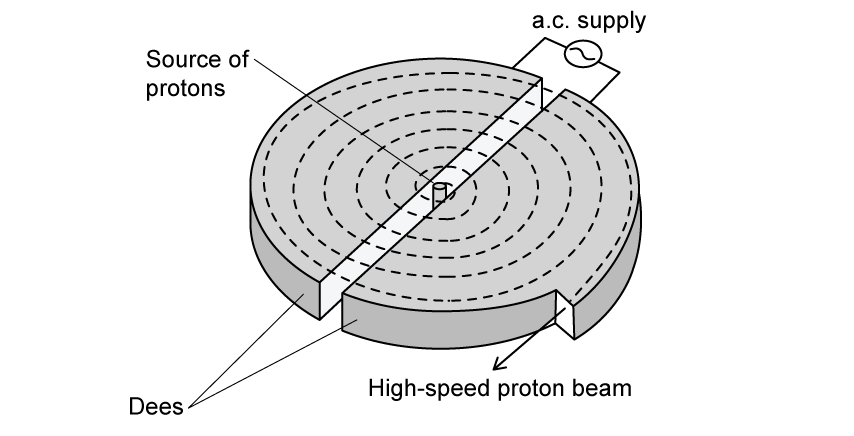
The diagram shows the structure of a cyclotron.

A uniform magnetic field is applied perpendicular to the plane of the dees. An alternating potential difference is applied across the gap between the dees.

A schematic of a cyclotron showing two semicircular dees separated by a narrow gap, connected to an alternating current (a.c.) supply across the gap. A proton source sits at the centre. A spiral path of increasing radius runs from the centre outwards, and an arrow indicates a high-speed proton beam leaves the cyclotron.

Explain how the cyclotron produces a beam of high-energy protons.

4b
3 marks

The frequency of the alternating potential difference is constant.

Derive an expression to show that the time taken by a proton to travel around one dee is independent of the radius of its path.

4c
2 marks

The dees of the cyclotron have a radius of 0.60 m.

Calculate the maximum speed of a proton as it leaves the cyclotron.

magnetic flux density = 0.80 T

4d
4 marks

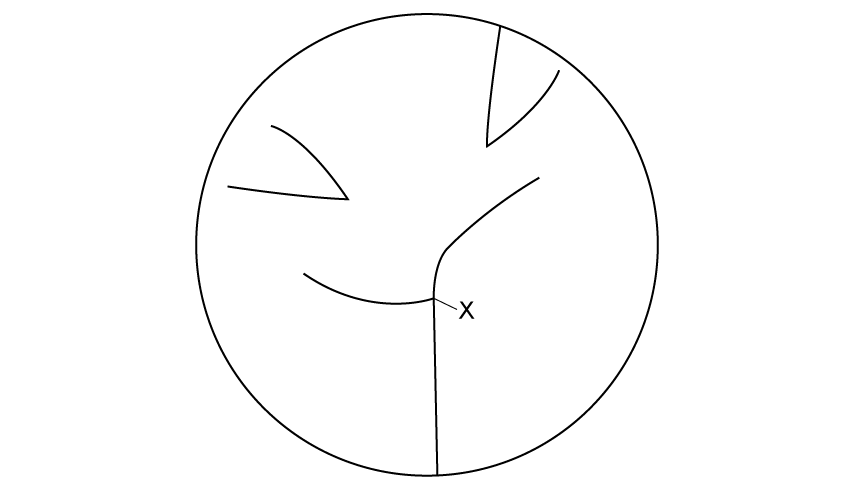
The protons strike a stationary target at X inside a bubble chamber. The diagram shows the tracks produced by one collision. Two neutral particles are produced in the collision, and both later decay into charged particles. A uniform magnetic field is applied perpendicular to the plane of the diagram.

[IMAGE: A circular bubble-chamber view. A straight track enters from the bottom edge and ends at X near the centre, where two tracks leave, both curving in the same sense. In the upper left and upper right of the chamber, two separate V-shaped pairs of tracks each appear from a point, opening away from X. In the left pair the two tracks curve in opposite directions; in the right pair one track is almost straight and the other is curved. No track joins X to either V.]

Explain the evidence provided by the diagram for these particle interactions.