Exploring the Structure of Matter (Edexcel A Level Physics): Exam Questions

Exam code: 9PH0

2 hours16 questions
1
1 mark

Electric and magnetic fields can be used in particle accelerators.

Which row in the table correctly describes the use of electric and magnetic fields in the particle accelerator indicated?


Particle accelerator

 Magnetic field

Electric field

A

cyclotron

not used

used to accelerate particles

B

cyclotron

used to accelerate particles

used to accelerate particles

C

linac

used to accelerate particles

not used

D

linac

used to accelerate particles

used to accelerate particles

    2
    1 mark

    Which of the following describes why electrons are released from a metal filament during thermionic emission?

    • Electrons in the metal filament are accelerated by a strong electric field.

    • Electrons in the metal filament are bombarded by high-energy particles.

    • Electrons gain energy when photons are incident on the metal surface.

    • Electrons gain energy when the metal filament is heated by an electric current.

    3
    1 mark

    The solid line shows the path of an alpha particle as it passes close to a nucleus. 

    q10-june-2019-9ph0-01-edexcel-as-a-level-phy

    Another alpha particle approaches the nucleus with the same initial kinetic energy.

    Which dashed path is possible for this alpha particle?  

      4
      1 mark

      A nuclide of bismuth contains 214 nucleons and 83 protons.

      How many neutrons are in the nuclide?

      • 83

      • 131

      • 214

      • 297

      5
      1 mark

      The diagram shows particle tracks in a bubble chamber. A photon enters the chamber and collides with a stationary neutral hydrogen atom. An electron is ejected from the atom, and an electron–positron pair is produced.

      Bubble chamber tracks showing two tightly wound spiral tracks curling in opposite directions and a nearly straight track exiting to the right.

      Which of the following is a valid conclusion from these tracks?

      • The photon enters the chamber from the right

      • The momentum of the ejected electron is greater than the momentum of the electron–positron pair

      • The magnetic field is directed out of the page

      • Charge is not conserved in this interaction

      6
      1 mark

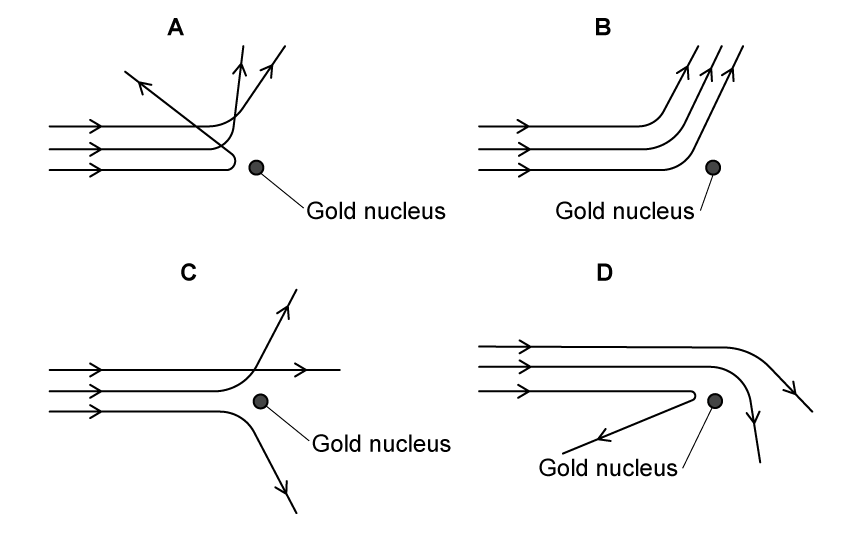
      In an alpha scattering experiment, three alpha particles with equal energies are directed towards the nucleus of a gold atom.

      Which of the following diagrams shows the possible paths of the alpha particles?

      Four diagrams, A to D, each showing three parallel alpha particle paths approaching a gold nucleus and being deflected in different ways.
A: The bottom path (closest to the nucleus) curves upwards by more than 90 degrees. The middle path curves upwards by around 90 degrees. The top path (furthest from the nucleus) curves upwards by less than 90 degrees.
B: All three paths curve upwards through the same angle.
C: The bottom and middle paths curve by the same angle but in opposite directions. The top path passes the nucleus and does not curve.
D: The bottom path curves downwards by more than 90 degrees. The middle path passes the nucleus and then curves downwards by around 90 degrees. The top path passes the nucleus and then curves downwards by less than 90 degrees.
        7
        1 mark

        Muons created in the upper atmosphere travel towards the ground at speeds close to the speed of light. More muons reach the ground than expected from their lifetime measured at rest.

        Which statement explains this observation?

        • The mass of the muons increases at high speed, so they take longer to decay

        • The lifetime of the muons is extended by time dilation, so they travel further before decaying

        • Time dilation means the muons decay in a shorter time as observed from the ground

        • The muons travel faster than light relative to the ground, so they reach it before decaying