Density, Upthrust & Viscous Drag (Edexcel A Level Physics): Exam Questions

Exam code: 9PH0

32 mins5 questions
1a
Sme Calculator
2 marks

Raindrops of different sizes fall with different terminal velocities through air.

The table shows the measured value of the terminal velocity for raindrops of different sizes.

Raindrop size

Drop diameter / mm

Terminal velocity / m s-1

small

0.5

2.1

medium

2.0

6.5

large

5.0

9.1

Derive, using Stokes’ law, the following expression for the terminal velocity v of a spherical raindrop in terms of its radius r.

v = 2gρr29η

where ρ is the density of rainwater and η is the viscosity of air.

You should ignore upthrust.

1b
Sme Calculator
2 marks

Show that the expression given in (a) produces a value of about 800 m s-1 for the terminal velocity of a large raindrop.

ρ = 1.0 × 10³ kg m-3

η = 1.8 × 10⁻⁵ Pa s

1c
Sme Calculator
3 marks

Explain whether Stokes’ law is suitable for calculating the terminal velocity of raindrops.

2a
2 marks

A student investigated the viscosity of olive oil at different temperatures using a steel sphere of radius r.

Describe how the student can make measurements of the steel sphere to determine its radius accurately.

2b
2 marks

Explain how the student can ensure that Stokes' law will apply to the steel sphere as it falls through the olive oil.

2c
5 marks

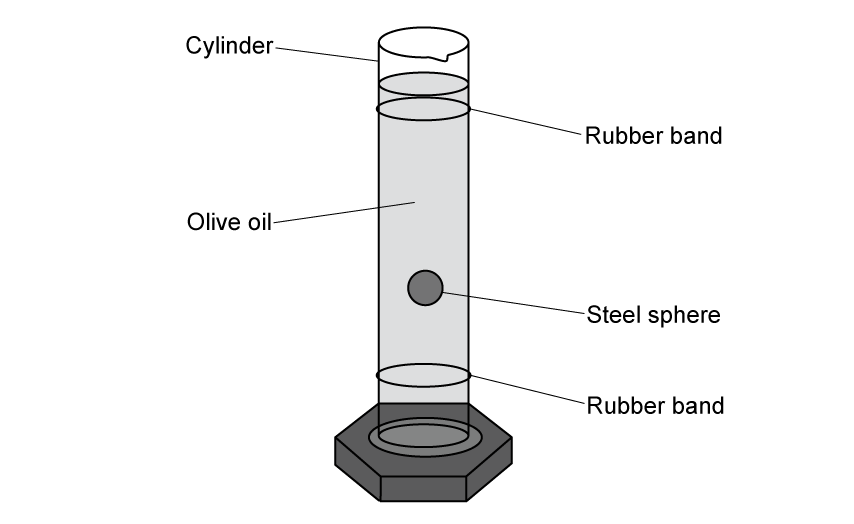
The student dropped the steel sphere into a tall cylinder of olive oil, as shown, and timed the sphere as it fell through the oil at terminal velocity.

A steel sphere falling through a tall measuring cylinder filled with olive oil. Two rubber bands near the top and bottom of the cylinder indicate the timed region.

The student placed two rubber bands around the cylinder and started a stopwatch when the sphere passed the first band and stopped it when the sphere passed the second band.

The student recorded the time t for the ball to fall through a distance of 21.0 cm and repeated this for three different temperatures. They calculated the viscosity η at each temperature using the formula

η = 2r2g(ρs ρo)9v

radius of steel sphere r=2.2 mm
density of steel ρs=7800 kg m3
density of olive oil at 20 °C ρo=920 kg m3

Their results are shown in the table.

Temperature T / °C

Time t / s

10

0.35

20

0.26

40

0.14

The student concluded that the viscosity of olive oil decreases linearly with temperature.

Criticise the student's investigation and conclusion.

1a
Sme Calculator
3 marks

Genuine crystal balls are made from clarified quartz rather than glass.

A student was given a small crystal ball and wanted to know whether it was genuine.

The mean diameter of the crystal ball was measured to be 5.06 cm and the mass of the crystal ball was measured to be 175 g. 

Show that the density of the material of the crystal ball is about 2600 kg m−3.

1b
Sme Calculator
6 marks

The student measured the diameter of the crystal ball using vernier calipers with a resolution of 0.01 cm. 

She measured the mass of the crystal ball using a balance with a resolution of 1 g.  

The table gives the densities of clarified quartz and glass.

Material

Density / kg m−3

Clarified quartz

2650

Glass

2590

Determine whether the crystal ball was genuine.

2a
Sme Calculator
4 marks

A student investigated the terminal velocity of steel spheres falling through oil.

The student obtained the following results.

radius of steel sphere = 1.50 mm

volume of steel sphere = 1.41 × 10⁻⁸ m3

mass of steel sphere = 1.10 × 10⁻⁴ kg

maximum speed of sphere = 0.849 ms−1

The student had the following table.

Type of oil

Density at 26°C / kg m−3

Viscosity at 26 °C / Pa s

Corn

918

0.0447

Hazelnut

918

0.0504

Sunflower

918

0.0414

Identify which type of oil the student used.

2b
2 marks

The values in the table are for oil at 26°C.

Explain the effect of carrying out the investigation with oil at a lower temperature.