Forces & Momentum (Edexcel A Level Physics): Structured Questions

Exam code: 9PH0

1 hour12 questions
1a
6 marks

A student released a ping pong ball in front of a metre rule and used a phone camera to record the motion of the ball as it fell. The phone camera captures 60 images per second, which may be played back one image at a time.

The ball was dropped from a height such that it reached its terminal velocity as it passed the metre rule.

i) Explain how the terminal velocity of the ball could be determined using the phone camera recording.

(4)

ii) Explain how a systematic error could affect the value obtained for the terminal velocity.

(2)

1b
2 marks

This experiment could have been attempted using a stopwatch to measure the time as the ping pong ball fell.

Explain an advantage of using a phone camera rather than a stopwatch.

2a
6 marks

A student carried out an experiment with coins.

She gave a 2p coin a sharp tap, so that it slid along a horizontal surface and came to rest as shown. 

q14a-june-2019-9ph0-01-edexcel-as-a-level-phy

The student recorded the distance s moved by the coin.

She then replaced the 2p coin with a 1p coin and repeated the process.

The student read that the frictional force between an object and a surface is directly proportional to the mass of the object. She suggested that, in her experiment, u is directly proportional to √s and is independent of the mass of the coin.

Discuss the validity of this suggestion.  

2b
6 marks

She arranged a collision between a 2p coin and a stationary 1p coin. She noted the directions in which the coins moved after the collision and determined their velocities.  

q14b-june-2019-9ph0-01-edexcel-as-a-level-phy

i) Show that the velocity of the 2p coin just before the collision was about 2 ms-1 .

mass of 2p coin = 7.1 g

mass of 1p coin = 3.6 g 

(4)

ii) Show that the collision was inelastic

(2)

3a
3 marks

A student determines the acceleration of free fall g using a trolley on a ramp.

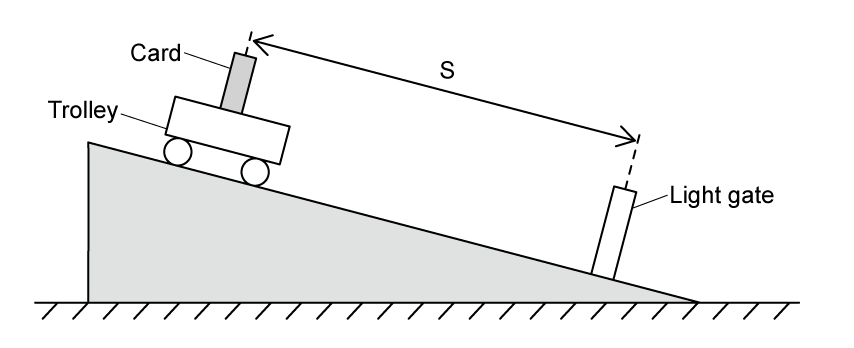
The trolley is released from rest and moves down the ramp. A card attached to the trolley interrupts a light gate near the bottom of the ramp, as shown.

A trolley with a vertical card mounted on top rests near the top of a ramp that slopes down to the right. A light gate stands across the ramp surface near the bottom of the slope. A double-headed arrow labelled s spans the distance along the ramp between the centre of the card and the light gate.

The student varies the distance s between the release position and the light gate. For each value of s, the student determines the velocity v of the trolley as it passes through the light gate.

Describe the measurements that need to be made using this apparatus and how they are used to determine v and s.

3b
2 marks

Explain why a graph of v2 against s gives a straight line through the origin.

3c
2 marks

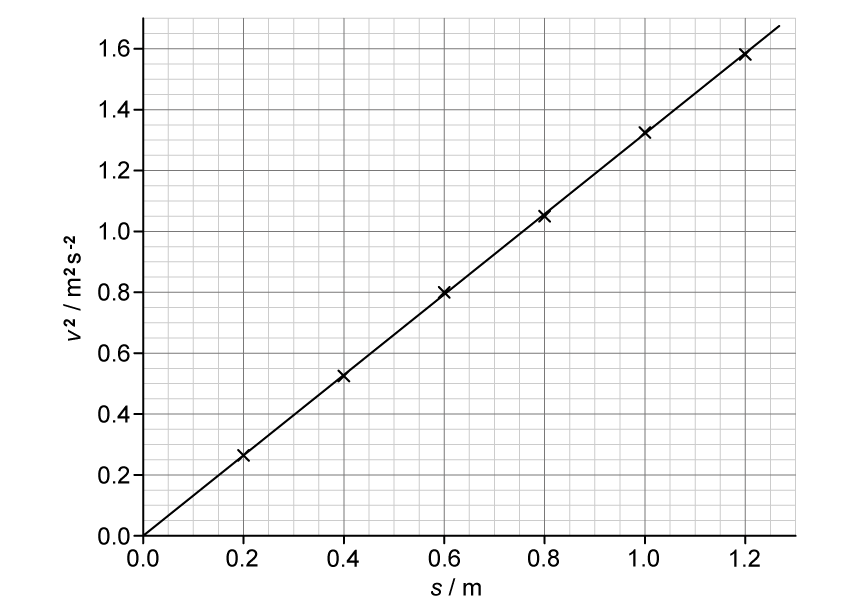
The student plotted a graph of v2 against s, as shown.

Graph of v squared against s, with a straight best-fit line through the origin. s runs from 0 to 1.3 metres and v squared from 0 to 1.7 metres squared per second squared; plotted points include (0.2, 0.26) and (1.2, 1.58).

The ramp is inclined at an angle of 4.0° to the horizontal.

Determine a value for g using the graph.

3d
1 mark

The student's value for g is less than 9.81 m s-2.

Give a reason for this difference.

4a
2 marks

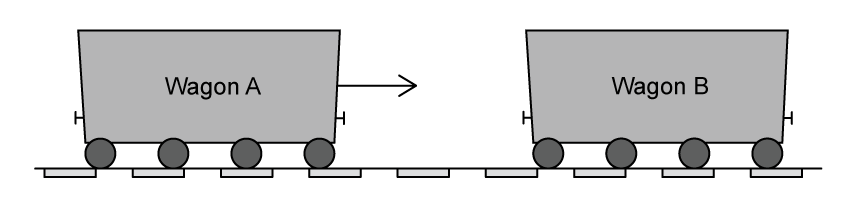
The diagram shows two freight wagons, A and B, on a straight, horizontal railway track.

Wagon A moves towards wagon B. Wagon B is stationary. Wagon A collides with wagon B, and the wagons join together.

Two wagons on a horizontal railway track. Wagon A moves to the right towards stationary wagon B.

State the principle of conservation of momentum.

4b
2 marks

Explain how Newton's second and third laws show that the momentum of the wagons is conserved during the collision.

4c
3 marks

Before the collision, wagon A moved with a velocity of 3.0 m s−1.

An operator claims that, after the collision, the wagons move at more than half the original speed of wagon A.

Assess whether this claim is correct.

mass of wagon A =8000 kg

mass of wagon B =16000 kg

1a
4 marks

In the sport of curling, two teams of ‘curlers’ take turns sliding polished granite stones across an ice surface towards a circular target marked on the ice.

Black-and-white photograph of a curling match. One player crouches low on the ice, releasing a granite stone, while two teammates holding brushes walk alongside, ready to sweep the ice in front of it. Credit: commons.wikimedia.org.

A stone of mass 19.6 kg is accelerated uniformly for 1.25 s before being released by a curler.

The stone then decelerates uniformly to rest, travelling 32.5 m in a time of 17.5 s.

Calculate the average useful power developed by the curler in accelerating the stone.

Average power = .......................................................

1b
6 marks

Stone B is stationary. Stone A travels towards the target and makes a direct hit on stone B as shown. Both stones have mass m.

Plan view of the circular target on the ice, drawn as grey and white rings. Stone B is at rest inside the target, just to the right of its centre. Stone A is to the right of the target, moving left towards stone B, shown by an arrow.

The collision is elastic. Just before the collision stone A has a velocity v. After the collision stone B moves off with velocity v.

Discuss how the relevant conservation laws apply to this collision.

1c
2 marks

While a stone is moving towards the target, the curlers vigorously sweep the ice directly in front of the stone. 

Explain why this may make the stone travel further.

2a
6 marks

A delivery drone rises vertically from rest. It then hovers above a garden before descending at constant velocity.

Explain how the forces acting on the drone change during the flight, with reference to Newton's laws of motion.

2b
2 marks

The mass of the drone is 0.90 kg. At take-off, the upward lift force on the drone is 12.2 N.

Show that the initial acceleration of the drone is about 4 m s−2.

2c
2 marks

The drone descends at constant velocity.

Explain the energy transfers taking place during the descent.