11 mark
Select the row of the table that describes the relative ionisation and relative penetration of nuclear radiations.
| Most ionising | Most penetrating |
A | α | α |
B | α | γ |
C | γ | α |
D | γ | γ |
Was this exam question helpful?
Exam code: 9PH0
Select the row of the table that describes the relative ionisation and relative penetration of nuclear radiations.
| Most ionising | Most penetrating |
A | α | α |
B | α | γ |
C | γ | α |
D | γ | γ |
Was this exam question helpful?
A nucleus of protactinium, , decays by emitting an α particle.
The nucleus formed is
Was this exam question helpful?
The radioactive decay of uranium-234 to thorium-230 is described by the equation
Particle X is
a beta-minus particle
a proton
a gamma-ray photon
an alpha particle
Was this exam question helpful?
Radioactive decay is described as a random process.
Which statement describes the random nature of radioactive decay?
The decay is unaffected by external conditions such as temperature or pressure
The half-life can be used to predict when a particular nucleus will decay
It is impossible to predict which nucleus will decay next, or when a decay will occur
The randomness of the decay can be removed by counting for a longer time
Was this exam question helpful?
A detector is placed 30 cm from a gamma source, the count rate is 64 counts per minute.
The detector is then placed 60 cm from the source.
The background rate is presumed to be a constant 24 counts per minute.
Which of the following gives the expected counts per minute?
16
32
34
44
Was this exam question helpful?
The radium isotope is unstable and undergoes a series of and emissions until a stable isotope of lead is formed.
Which of the following nuclear equations correctly shows the number of and emissions?
Was this exam question helpful?
A student used the apparatus shown to investigate the absorption of gamma radiation by lead.
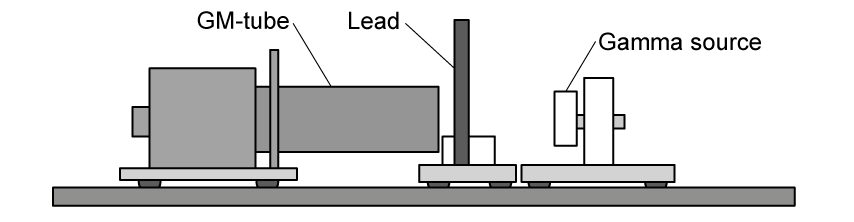
When no lead was present, the intensity of radiation was . When lead with a thickness of was present, the intensity was reduced by 50%.
What thickness of lead would reduce the intensity of radiation to ?
Was this exam question helpful?