Waves, Electrons & Photons (Edexcel A Level Physics): Exam Questions

Exam code: 9PH0

1 hour8 questions
1a
Sme Calculator
5 marks

Light from a laser pointer was passed through a diffraction grating. The light was perpendicular to the diffraction grating as shown. A diffraction pattern was produced on a screen.

q11-nov-2021-9ph0-03-edexcel-as-a-level-phy

The distance between the first order maximum and the central maximum of the diffraction pattern was x. The distance between the diffraction grating and the screen was D.

Distance x was measured to be 0.500 m with a metre rule. The wavelength of light λ1from the laser pointer was 650 nm.

The laser pointer was replaced with one that produced light of a different wavelength. The new distance x was measured to be 0.400 m.

D = 1.45 m

Calculate the wavelength λ2 of the light emitted by the replacement laser pointer.

λ2= .......................................................

1b
Sme Calculator
2 marks

Explain one modification to this method that would decrease the uncertainty in the calculated value of λ2.

1c
Sme Calculator
3 marks

In another experiment, the light from the laser pointer was not quite perpendicular to the screen.

Explain how this would change the diffraction pattern produced on the screen.

2
Sme Calculator
6 marks

In 1965, Richard Feynman proposed a double slit experiment to investigate the wave properties of electrons.

The experiment was later carried out using the arrangement shown.

q14-june-2018-9ph0-02-edexcel-as-a-level-phy

A beam of electrons was directed at a barrier with two slits.

The detector recorded the positions where electrons arrived after passing through the slits.

The following pattern was obtained. Black dots represent points where electrons were detected. A band where electrons were not detected has been labelled X and a band where electrons were detected has been labelled Y.

q14-1-june-2018-9ph0-02-edexcel-as-a-level-phy

The path difference for electrons arriving at band X from the separate slits was 2.5 × 10⁻¹¹ m.

For electrons arriving at band Y the path difference was 5.0 × 10⁻¹¹ m.

Explain why this pattern is observed when the electron energy is 9.6 × 10⁻¹⁷ J.

The electrons are travelling at non-relativistic speeds.

3a
Sme Calculator
3 marks

The photograph shows a school spectrometer.  

q17-june-2019-9ph0-02-edexcel-as-a-level-phy

The spectrometer allows parallel rays of light to be passed through a diffraction grating and the resulting angles of diffraction to be measured.

In the telescope, light from the grating is focused to make a real image 16.7 mm in front of the eyepiece lens. The eyepiece lens then uses this real image as an object to produce a magnified virtual image for the observer.

Calculate the magnification produced by the eyepiece lens.

focal length of eyepiece lens = 17.9 mm  

Magnification = ........................................

3b
Sme Calculator
9 marks

The spectrometer and diffraction grating are used to analyse the light from a sodium lamp. In the sodium lamp, sodium is heated until it becomes a vapour and an electric current is passed through it. The vapour then emits light.

After the light passes through the diffraction grating a line spectrum is observed.

i) Explain why only certain wavelengths are observed.  

(6)

ii) Diffraction gratings with the following spacings are available: 

d /10-6 m

1.0

1.7

2.0

3.3

Explain which would be the best spacing to use to measure the diffraction angle for the third order maximum for yellow light of wavelength 589 nm. 

(3)

3c
Sme Calculator
4 marks

The diagram shows some of the energy levels in a sodium atom. 

q17c-june-2019-9ph0-02-edexcel-as-and-a-level-phy

Add an arrow to the diagram to show the transition involved in the emission of yellow light of wavelength 589 nm.

Show your working below.

4a
6 marks

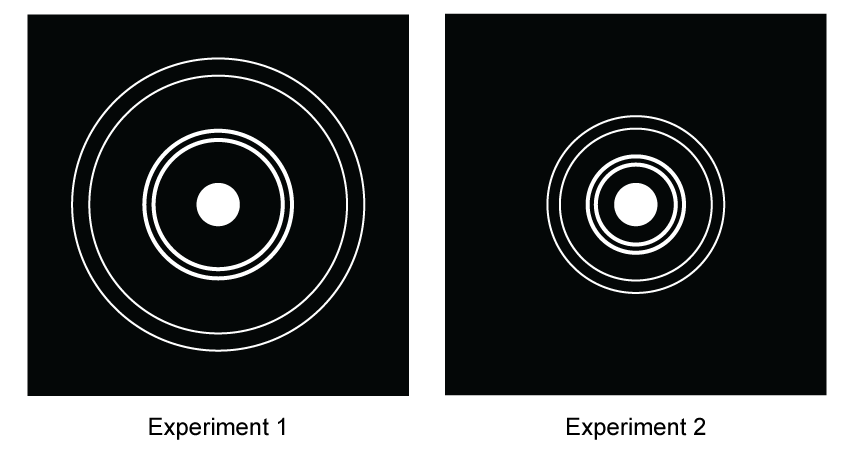
A student used an electron beam tube to accelerate electrons towards a thin polycrystalline gold film. A pattern consisting of concentric bright rings is observed on a fluorescent screen.

In Experiment 1, the electrons are accelerated from rest through a potential difference of 5.00 kV.

In Experiment 2, the potential difference across the tube is increased.

Two black squares with a series of concentric white circles. Experiment 1 shows larger circles, Experiment 2 shows smaller circles.

Discuss the conclusions that can be made from these experiments about the nature of electrons and the structure of gold.

4b
Sme Calculator
3 marks

Calculate the de Broglie wavelength of the electrons in Experiment 1.

4c
3 marks

The student suggested that alpha particles accelerated through a potential difference of 5.00 kV would also be suitable for investigating the structure of the gold film.

Comment on the student's suggestion.

5a
2 marks

Ultrasound can be used to investigate the structure of organs of the human body using the pulse-echo technique. A transducer emits ultrasound waves through body tissue and detects the reflected waves.

Describe how an ultrasound wave travels through body tissue.

5b
Sme Calculator
3 marks

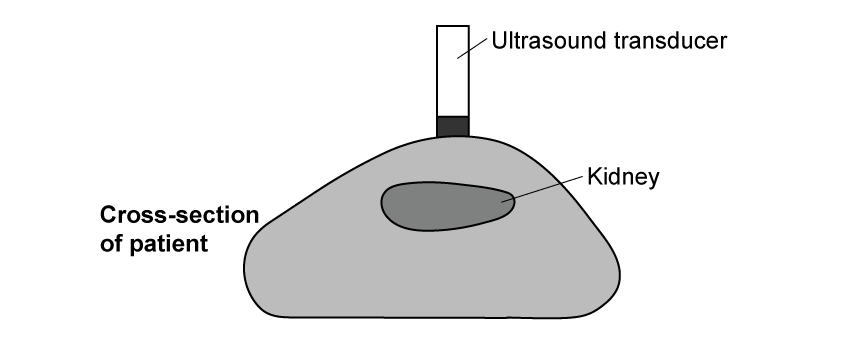
The diagram shows the transducer emitting a short pulse of ultrasound into a patient's body.

A cross-section of a patient, showing an ultrasound transducer on the skin above a kidney inside the body.

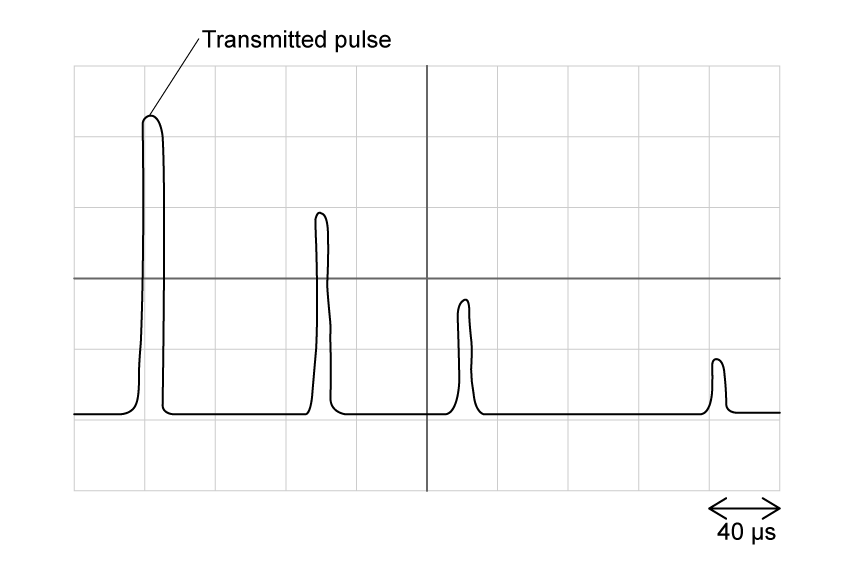
The oscilloscope trace below shows the transmitted and detected pulses. Each division on the oscilloscope trace represents 40 μs.

Oscilloscope trace showing four pulses: the transmitted pulse and three echo pulses of decreasing intensity. There are 2.5 squares between the transmitted pulse and the first reflected pulse, then 2 squares to the next pulse, and 3.5 squares to the final pulse. A square on the horizontal axis is marked 40 microseconds.

Calculate the diameter of the kidney.

speed of ultrasound in soft body tissue = 1540 m s1

5c
1 mark

Give a reason why the ultrasound must be emitted in short pulses rather than as a continuous wave.

5d
2 marks

The transducer emits ultrasound at a frequency of 2.5 MHz.

Explain why ultrasound waves of much lower frequency are unsuitable for medical imaging.

6a
Sme Calculator
4 marks

A student used a diffraction grating to check the wavelength of the light emitted by a laser labelled 630±10 nm. Light from the laser was directed through the diffraction grating and onto a screen a distance D away.

The diffraction pattern consisted of the central maximum and the first and second order maxima, as shown.

A laser directed at a diffraction grating, with the diffracted beams reaching a screen showing the central maximum and first- and second-order maxima on either side. The distance between the grating and the screen is labelled "D".

The student measured the distance between the two first-order maxima as 1640 mm. The diffraction grating had 600 lines mm1.

D=2.00 m

Deduce whether the light from the laser was within the range 630±10 nm.

6b
2 marks

Explain one modification to this method that would produce a smaller percentage uncertainty in the value of wavelength.

6c
3 marks

A polarising filter is placed between the laser and the grating.

The polarising filter is rotated slowly through 360° in the plane perpendicular to the laser beam. The student makes the following observations.

  • As the polarising filter is rotated, the intensity of the diffraction pattern on the screen varies.

  • At two positions during the rotation, the diffraction pattern is not visible on the screen.

Explain what these observations show about the light emitted by the laser.