Black Body Radiation (Edexcel A Level Physics): Exam Questions

Exam code: 9PH0

28 mins5 questions
1a
Sme Calculator
3 marks

The photograph shows a filament bulb.

q14-nov-2020-9ph0-02-edexcel-as-a-level-phy

The filament is an emitter with 35% of the power output of a black body radiator of the same temperature.

When a potential difference (p.d) of 2.0 V is applied across the bulb, there is a current of 0.37 A in the filament.

Calculate the temperature of the filament.

surface area of filament = 3.9 × 10⁻⁶ m2

Temperature = ....................................................................

1b
Sme Calculator
7 marks

In an experiment to investigate the efficiency of a filament light bulb a p.d. was applied. The p.d. and current were measured and the light bulb was observed. The p.d. was then increased and new measurements taken.

When a small p.d. is applied to the bulb, no light is visible. If the p.d. is gradually increased, the filament starts to glow and eventually appears white.

i) Add to the graph to show the distribution of radiation from a black body at a temperature of 2026 K.

Your answer should include a calculation.

(5)

q14bi-nov-2020-9ph0-02-edexcel-as-a-level-phy

ii) Use your graph to explain why filament light bulbs are considered inefficient.

(2)

2a
Sme Calculator
3 marks

An oximeter is a device used in hospitals to monitor the oxygen level in a patient’s blood.

In an oximeter, two light-emitting diodes (LEDs) are mounted opposite light sensors in a clip and attached to the patient’s finger. One of the LEDs produces red light and the other produces infrared.

q5-june-2019-9ph0-03-edexcel-as-a-level-phy

The intensity I of electromagnetic radiation received by the detector, after passing through a thickness x of blood, is given by

I = I0eμx

where I0 is the intensity that would have been received if the blood were not present and μ is the attenuation coefficient of blood.

The red LED emits visible light of wavelength 650 nm and the infrared LED emits infrared of wavelength 950 nm.

The graph shows how μ varies with wavelength λ for oxygenated blood and deoxygenated blood.

q5-1-june-2019-9ph0-03-edexcel-as-a-level-phy

I0for the infrared LED is 1.8 W m–2

Calculate I for the infrared after passing through 1.4 mm of oxygenated blood.

I = .......................................................

2b
Sme Calculator
3 marks

The oximeter determines I/I0 the fraction of radiation transmitted at each wavelength.

Deduce whether I/I0 will be smaller for the red or the infrared radiation if the blood is deoxygenated.

2c
Sme Calculator
3 marks

It is suggested that ambient light could affect the readings produced by the oximeter.

Halogen lamps have a filament temperature of 3200 K.

Deduce whether the light from such a lamp would have a significant effect on the oximeter readings.

3
Sme Calculator
2 marks

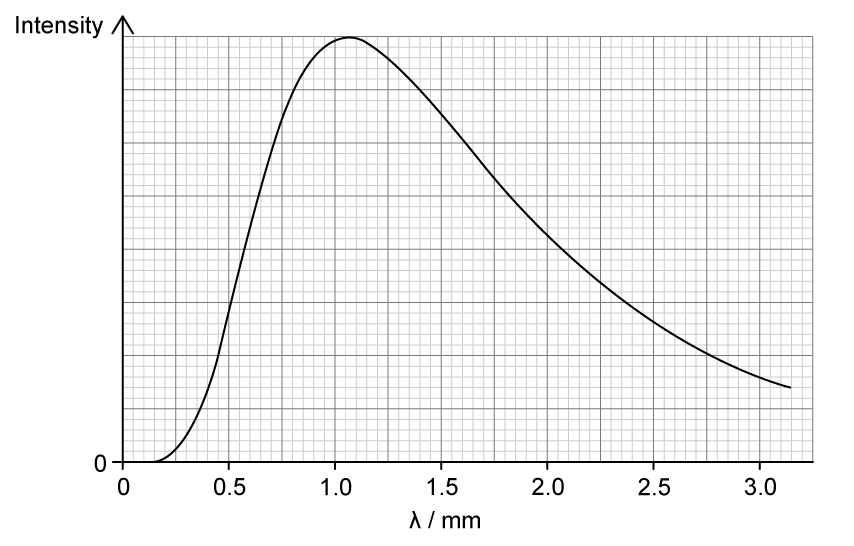
The cosmic microwave background (CMB) radiation is detected to come from all directions in space equally. The graph shows how the intensity of the CMB radiation varies with its wavelength.

Graph of intensity against wavelength in mm, showing a single peak near 1 mm and a gradual decline in intensity as wavelength increases to about 3 mm.

Show that the graph is consistent with a black-body temperature of about 3 K.

1a
Sme Calculator
4 marks

Infrared cameras are used to create images that show the infrared radiation emitted by objects.

The photographs show the same scene taken first with an ordinary camera and then with an infrared camera.

q12-june-2018-9ph0-02-edexcel-as-a-level-phy

Deduce whether the objects shown in the photographs would be expected to have peak emissions at infrared wavelengths. Your answer should include a calculation.

longest wavelength of visible red light ≅ 700 nm

1b
Sme Calculator
2 marks

The photograph shows the result when someone tries to take an infrared photograph of the same scene through a window. The image does not show the outdoor scene but does show an image of the photographer.

State what can be concluded about glass and infrared radiation.