Inverse Square Law of Flux (Edexcel A Level Physics): Revision Note
Exam code: 9PH0

Inverse Square Law of Flux
The moment the light leaves the surface of the star, it begins to spread out uniformly through a spherical shell
Light sources which are further away appear fainter because the emitted light has been spread over a greater area
The surface area of a sphere is equal to 4πr2
The radius r of this sphere is equal to the distance d between the star and the Earth
Therefore the radiation received at Earth has been spread over an area of 4πd2
The inverse square law of flux can therefore be calculated using:
Where:
F = radiant flux intensity, or observed intensity on Earth (W m-2)
L = luminosity of the source (W)
d = distance between the star and the Earth (m)
This equation assumes:
The power from the star radiates uniformly through space
No radiation is absorbed between the star and the Earth
This equation tells us:
For a given star, the luminosity is constant
The radiant flux follows an inverse square law
The greater the radiant flux (larger F) measured, the closer the star is to the Earth (smaller d)
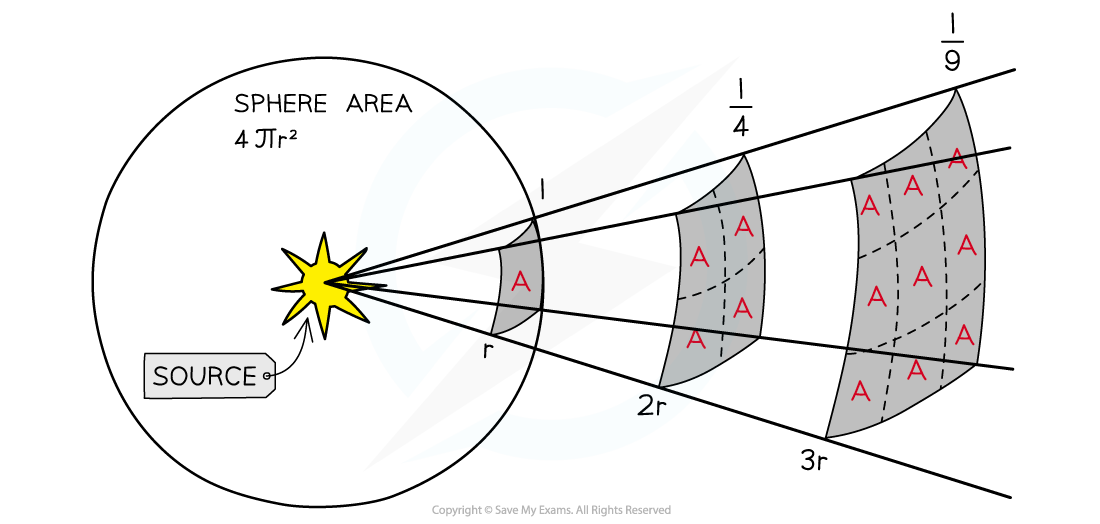
Inverse square law; when the light is twice as far away, it has spread over four times the area, hence the intensity is four times smaller
Worked Example
A star has a luminosity that is known to be 4.8 × 1029 W. A scientist observing this star finds that the radiant flux intensity of light received on Earth from the star is 2.6 nW m–2. Determine the distance of the star from Earth.
Answer:
Step 1: Write down the known quantities
Luminosity, L = 4.8 × 1029 W
Radiant flux intensity, F = 2.6 nW m–2 = 2.6 × 10⁻⁹ W m–2
Step 2: Write down the inverse square law of flux
Step 3: Rearrange for distance d, and calculate

Unlock more, it's free!
Join the 100,000+ Students that ❤️ Save My Exams
the (exam) results speak for themselves:

Was this revision note helpful?
Build on this topic
