The Standard Model (Edexcel A Level Physics): Revision Note
Exam code: 9PH0

Baryons & Mesons
All particles of matter are made up of either quarks and/or leptons
The standard model of particle physics categorises quarks and leptons by charge and mass

Quarks and leptons form the standard model of particle physics. The first generation of particles make up all ordinary matter
Hadrons are made up of quarks and interact with the strong nuclear force
Baryons and mesons are types of hadron
Baryons consist of 3 quarks
Mesons consist of a quark-antiquark pair
The most common baryons are protons and neutrons
The most common mesons are pions and kaons

Hadrons may be either a baryon or a meson. Both baryons and mesons interact with the strong nuclear force

Anti-hadrons may be either an anti-baryon or an anti-meson
Quarks have never been discovered on their own, always in pairs or groups of three
Note that all baryons or mesons have integer (whole number) charges e.g. +1e, -2e, etc.
This means quarks in a baryon are either all quarks or all anti–quarks
Combinations of quarks and anti–quarks don’t exist in a baryon
e.g. would not be a quark combination that exists
The anti–particle of a meson is still a quark and anti–quark pair. The difference being the quark becomes the anti–quark and vice versa
Worked Example
The baryon Δ++ was discovered in a particle accelerator using accelerated positive pions on hydrogen targets.
Which of the following is the quark combination of this particle?
A.
B.
C.
D.
Answer: A
Since it is a baryon, it's made up of three quarks
This rules out option C
Baryons are made up of 3 quarks
Anti-baryons are made up of 3 anti-quarks
This rules out option B
There cannot be a combination of quarks and anti-quarks
The baryon Δ++ has a charge of 2+
Adding up the charges of quarks
A:
D:
Therefore, the correct combination is option A
Examiner Tips and Tricks
Remembering quark combinations is useful for the exam
However, as long as you can remember the charges for each quark, it is easy to figure out the combination by making sure the combination of quarks adds up to the total charge of the particle (just like in the worked example!)
Leptons & Photons
Leptons
Leptons are a group of fundamental (elementary) particles
This means they are not made up of any other particles (no quarks)
Leptons interact with other particles via the weak or gravitational interactions, and charged leptons (not neutrinos) also interact via the electromagnetic interaction
Unlike hadrons (baryons & mesons), leptons do not interact via the strong nuclear force
The most common leptons are:
The electron, e–
The electron neutrino, ve
The muon, μ–
The muon neutrino, vμ
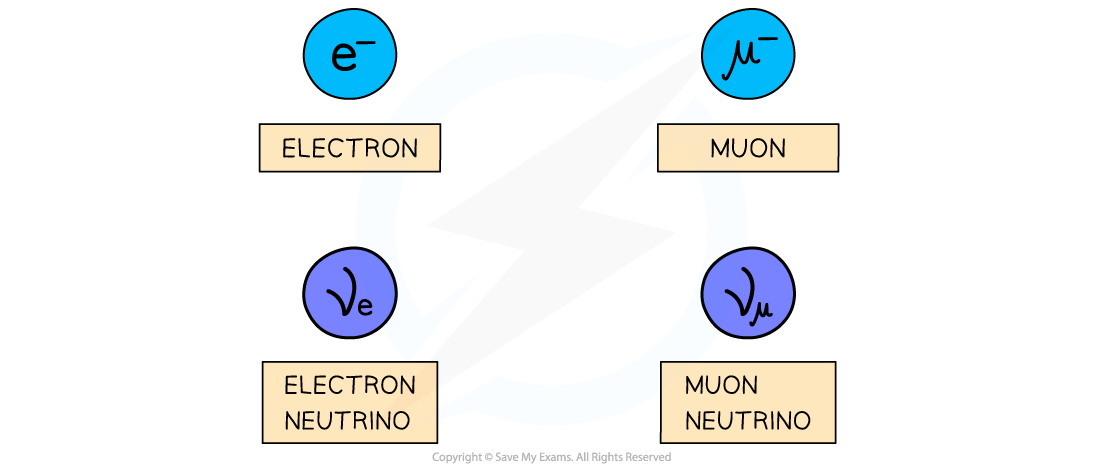
The most common leptons are the electron and muon, along with their associated neutrinos
The muon is similar to the electron but is 200 times more massive
Electrons and muons both have a charge of -1e
Electrons have a mass of 0.0005 u
Muons have a mass of 0.11 u
Neutrinos are the most abundant leptons in the universe and have no charge and negligible mass (almost 0)
Although quarks are fundamental particles too, they are not classed as leptons
Worked Example
State all the anti-leptons in the following decay equation.
Answer:
The pion (π+) is a meson (a type of hadron) and is made up of quarks
Therefore it is not a fundamental particle and hence not a lepton
The anti-muon (μ+) is the anti-particle of the muon
Therefore it is an anti-lepton
The muon neutrino is a lepton, not an anti-lepton
The anti-lepton would be the anti-muon neutrino
Therefore, the only anti-lepton is an anti-muon (μ+)
Photons
Photons are a group of particles which mediate the electromagnetic interaction
They are uncharged
They have zero mass
They are sometimes called "exchange bosons" because they mediate one of the fundamental forces (electromagnetism)
For example, the electrostatic repulsion between two electrons is understood in terms of exchanging photons
Examiner Tips and Tricks
In some topics, you may need to use the energy of a photon. This is given by the equation E = hf = .
Symmetry of the Standard Model
The first four quarks discovered were:
The up quark
The down quark
The strange quark
The charm quark
The symmetry of the standard model predicted a third generation of particles, namely the top and bottom quark
Experiments were carried out to discover these, and eventually they were found as predicted
Therefore, the three generations of quarks are and their respectively charges are:

The three generations of quarks. e is the charge of an electron.
They each have their own anti-quark, which has the opposite charge

Three generations of anti-quarks. These have the same properties as the quarks except for opposite charges.
Examiner Tips and Tricks
You will not be expected to describe the strong nuclear force in your exam, but you should understand that photon is the exchange particle for the electromagnetic force and that it has zero charge and mass.

Unlock more, it's free!
Join the 100,000+ Students that ❤️ Save My Exams
the (exam) results speak for themselves:

Was this revision note helpful?
Build on this topic