Nuclear Fusion (OCR A Level Physics): Revision Note
Exam code: H556

Nuclear Fusion
Fusion is defined as:
Small nuclides that combine together to make larger nuclei, releasing energy
Low mass nuclei, such as hydrogen and helium, can undergo fusion and release energy
On Earth, research is focused on achieving the deuterium-tritium (D-T) reaction
This involves fusing a deuterium nucleus and a tritium nucleus together to produce a helium nucleus and a neutron
Deuterium-tritium fusion
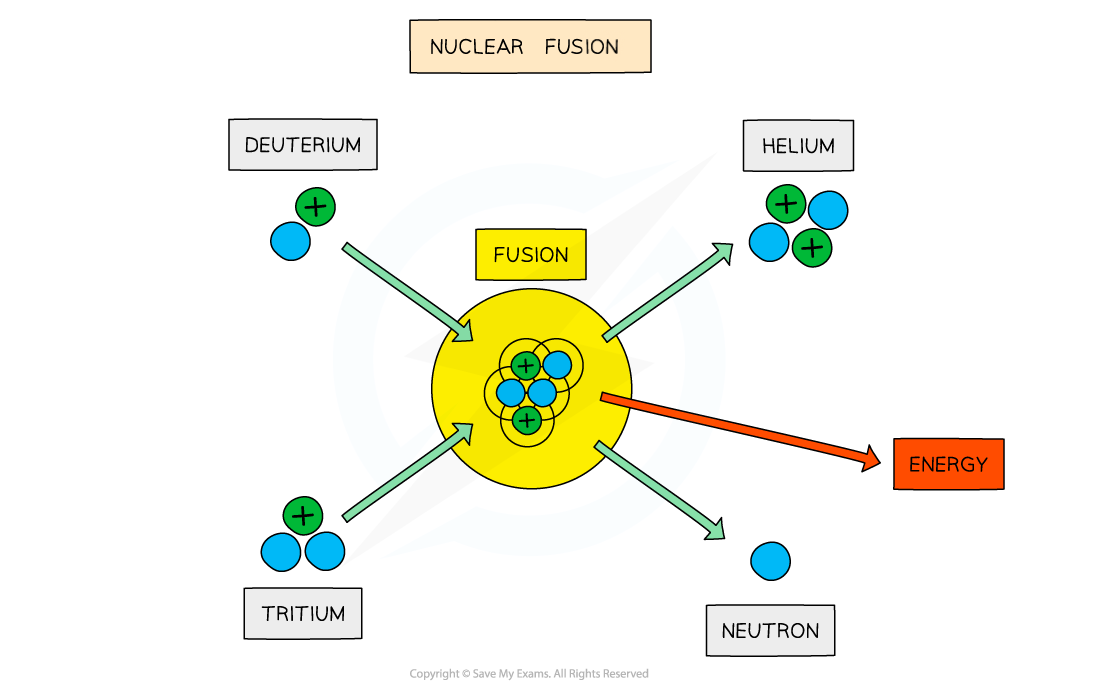
For two nuclei to fuse, both nuclei must have high kinetic energy
This is because protons are positively charged, which means that they repel one another
It takes a great deal of energy to overcome the electrostatic force, hence, fusion can only be achieved in an extremely hot, dense environment, such as the core of a star
When two hydrogen nuclei (protons) fuse, a deuterium nucleus is produced
A positron and an electron neutrino are also produced as one of the protons converts into a neutron through beta-plus decay
In the centres of stars, four hydrogen nuclei fuse to produce a helium nucleus , plus the release of energy
This provides fuel for the star to continue burning
Examiner Tips and Tricks
In the fusion process, the mass of the new, heavier nucleus is less than the mass of the constituent parts of the nuclei fused together, as some mass is converted into energy.
Not all of this energy is used as binding energy for the ne,w larger nucleus, so energy will be released from this reaction. The binding energy per nucleon afterwards is higher than at the start.

Unlock more, it's free!
Join the 100,000+ Students that ❤️ Save My Exams
the (exam) results speak for themselves:

Was this revision note helpful?
Build on this topic