Examples of Forced Oscillations & Resonance (OCR A Level Physics): Revision Note
Exam code: H556

Examples of Forced Oscillations & Resonance
Resonance occurs for any forced oscillation where the frequency of the driving force is equal to the natural frequency of the oscillator
For example, a glass smashing from a high pitched sound wave at the right frequency
Some other practical examples of forced oscillations and resonance include:
An organ pipe
Radio receivers
Microwave oven
Magnetic resonance imaging (MRI)
In an organ pipe
Air molecules vibrate in an air column setting up a stationary wave in the pipe
This causes the air molecules to resonate leading to an increase in amplitude of sound
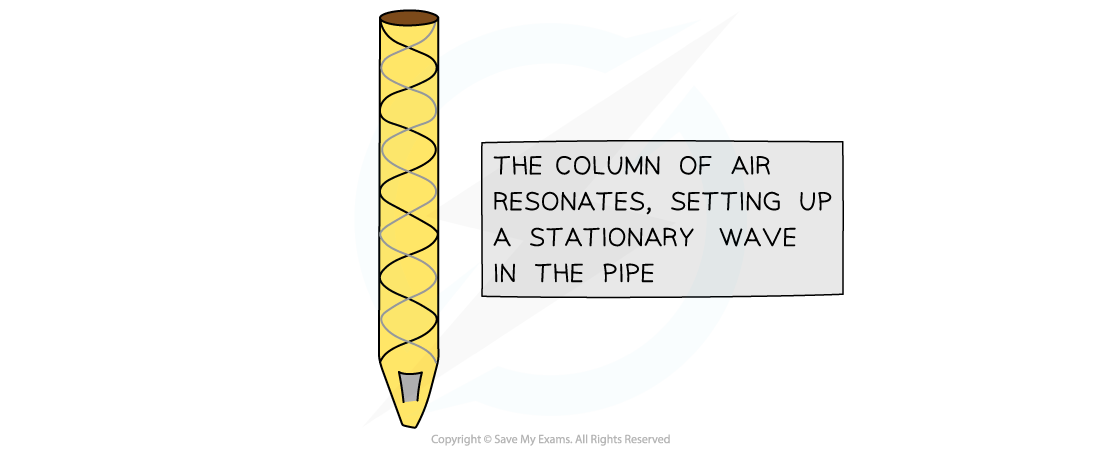
Standing waves forming inside an organ pipe from resonance
Radio receivers
The radio is “tuned” by setting its natural frequency equal to that of a radio station
The radio tuned so that the electric circuit resonates at the same frequency as the specific broadcast
The resonance of the radio waves allows the signal to be amplified by the receiver to listen
Microwave oven
Conventional cooking methods involve transferring heat energy by conduction or convection
A microwave transfers heat energy by radiation i.e. microwaves of a particular frequency that resonate with the water molecules in food

Magnetic resonance imaging (MRI)
This type of scanner is a widely used medical diagnostic tool used to look at organs and structures inside the body
The atomic nuclei in the body are made to resonate with incoming radio waves (of the order of 100 MHz)
The signals are then sent to a computer to create digital scans and provide a detailed image of the scanned area
Barton's Pendulums
A mechanical system commonly used to show resonance is Barton's pendulums
A set of light pendulums labelled A-E are suspended from a string
A heavy pendulum X, with a length L, is attached to the string at one end and will act as the driving pendulum
When pendulum X is released, it pushes the string and begins to drive the other pendulums
Most of the pendulums swing with a low amplitude but pendulum C with the same length L has the largest amplitude
This is because its natural frequency is equal to the frequency of pendulum X (the driving frequency)
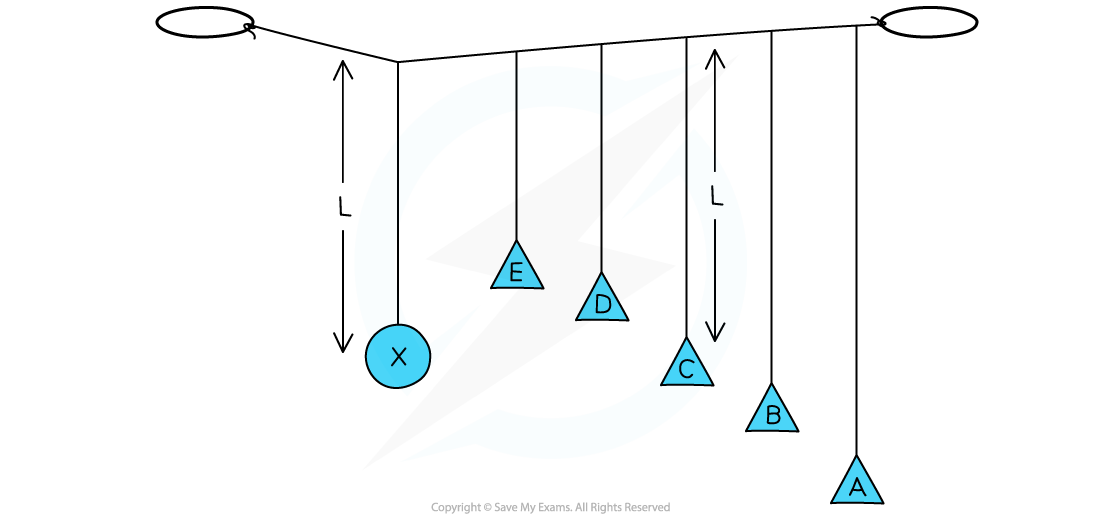
Barton's pendulums helps display resonance
The phase of the oscillations relative to the driver are:
Pendulums E and D with lengths < L are in phase
Pendulum C with length = L is 0.5π out of phase
Pendulums B and A with lengths > L are π out of phase

Unlock more, it's free!
Join the 100,000+ Students that ❤️ Save My Exams
the (exam) results speak for themselves:

Was this revision note helpful?
Build on this topic