Tension, Normal force, Upthrust & Friction (OCR A Level Physics): Revision Note
Exam code: H556

Tension, Normal Force, Upthrust & Friction
Tension:
The force experienced by a cable, rope, or string when pulled, hung, rotated or supported
This is normally labelled as T on free body diagrams

Tension always acts away from the mass
Normal Contact Force:
The force arising when an object rests against another object acting at a 90° angle to the plane of contact
It is sometimes also referred to as the reaction force
This is normally labelled as N or R on free body diagrams
This force arises from Newton's Third Law

Normal contact force always acts perpendicular to the surface
Upthrust:
The upward buoyancy force acting on an object when it is in a fluid
Upthrust can occur in liquids and gases

Upthrust always acts upwards
Friction:
The force that arises when two surfaces are in contact with each other
Friction always opposes the motion
This is normally labelled as F or Fr on free body diagrams

Friction always acts at the point where the objects are in contact, and in the opposite direction to the direction of motion
Free-body diagrams
Free body diagrams are useful for modelling the forces that are acting on an object
Each force is represented as a vector arrow, where each arrow:
Is scaled to the magnitude of the force it represents
Points in the direction that the force acts
Is labelled with the name of the force it represents
Free body diagrams can be used:
To identify which forces act in which plane
To resolve the net force in a particular direction
The net force in a particular direction can be calculated by:
Using the labelled angles and magnitudes
Resolving each force into horizontal and vertical components
Worked Example
Draw free-body diagrams for the following scenarios:
a) A picture frame hanging from a nail
b) A box being pulled up a slope by a mass on a pulley (resolving the weight into parallel and perpendicular directions)
c) A man fishing in a stationary boat
d) A car accelerating along a road
Answer:
Part (a)

The size of the arrows should be such that the 3 forces would make a closed triangle as they are in equilibrium
Part (b)

In problems such as this, it is best to resolve the forces parallel and perpendicular to the slope
Usually, an angle will be given to allow calculation of the weight in these directions
Part (c)
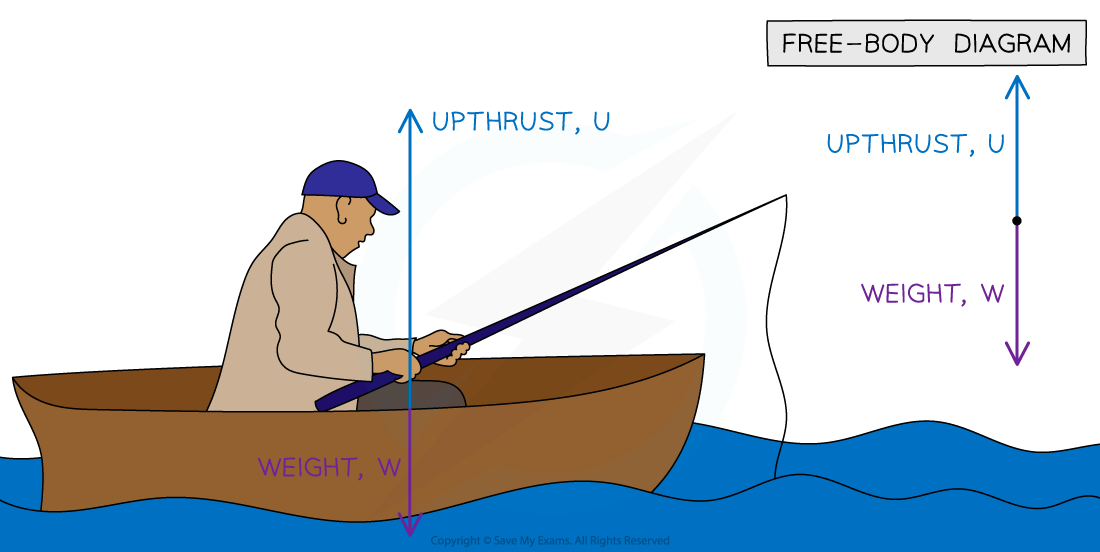
As the boat is not moving, the size of both arrows must be the same
Part (d)

As the car is accelerating, the size of the thrust must be larger than the size of the friction force
As in part (c), the upwards and downwards forces must be equal
Examiner Tips and Tricks
If you need a reminder on how to combine and resolve vectors, take a look at the notes in '3.3 Scalars & Vectors'

Unlock more, it's free!
Join the 100,000+ Students that ❤️ Save My Exams
the (exam) results speak for themselves:

Was this revision note helpful?
Build on this topic