Drag Forces (OCR A Level Physics): Revision Note
Exam code: H556

Drag Forces
Drag forces are forces that oppose the motion of an object moving through a fluid (gas or liquid)
Examples of drag forces are friction and air resistance
Drags forces:
Are always in the opposite direction to the motion of the object
Never speed an object up or start them moving
Slow down an object or keeps them moving at a constant speed
Convert kinetic energy into heat and sound
Lift is an upwards force on an object moving through a fluid. It is perpendicular to the fluid flow
For example, as an aeroplane moves through the air, it pushes down on the air to change its direction
This causes an equal and opposite reaction upwards on the wings (lift) due to Newton's third law

Drag forces are always in the opposite direction to the thrust (direction of motion). Lift is always in the opposite direction to the weight
A key component of drag forces is it increases with the speed of the object
This is shown in the diagram below:

Frictional forces on a car increase with speed
Worked Example
A car of mass 800 kg has a horizontal driving force of 3 kN acting on it.Its acceleration is 2.0 m s-2.What is the frictional force acting on the car?

Answer:

Factors Affecting Drag
The magnitude of the drag force depends on several factors, including:
The speed of the object
The object’s shape and texture
The density of the fluid
The two most significant factors are the speed of the object and the object’s cross-sectional area
Air Resistance
Air resistance increases with the speed of an object
However, there are other factors that also affect the maximum speed, such as:
Cross-sectional area
Shape
Altitude
Temperature
Humidity
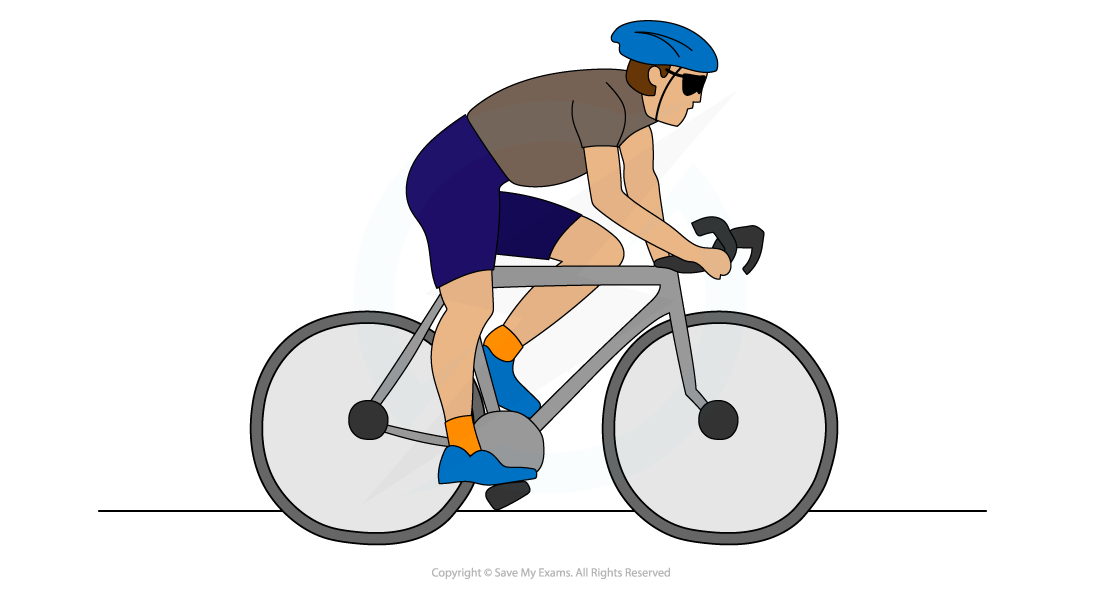
Many factors such as posture, clothes and bicycle shape must be considered when trying to reduce air resistance
Examiner Tips and Tricks
If a question considers air resistance to be ‘negligible’ this means in that question, air resistance is taken to be so small it will not make a difference to the motion of the body. You can take this to mean there are no drag forces acting on the body.
Objects Falling in a Uniform g Field with Drag
When an object is falling vertically in a uniform gravitational field, it is usually considered to have only a constant attractive force, weight, acting on it
However, for a more realistic approach, the opposing drag forces should be considered
Opposing drag forces reduce the net force acting on an object and as a result, reduce the magnitude of the acceleration
The drag force will increase until it is equal in magnitude to the weight of the object
This leads to the object reaching a steady speed, known as its terminal velocity
Because of drag, experimental values of the acceleration due to gravity, g, tend to be less than 9.81 m s-2
Air Resistance & Projectile Motion
Air resistance decreases the horizontal component of the velocity of a projectile
This means both its range and maximum height is decreased compared to no air resistance

A projectile with air resistance travels a smaller distance and has a lower maximum height than one without air resistance

Unlock more, it's free!
Join the 100,000+ Students that ❤️ Save My Exams
the (exam) results speak for themselves:

Was this revision note helpful?
Build on this topic
