X-ray Attenuation Mechanisms (OCR A Level Physics): Revision Note
Exam code: H556

X-ray Attenuation Mechanisms
X-ray attenuation is defined as:
The reduction in energy, or intensity, of a beam of X-rays due to their interaction with matter
There are four main methods in which X-rays can be attenuated:
Simple scattering
Photoelectric effect
Compton scattering
Pair production
These mechanisms occur within the material the X-rays are travelling in
Simple Scattering
Simple scattering occurs when:
A low-energy X-ray photon encounters an electron in an atom causing it to be scattered without a change in energy
Simple scattering occurs with lower-energy X-ray photons
In this scenario, 'low-energy' means the energy of the X-ray photon is not sufficient to cause ionisation
During simple scattering, photons are deflected from their initial path by interaction with the atoms of the material. However, there are:
No change in energy of the X-ray photon
No absorption of the X-ray photon
This mechanism causes blurring or 'noise' in X-ray imaging
This is because scattered X-rays arrive at the detector from several angles as well as from the main beam

Photoelectric Effect
The photoelectric effect occurs when:
An X-ray photon is absorbed by an inner shell electron causing it to be ejected from the atom as a photoelectron
As a result of the photoelectric effect, the X-ray photon is completely absorbed and all its energy is imparted to the photoelectron
Since energy is always conserved, the energy of an incident X-ray photon is equal to:
The work function + the maximum kinetic energy of the photoelectron
The energy within a photon is equal to hf
This energy is transferred to the electron to release it from a material (the work function) and the remaining amount is given as kinetic energy to the emitted photoelectron
This equation is known as the photoelectric equation:
Where:
h = Planck's constant (J s)
f = the frequency of the incident radiation (Hz)
Φ = the work function of the material (J)
½ mv2max = Ek(max) = the maximum kinetic energy of the photoelectrons (J)

Compton Scattering
The Compton Effect is when:
An X-ray photon is deflected by an interaction with an orbital electron causing the wavelength of the photon to increase and the ejection of the electron from the atom at a high speed
This process is similar to simple scattering, except the X-ray photon imparts some of its energy to the orbital electron
Because of this exchange of energy:
The X-ray is deflected from its initial path
The X-ray’s wavelength increases, as its energy decreases
The electron involved is ejected from the atom involved in the interaction
The electron and X-ray are deflected in different directions due to conservation of momentum

Pair Production
Pair production occurs when:
A high energy X-ray photon passes close to the nucleus of an atom causing the production of an electron-positron pair
This arises as a consequence of Einstein's mass-energy equivalence principle:
E = mc2
Where:
E = the energy of the X-ray photon (J)
m = the mass of the electron and position = 2me (kg)
c = the speed of light (m s−1)
Pair production can, therefore, only occur with high energy X-rays
This is because the energy of the X-ray photon must be above a certain value to provide the total rest mass energy of the electron-positron pair
The minimum energy, Emin, for a photon to undergo pair production is the total rest mass energy of the particles produced:
Emin = hfmin = 2mec2
As a result of pair production, the X-ray photon is completely absorbed and all its energy is imparted to the electron-positron pair

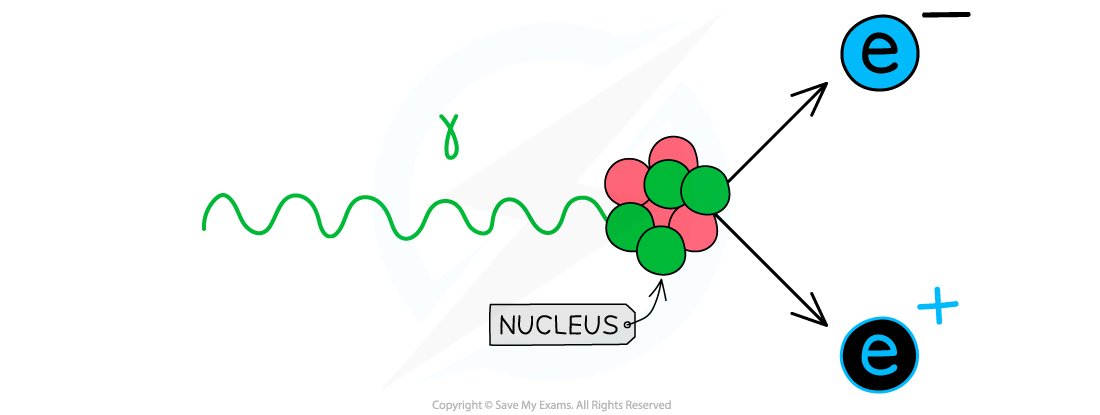
When a photon with enough energy interacts with a nucleus it can produce an electron-positron pair

Unlock more, it's free!
Join the 100,000+ Students that ❤️ Save My Exams
the (exam) results speak for themselves:

Was this revision note helpful?
Build on this topic
