Hooke's Law (OCR A Level Physics): Revision Note
Exam code: H556

Hooke's Law
When a force F is added to the bottom of a vertical metal wire of length L, the wire stretches
A material obeys Hooke’s Law if:
The extension of the material is directly proportional to the applied force (load) up to the limit of proportionality
This linear relationship is represented by the Hooke’s law equation:

The spring constant, which is sometimes called the force constant k, is a property of the material being stretched and measures the stiffness of a material
The larger the spring constant, the stiffer the material
Hooke's Law applies to both extensions and compressions:
The extension of an object is determined by how much it has increased in length
The compression of an object is determined by how much it has decreased in length
Worked Example
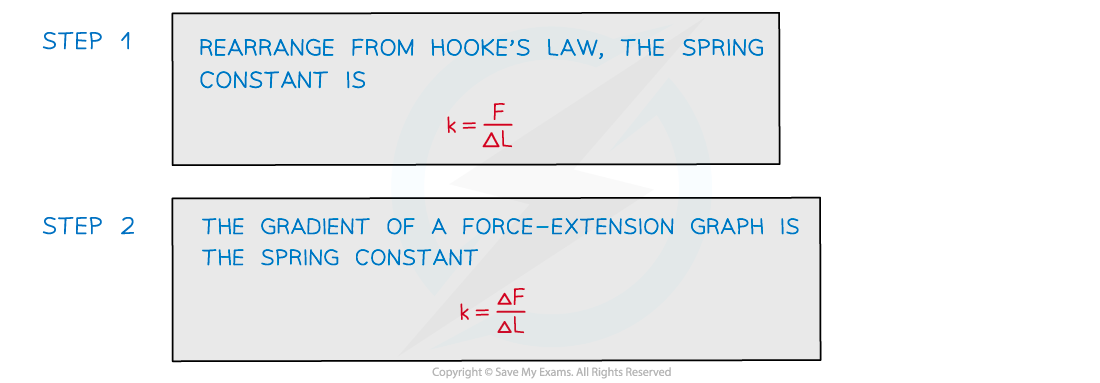
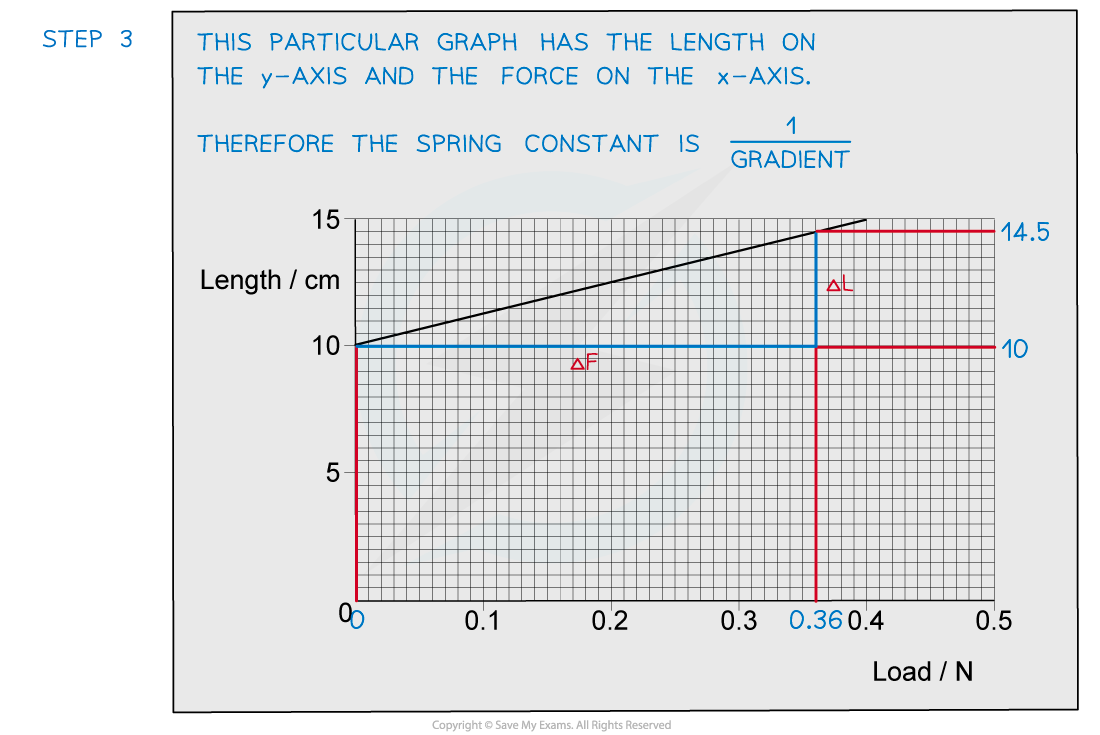
A spring was stretched with increasing load.
The graph of the results is shown below.

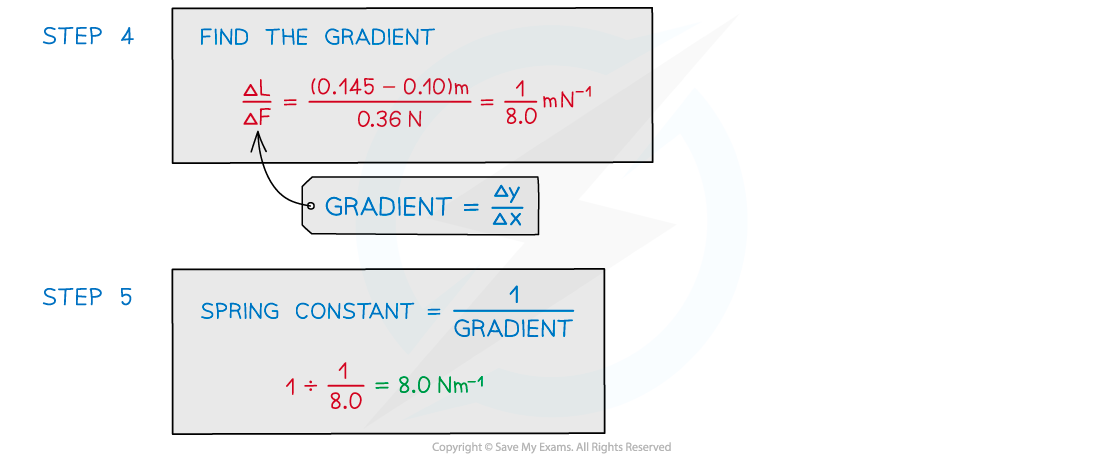
What is the spring constant?
Answer:
Examiner Tips and Tricks
Always double-check the axes before finding the force constant as the gradient of a force-extension graph. Exam questions often swap the force (or load) onto the x-axis and extension (or length) on the y-axis. In this case, the gradient is not the force constant, it is 1 ÷ gradient instead.

Unlock more, it's free!
Join the 100,000+ Students that ❤️ Save My Exams
the (exam) results speak for themselves:

Was this revision note helpful?
Build on this topic
