Geostationary Orbits (OCR A Level Physics): Revision Note
Exam code: H556

Geostationary Orbits & Satellites
Many communication satellites around Earth follow a geostationary orbit
This is sometimes referred to as a geosynchronous orbit
This is a specific type of orbit in which the satellite:
Remains directly above the equator
Is in the plane of the equator
Always orbits at the same point above the Earth’s surface
Moves from west to east (same direction as the Earth spins)
Has an orbital time period equal to Earth’s rotational period of 24 hours
Geostationary satellites are used for telecommunication transmissions (e.g. radio) and television broadcast
A base station on Earth sends the TV signal up to the satellite where it is amplified and broadcast back to the ground to the desired locations
The satellite receiver dishes on the surface must point towards the same point in the sky
Since the geostationary orbits of the satellites are fixed, the receiver dishes can be fixed too
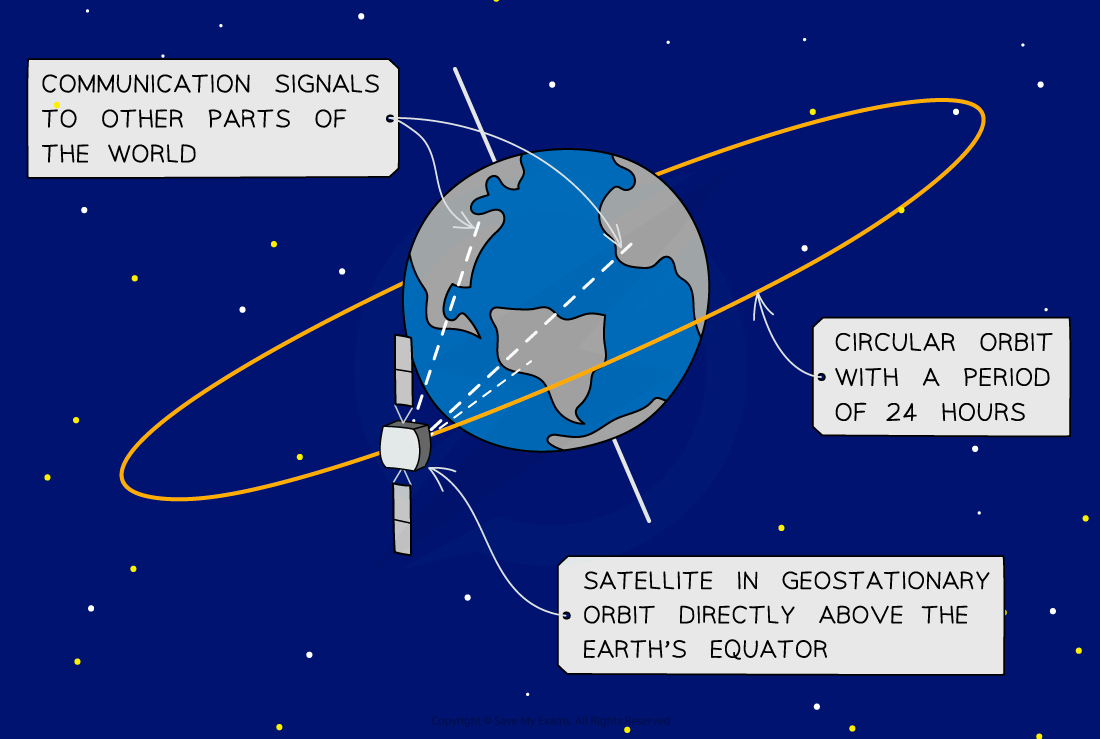
Geostationary satellite in orbit
Worked Example
Calculate the distance above the Earth's surface that a geostationary satellite will orbit.
Mass of the Earth = 6.0 × 1024 kg
Radius of the Earth = 6400 km
Answer:

Examiner Tips and Tricks
Make sure to memorise the key features of a geostationary orbit, since this is a common exam question. Remember:
Equatorial orbit
Moves west to east
Period of 24 hours
You will also be expected to remember that the time period of the orbit is 24 hours for calculations on a geostationary satellite.

Unlock more, it's free!
Join the 100,000+ Students that ❤️ Save My Exams
the (exam) results speak for themselves:

Was this revision note helpful?
Build on this topic