Braking & Reaction Times (OCR A Level Physics): Revision Note
Exam code: H556

Braking & Reaction Times
The stopping distance of a car is the distance it travels in the time it takes to stop in response to an emergency
The stopping distance consists of two parts:
The thinking distance
The braking distance
Therefore, the stopping distance is equal to:
Stopping distance = Thinking distance + Braking distance
The graph below shows how the velocity of a car will typically change during an emergency stop

A velocity-time graph for a stopping car showing thinking and braking distance
The stopping distance increases considerably with the speed of a car
This is mostly because a car will travel further whilst braking before coming to rest
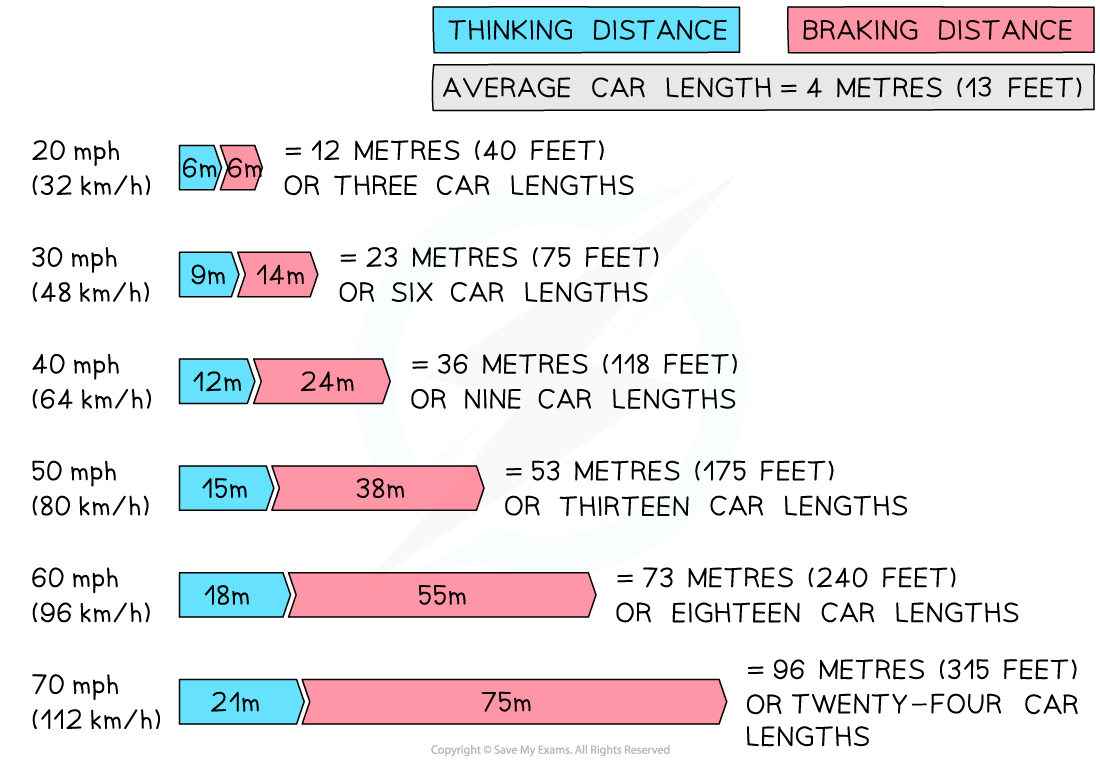
Estimate of stopping distances for various speeds
The image illustrates the following important principles:
The thinking distance increases proportionally with speed (i.e. if speed doubles, the thinking distance doubles)
The braking distance increases at an even faster rate with speed
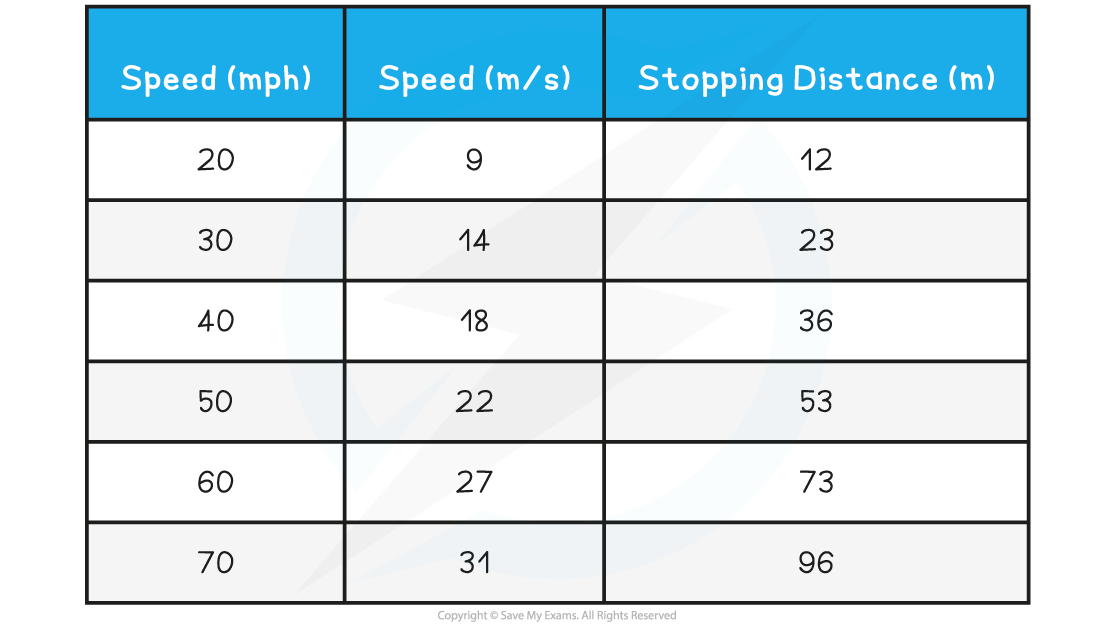
For a typical family car, these speeds and stopping distances are summarised in the table below:
Table of Stopping Distances for a Family Car
Thinking Distance
Thinking distance is defined as:
The distance travelled by the vehicle from when the driver sees a problem and the brakes are applied
The thinking distance is proportional to the initial speed, u, of the vehicle
The thinking distance can be calculated from:
Thinking distance = Initial speed × Reaction time
Where:
Reaction time = the time taken by the driver to respond to the problem
Factors that affect thinking distance are:
The initial speed of the vehicle
Intoxication ie. consumption of alcohol or drugs
Distractions ie. using a mobile phone
Tiredness (since reaction times increase when tired)
Braking Distance
Braking distance is defined as:
The distance travelled by the vehicle after the driver has applied the brake
The braking distance of the vehicle is proportional to the square of the initial speed of the car, u2
This is because all of the vehicle’s kinetic energy (½ mv2) must be dissipated by the brakes in order to come to a stop
The work done by the brakes is given by:
Work Done = Braking Force × Braking Distance = ½ mv2
Factors that affect braking distance are:
The initial speed of the vehicle
Mass of the vehicle
Poor road conditions eg. icy, wet
Car conditions eg. worn brakes

Unlock more, it's free!
Join the 100,000+ Students that ❤️ Save My Exams
the (exam) results speak for themselves:

Was this revision note helpful?
Build on this topic