The Doppler Effect (OCR A Level Physics): Revision Note
Exam code: H556

The Doppler Effect
If a wave source is stationary, the wavefronts spread out symmetrically
If the wave source is moving, the waves can become squashed together or stretched out
If the wave source is moving towards an observer the wavefronts will appear squashed
If the wavefront is moving away from an observer the wavefronts will appear stretched out
Therefore, when a wave source moves relative to an observer there will be a change in the observed frequency and wavelength
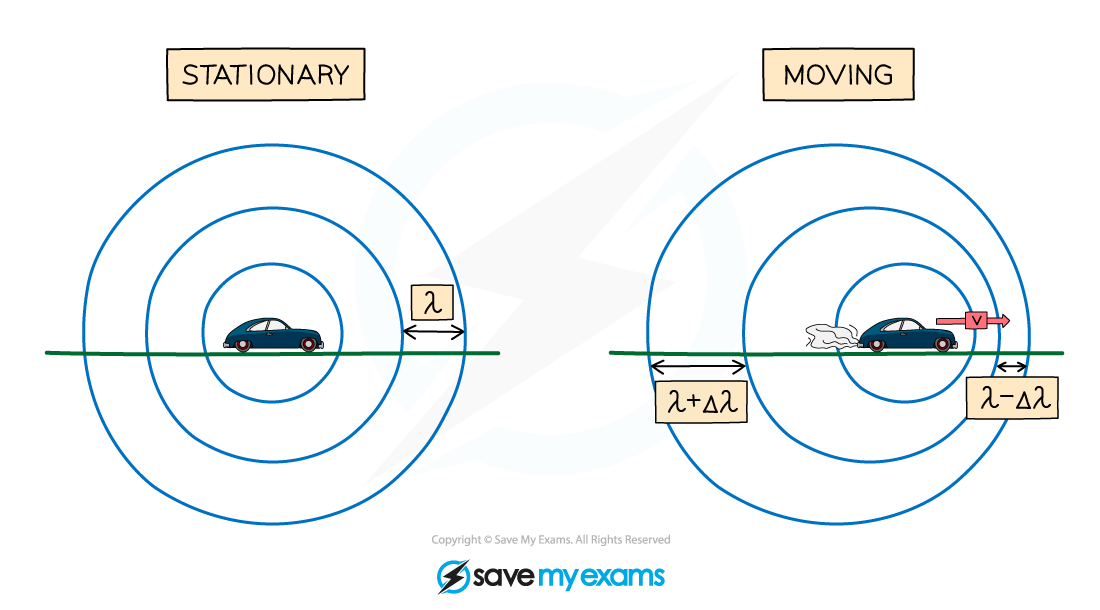
Wavefronts are even in a stationary object but are squashed in the direction of the moving wave source
A moving object will cause the wavelength, λ, (and frequency) of the waves to change:
The wavelength of the waves in front of the source decreases (λ – Δλ) and the frequency increases
The wavelength behind the source increases (λ + Δλ) and the frequency decreases
Note: Δλ means 'change in wavelength'
The actual wavelength emitted by the source remains the same
It is only the wavelength that is received by the observer that appears to have changed
This effect is known as the Doppler effect or Doppler shift
The Doppler effect is defined as:
The apparent shift in wavelength occurring when the source of the waves is moving
The Doppler effect, or Doppler shift, can be observed using any form of electromagnetic radiation
It can be observed by comparing the light spectrum produced from a close object, such as our Sun, with that of a distant galaxy
The light from the distant galaxy is shifted towards the red end of the spectrum (There are more spectral lines in the red end)
This provides evidence that the universe is expanding
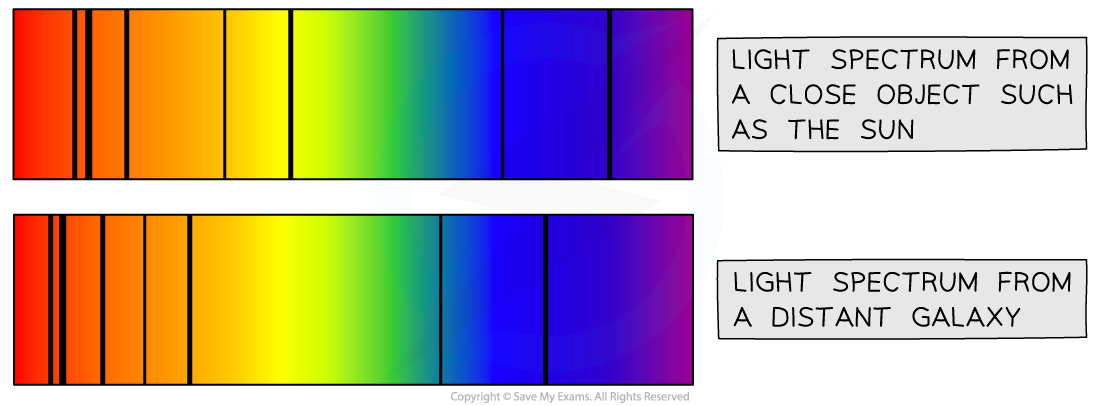
Comparing the light spectrum produced from the Sun and a distant galaxy
The Doppler Equation
Doppler shift (Doppler effect) describes how the wavelength (or frequency) of waves change when the source of the waves and observer are moving relative to each other
If the relative speed between the source of the waves and the observer, ∆v, is small compared to the speed at which the wave is travelling, c, then the Doppler wavelength shift, ∆λ, and frequency shift, ∆f, is given by:
Where:
Δv = relative speed between source and observer (m s–1)
c = speed of the wave (m s–1)
Δf = observed change in frequency between moving source and stationary source of wave (Hz)
f = unshifted frequency of the wave emitted (Hz)
Δλ = observed change in wavelength between moving source and stationary source of wave (m)
λ = unshifted wavelength of the wave emitted (m)
The relative speed between source and observer along the line joining them is give by:
∆v = vs – vo
Where:
vs = velocity of electromagnetic waves source
vo = velocity of observer
Usually, we are calculating the speed of the source of electromagnetic waves relative to an observer which we assume to be stationary
Therefore vo = 0, hence ∆v = vs = v
Where v is the velocity at which the source of the electromagnetic waves is moving from the observer
Hence, the Doppler shift equation can therefore be written as:
Worked Example
A stationary source of light is found to have a spectral line of wavelength 438 nm. The same line from a distant star that is moving away from us has a wavelength of 608 nm.
Calculate the speed at which the star is travelling away from Earth.
Answer:
Step 1: List the known quantities
Unshifted wavelength = λ = 438 nm = 438 × 10–9 m
Shifted wavelength = 608 nm = 608 × 10–9 m
Change in wavelength = ∆λ = (608 – 438) × 10–9 = 170 × 10–9 m
Speed of light = c = 3.00 × 10⁸ m s–1
Step 2: State the Doppler shift equation
Step 3: Substitute values to calculate v
v = = = 1.16 × 10⁸ m s–1
Examiner Tips and Tricks
You need to know that in the visible light spectrum red light has the longest wavelength and the smallest frequency compared to blue light which has a shorter wavelength and higher frequency.

Unlock more, it's free!
Join the 100,000+ Students that ❤️ Save My Exams
the (exam) results speak for themselves:

Was this revision note helpful?
Build on this topic
