How to Answer 5 Mark Decision-Making Questions (Cambridge (CIE) IGCSE Geography): Revision Note
Syllabus Edition
First teaching 2025
First exams 2027
Exam code: 0460 & 0976

What is a decision-making question?
The 5-mark questions in Paper 1 and Paper 2 are Section B, Question 3 b(ii)
The questions give you information about different options and ask you to choose between them
This tests a specific AO3 skill: "make and justify a decision based upon information provided."
Command phrases and assessment objectives
This question uses the command phrase "justify your decision"
The question tests:
AO3 (Evaluation and decision-making)
How this question is marked
Unlike the longer 7-mark decision making question, these are point-marked, not levels-marked
You are awarded marks for specific content points, with one mark specifically reserved for your evaluation or judgement
You're reading resources rather than recalling your own knowledge, and you must commit to one option, not just weigh up pros and cons in the abstract
How marks are awarded
Up to 4 marks for relevant points
Either four simple points, or fewer points developed further (a point plus its development counts as 2 marks)
1 mark is reserved specifically for a stated evaluation or judgement
This means you cannot get full marks from a list of facts alone, however accurate
The judgement mark only comes from an evaluative statement
Structuring your answer
Give three to four relevant points (advantages of the plan you have selected and disadvantages of the plans you have rejected), briefly developed rather than just named
Finish your answer with a clear evaluative sentence
A word like "however", "overall" or "ultimately" is often the signal that you have reached your judgement
Assessment objectives
These 5 mark questions are used to assess AO3: Evaluation and decision-making
This means you are expected to:
Evaluating the importance of geographical factors, processes and change
Recognise the limitations of data, theories and models
Evaluate the impact of different values and attitudes in environmental management; making and justifying decisions
Weigh up the options available to decision-makers
Evaluating the success of management strategies, including sustainable approaches
Worked Example
Study Table 3.1, which shows three plans which the government of a country in Africa is considering to sustainably manage the tropical rainforest.
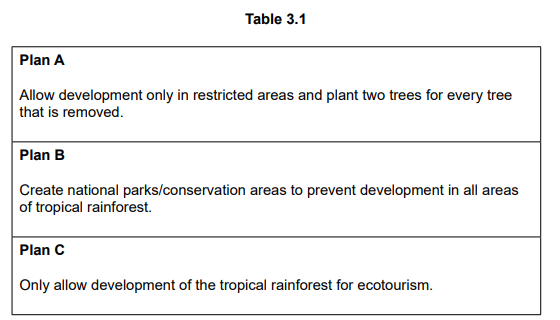
Choose the plan that you think will be the most effective in sustainably managing the tropical rainforest. Justify your decision.
Answer
Plan chosen - A
Justification - Plan A has several advantages by restricting the places where development can happen it will prevent large scale destruction [1] and the development can be focussed on areas which do not contain sensitive ecosystems [d]. The planting of trees also means that more trees will be planted than removed [1]. However, there are disadvantages such as the new trees planted will take time to grow [1] but the advantages of this plan outweigh the disadvantages [1].
The command word is 'justify' this means the answer needs to include valid reasons to support the point of view given. The answer must explain why it is the best option.
Mark allocation
1 mark for evaluation/judgement [1]
1 mark for each simple point [1]
1 mark for each developed point [d]
Answers can be either:
4 simple points plus evaluation
1 developed point plus 2 simple points plus evaluation
2 points which are developed plus evaluation
Common errors
Common errors where students lose marks include:
Not including judgement or evaluation within the answer
Alternative content
The answer above is just one example of a response to this question. Other information that could be used in the answer includes:
Plan B
The area will be conserved
Ecosystems will not be destroyed
Resources will not be exploited
May affect the growth of the economy
Plan C
Development can be controlled
The community can be involved in decision making/jobs
Many areas have already been destroyed

Unlock more, it's free!
Join the 100,000+ Students that ❤️ Save My Exams
the (exam) results speak for themselves:

Was this revision note helpful?