Wave Behaviour (Cambridge (CIE) IGCSE Physics): Revision Note
Exam code: 0625 & 0972

Reflection, refraction & diffraction
All waves, whether transverse or longitudinal, can undergo:
reflection at a plane surface
refraction due to a change of speed
diffraction through a narrow gap
The material a wave travels through is called a medium
When referring to more than one medium, these are called media
Reflection
Reflection occurs when:
A wave hits the boundary between two media and bounces back, staying in the original medium instead of passing through
An example of reflection

Refraction
When waves enter a different medium, their speed can change
This effect is called refraction, and it occurs when:
A wave passes a boundary between two different media and undergoes a change in speed
When a wave refracts, the wave undergoes:
a change in speed
a change in wavelength
a change in direction
no change in frequency
An example of refraction
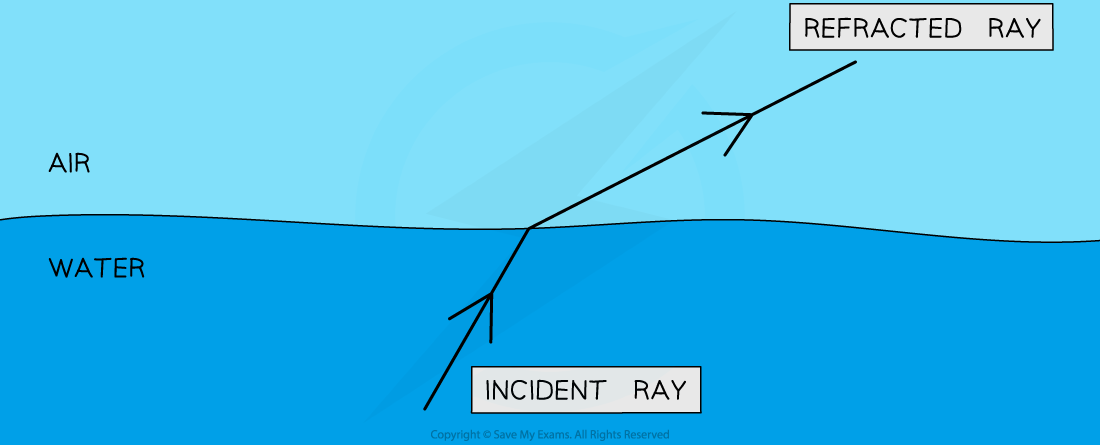
The direction of the incident and refracted rays (opens in a new tab) is also taken from the normal line
If the waves slow down, they will bunch together, causing the wavelength to decrease
The waves will also start to turn slightly towards the normal
If the waves speed up then they will spread out, causing the wavelength to increase
The waves will also turn slightly away from the normal
Diffraction
When waves pass through a narrow gap, the waves spread out
This effect is called diffraction
Waves diffracting through a narrow gap
diffracted,
Examiner Tips and Tricks
When drawing waves being reflected, take care to:
Make sure that the angle of incidence is equal to the angle of reflection
Keep the wavelength of the waves the same
Similarly, when waves are diffracted the wavelength remains constant.
Refraction is the only wave effect in which the wavelength changes.
Refraction is the name given to the change in the speed of a wave when it passes from one medium to another. The change in direction is a consequence of this.
Factors affecting diffraction
Extended Tier Only
The extent of diffraction depends on the width of the gap compared with the wavelength of the waves
Diffraction is greatest when the wavelength of the wave is similar to (or equal to) the width of the gap
As the gap gets bigger, the effect gradually gets less pronounced until, in the case that the gap is very much larger than the wavelength, the waves no longer spread out at all

Diffraction can also occur when waves curve around an edge or barrier
The waves spread out into the region behind the object
The extent of this diffraction also depends upon the wavelength of the waves
The greater the wavelength, the greater the diffraction

Examiner Tips and Tricks
When you are asked to draw wavefronts diffracting through a narrow gap, make sure that you draw semi-circular crests centred on the gap when its size is similar to the wavelength, and ensure that the wavelength is unchanged.

Unlock more, it's free!
Join the 100,000+ Students that ❤️ Save My Exams
the (exam) results speak for themselves:

Was this revision note helpful?
Build on this topic