Condensation Polymers (Edexcel IGCSE Chemistry): Revision Note
Exam code: 4CH1

Condensation polymers
Condensation polymers are formed when two different monomers are linked together with the removal of a small molecule, usually water
This is a key difference between condensation polymers and addition polymers:
Addition polymerisation forms the polymer molecule only
Condensation polymerisation forms the polymer molecule and one water molecule per linkage
The monomers have two functional groups present, one on each end
The functional groups at the ends of one monomer react with the functional group on the end of the other monomer, in so doing creating long chains of alternating monomers, forming the polymer
Polyesters are formed from two different monomers and produce water
For every ester linkage formed in condensation polymerisation, one molecule of water is formed from the combination of a -H and an -OH group
An example is terylene which is a polyester made from dicarboxylic acid monomers (a carboxylic acid with a -COOH group at either end) and diols (an alcohol with an -OH group at either end)
Each -COOH group reacts with another -OH group on another monomer
An ester linkage is formed with the subsequent loss of one water molecule per link
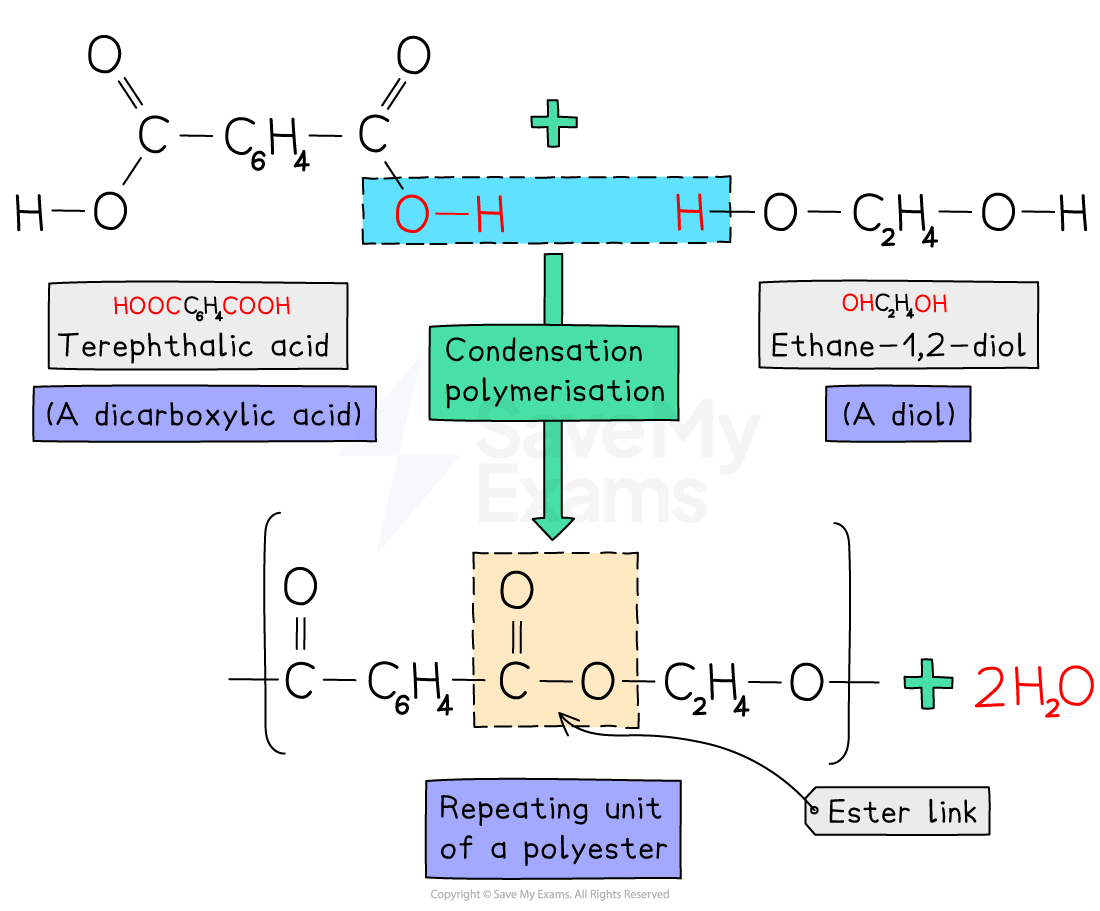
The condensation reaction in which the polyester terylene is produced
The structure of terylene can be represented by drawing out the polymer using boxes to represent the carbon chains
This can be done for all polyesters

Diagram showing a section of the polyester terylene
Examiner Tips and Tricks
Look at the ester links along the chain. They face opposite ways in turn (-COO- then -OOC-) because each monomer has the same functional group at both ends
Do not draw every ester link facing the same way
Worked Example
Propanedioic acid and ethanediol react to form a polyester. The displayed formulae of the two monomers are shown.
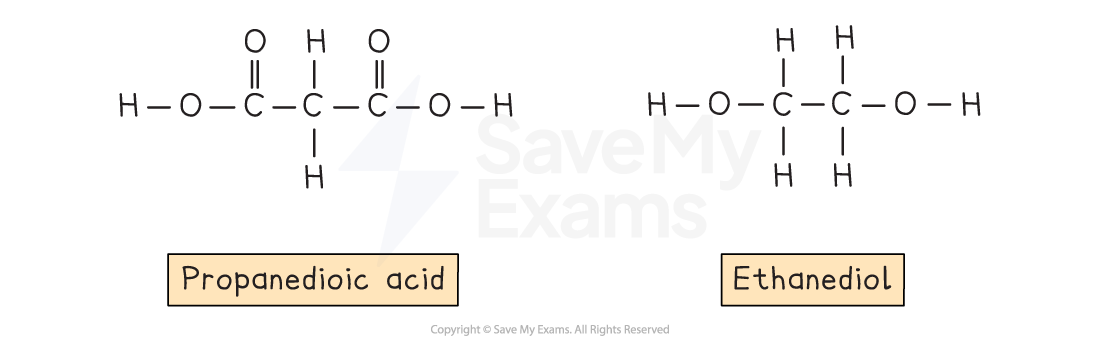
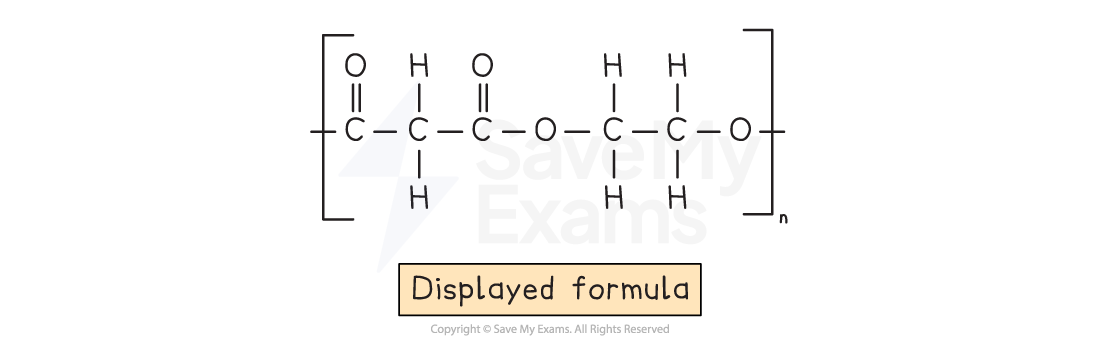
(a) Draw the displayed formula of the repeat unit of this polyester.
(b) Write the structural formula of the repeat unit.
Answer:
(a)
Step 1: Join the monomers with ester links
The two types of monomer alternate along the chain:
propanedioic acid → ethanediol → propanedioic acid → ethanediol
Each propanedioic acid molecule has a –COOH group at both ends
Each ethanediol molecule has an –OH group at both ends
Where a –COOH group reacts with an –OH group:
–OH is removed from the –COOH group
H is removed from the –OH group
These two form H2O
The remaining atoms join to form an ester link, –COO–
Since each monomer has a functional group at both ends, the reaction can continue to form a long polymer chain
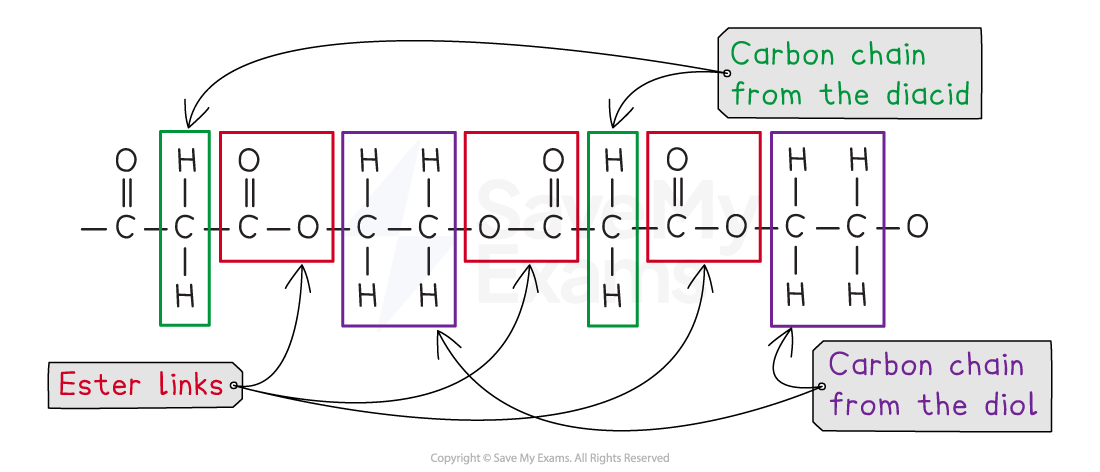
Step 2: Find the smallest repeating section
The same arrangement of atoms appears repeatedly along the polyester chain
One coloured section represents one repeat unit
The repeat unit contains atoms from one ethanediol molecule and one propanedioic acid molecule
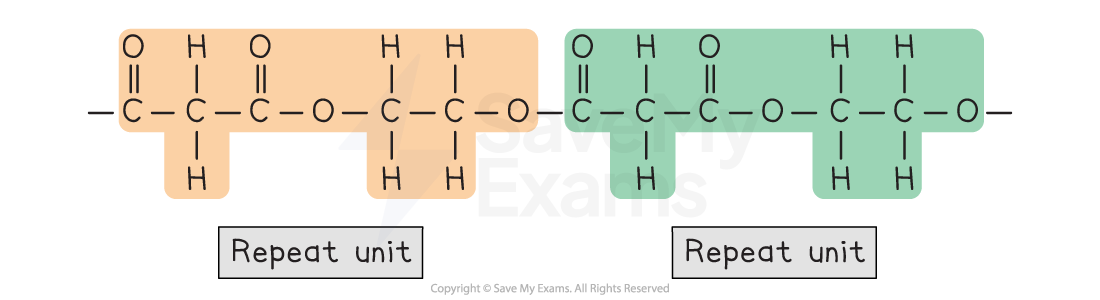
Step 3: Draw the repeat unit
The displayed formula should show:
Every atom and bond
The two C=O bonds
The –CH2– from propanedioic acid
The ester links
A bond extending through the bracket at each end
Brackets and n are good practice, although mark schemes do not require them for a repeat unit
(b)
Start from the displayed formula and write the atoms in the same order without showing the bonds
Keep the order of the atoms, so it is clear which atom is bonded to which
–[COCH2COOCH2CH2O]n–
Worked Example
Ethanedioic acid and ethanediol react to form a polyester. The displayed formulae of the two monomers are shown.
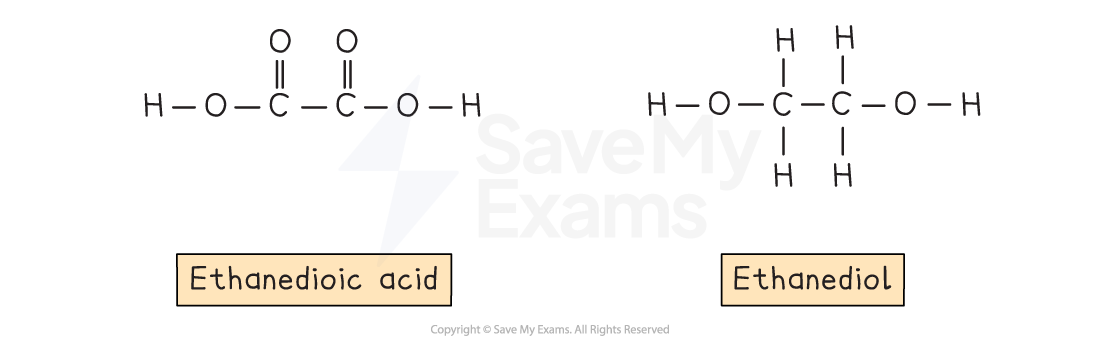
(a) Draw the displayed formula of the repeat unit of this polyester.
(b) Write the structural formula of the repeat unit.
Answer:
(a)
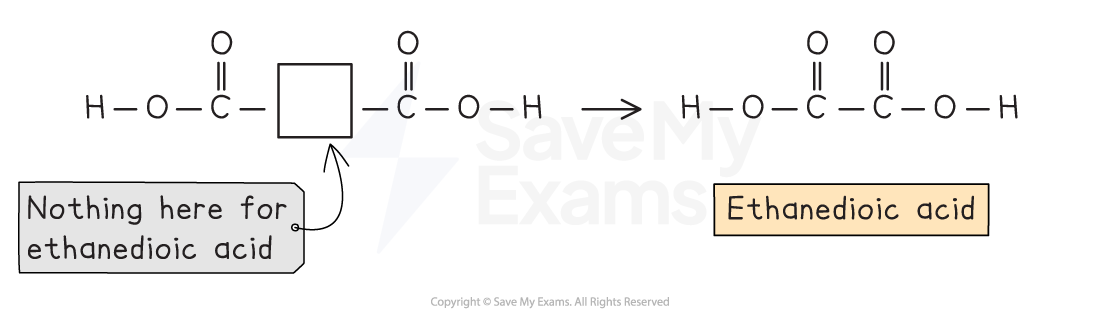
Step 1: Compare the acid with the general dicarboxylic acid

In the block diagram of terylene, a dicarboxylic acid is a carbon chain (the box) with a –COOH group at each end: HOOC–[box]–COOH
Ethanedioic acid is HOOC–COOH
There is nothing between the two –COOH groups, so the box is empty and the two carbon atoms are bonded directly to each other
Step 2: Join the monomers with ester links
This works in exactly the same way as in Worked Example 1
The two types of monomer alternate along the chain
ethanedioic acid → ethanediol → ethanedioic acid → ethanediol
Each ethanedioic acid molecule has a –COOH group at both ends
Each ethanediol molecule has an –OH group at both ends
Where a –COOH group reacts with an –OH group:
–OH is removed from the –COOH group
H is removed from the –OH group
These two form H2O
The remaining atoms join to form an ester link, –COO–
Step 3: Draw the repeat unit
The repeat unit contains atoms from one ethanedioic acid molecule and one ethanediol molecule
The two C=O groups sit side by side, because ethanedioic acid has no carbon atoms between its two –COOH groups
This is correct; it is not two ester links drawn by mistake

(b)
Write the atoms of the displayed formula in the same order, without showing the bonds
–[COCOOCH2CH2O]n–
Examiner Tips and Tricks
For a polyester made from a dicarboxylic acid and a diol:
Keep the carbon chains of both monomers
Remove the atoms that form water
Join the monomers using –COO– ester links
Find the smallest section that repeats
Place it inside brackets with n outside as good practice
Two ester links form for each repeat unit, so two molecules of water form for every repeat unit
n dicarboxylic acid + n diol → polyester + 2n H2O
Deducing the monomers from a polyester
If you are given the structure of a polyester, you can deduce the diol and dicarboxylic acid used to form it
It helps to think of this as the reversal of the formation of a polyester
When a polyester is formed, small molecules of water are removed
The OH comes from the acid / -COOH groups of the dicarboxylic acid
The H comes from the alcohol / -OH groups of the diol
To reverse this, water is added to the polyester which allows it to break back down into its monomers - this process is known as hydrolysis
Take the polyester, polybutylene terephthalate (PBT), as an example:

Diagram showing a section of the polyester polybutylene terephthalate, PBT
Identify the ester / -COO- linkages in the polymer
Separate the polymer into its two component monomers by breaking the C-O single bond in the ester linkage

This leaves 2 different structures:

Water is used to complete the molecules
Remember: When the polyester was made, the dicarboxylic acid lost OH groups and the diol lost H atoms
OH groups are added to the C=O carbon on one structure forming the two carboxylic acid / -COOH groups of the dicarboxylic acid
H atoms are added to the oxygen atoms on the other structure forming the two alcohol / -OH groups of the diol
The resulting molecules are the two monomers that are used to form polybutylene terephthalate, PBT

A diagram to show the two monomers used to form the polyester polybutylene terephthalate, PBT
Biopolyesters
Biopolyesters are polyesters that are biodegradable
After use, they can be broken down naturally in the environment by microorganisms such as bacteria
Some are made from sugars and plant oils using microorganisms

The biodegradation of a bottle made of biopolyesters

Unlock more, it's free!
Join the 100,000+ Students that ❤️ Save My Exams
the (exam) results speak for themselves:

Was this revision note helpful?
Build on this topic