Bearings (Cambridge (CIE) IGCSE Maths: Extended): Revision Note
Exam code: 0580 & 0980

Bearings
What are bearings?
Bearings are a way of describing an angle
They are commonly used in navigation
There are three rules which must be followed when using a bearing:
They are measured from North
North is usually straight up on a scale drawing or map, and should be labelled on the diagram
They are measured clockwise
The angle should always be written with 3 digits
059° instead of just 59°
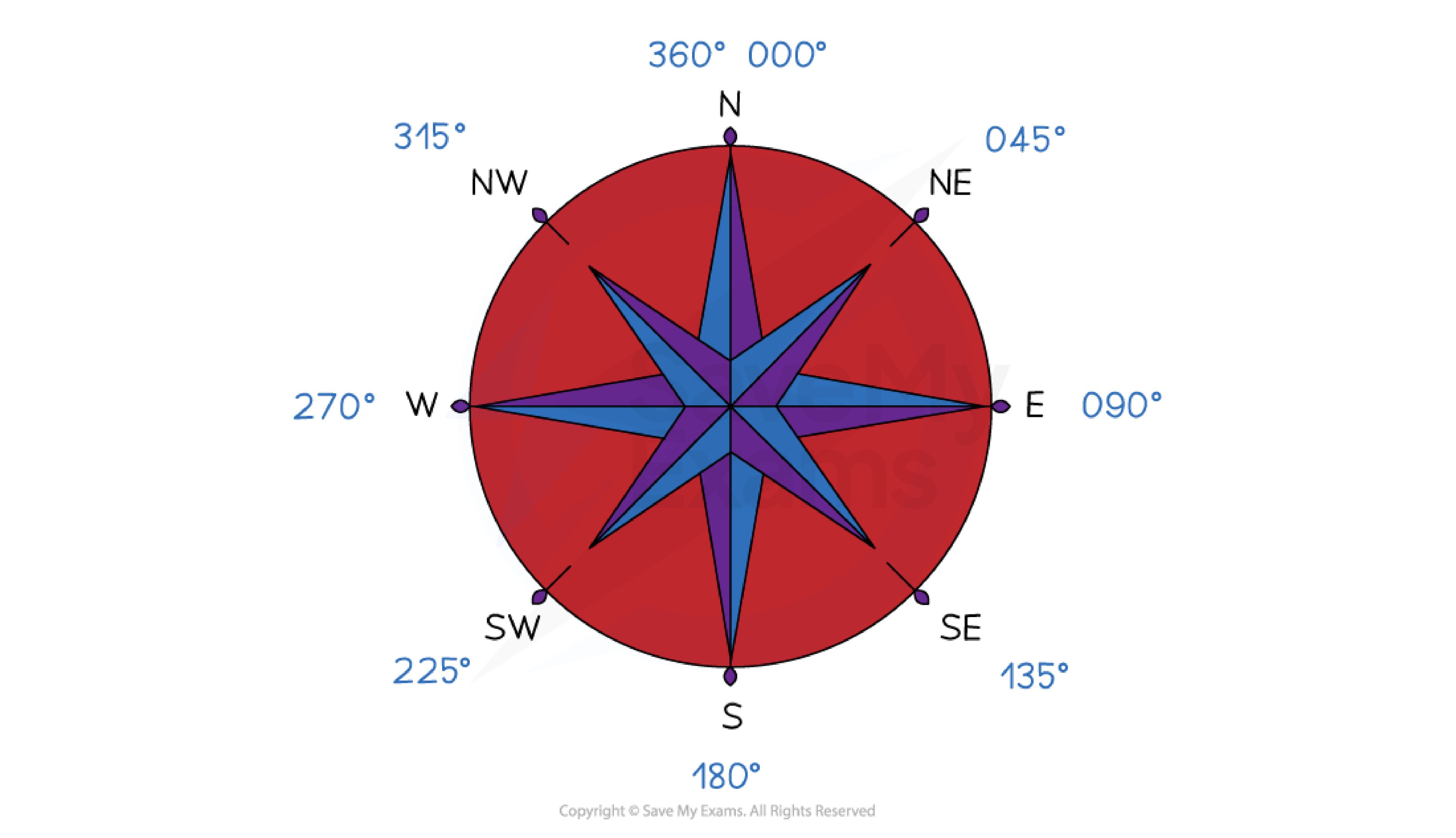
Knowing the compass directions and their respective bearings can be helpful
How do I find a bearing between two points?
Identify where you need to start
"The bearing of A from B" means start at B and find the bearing to A
"The bearing of B from A" means start at A and find the bearing to B
Draw a North line at the starting point
Draw a line between the two points
Measure the angle between the North line and the line joining the points
Measure clockwise from North
Write the angle using 3 figures
How do I draw a point on a bearing?
You might be asked to plot a point that is a given distance from another point and on a given bearing
STEP 1
Draw a North line at the point you wish to measure the bearing fromIf you are given the bearing from A to B draw the North line at A
STEP 2
Measure the angle of the bearing given from the North line in the clockwise directionSTEP 3
Draw a line and add the point B at the given distance
How do I find the bearing of B from A if I know the bearing of A from B?
If the bearing of A from B is less than 180°
Add 180° to it to find the bearing of B from A
If the bearing of A from B is more than 180°
Subtract 180° from it to find the bearing of B from A
How do I answer trickier questions involving bearings?
Bearings questions may involve the use of Pythagoras or trigonometry to find missing distances (lengths) and directions (angles)
You should always draw a diagram if there isn't one given
Examiner Tips and Tricks
Make sure you have all the equipment you need for your maths exams.
A rubber and pencil sharpener can be essential as these questions are all about accuracy. Make sure you can see and read the markings on your ruler and protractor.
Examiner Tips and Tricks
Always draw a big, clear diagram and annotate it, be especially careful to label the angles in the correct places!
Worked Example
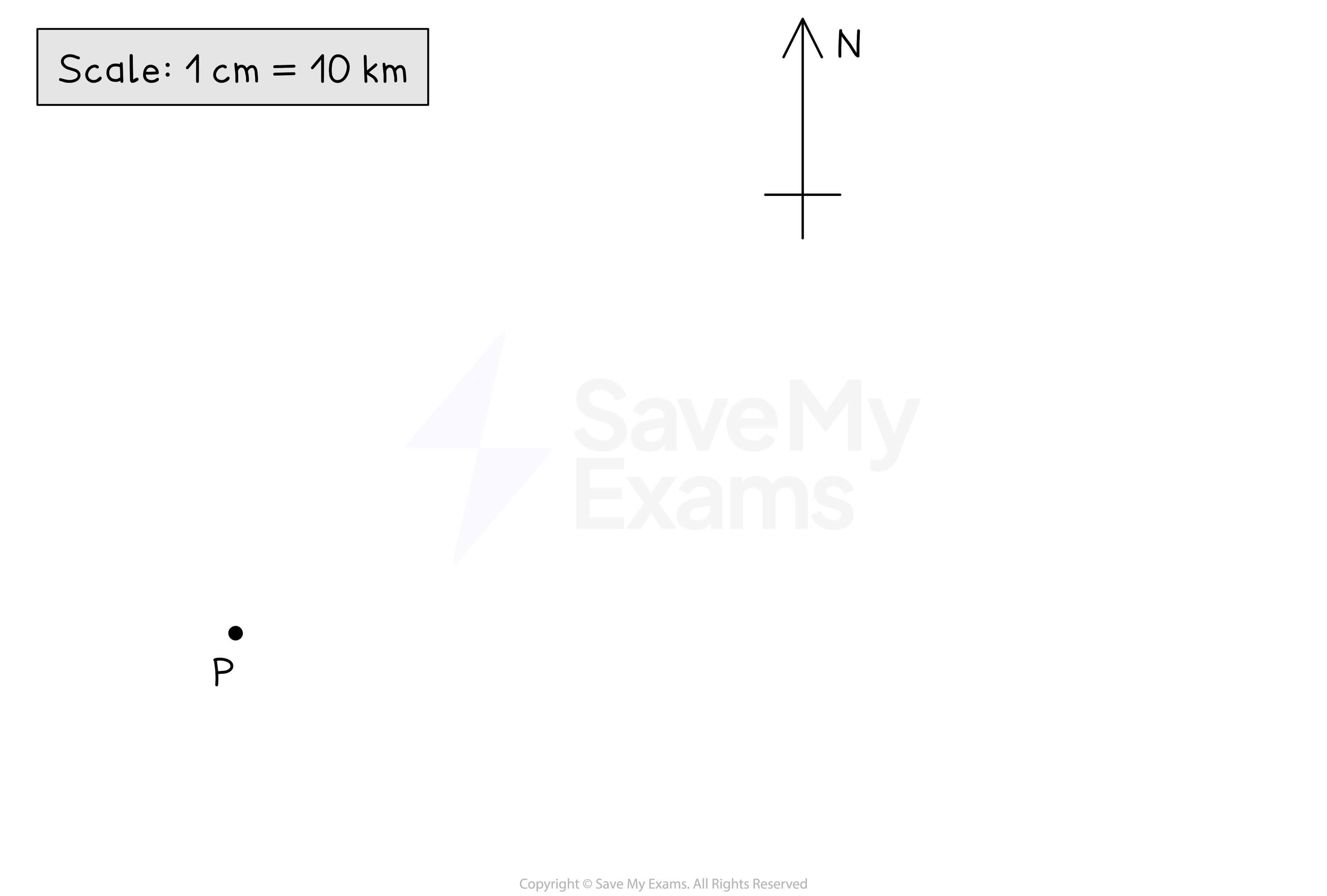
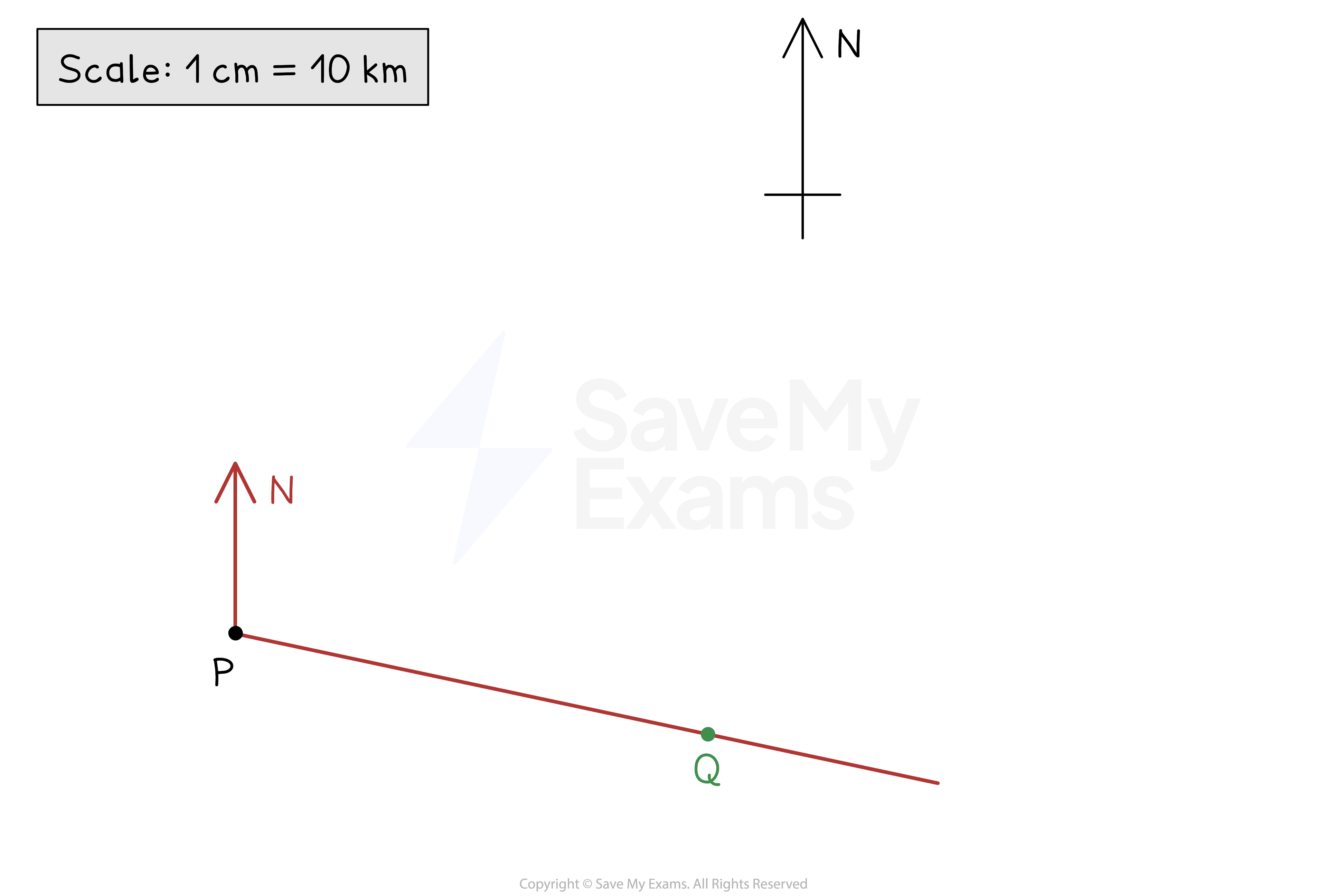
A ship sets sail from the point P, as shown on the map below.
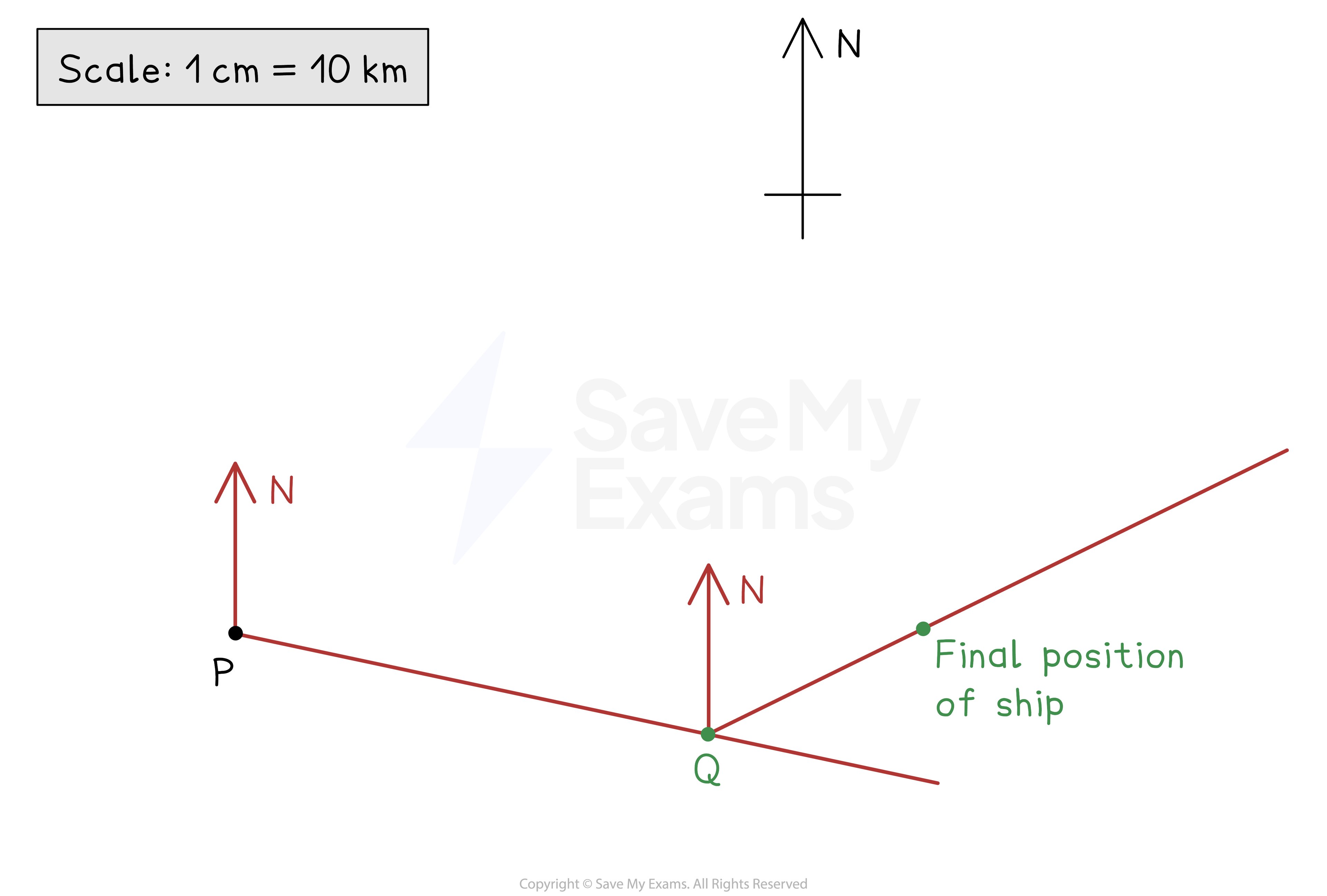
It sails on a bearing of 105° until it reaches the point Q, 70 km away. The ship then changes path and sails on a bearing of 065° for a further 35 km, where its journey finishes.
Show on the map below the point Q and the final position of the ship.
Answer:
Draw in a north line at the point P
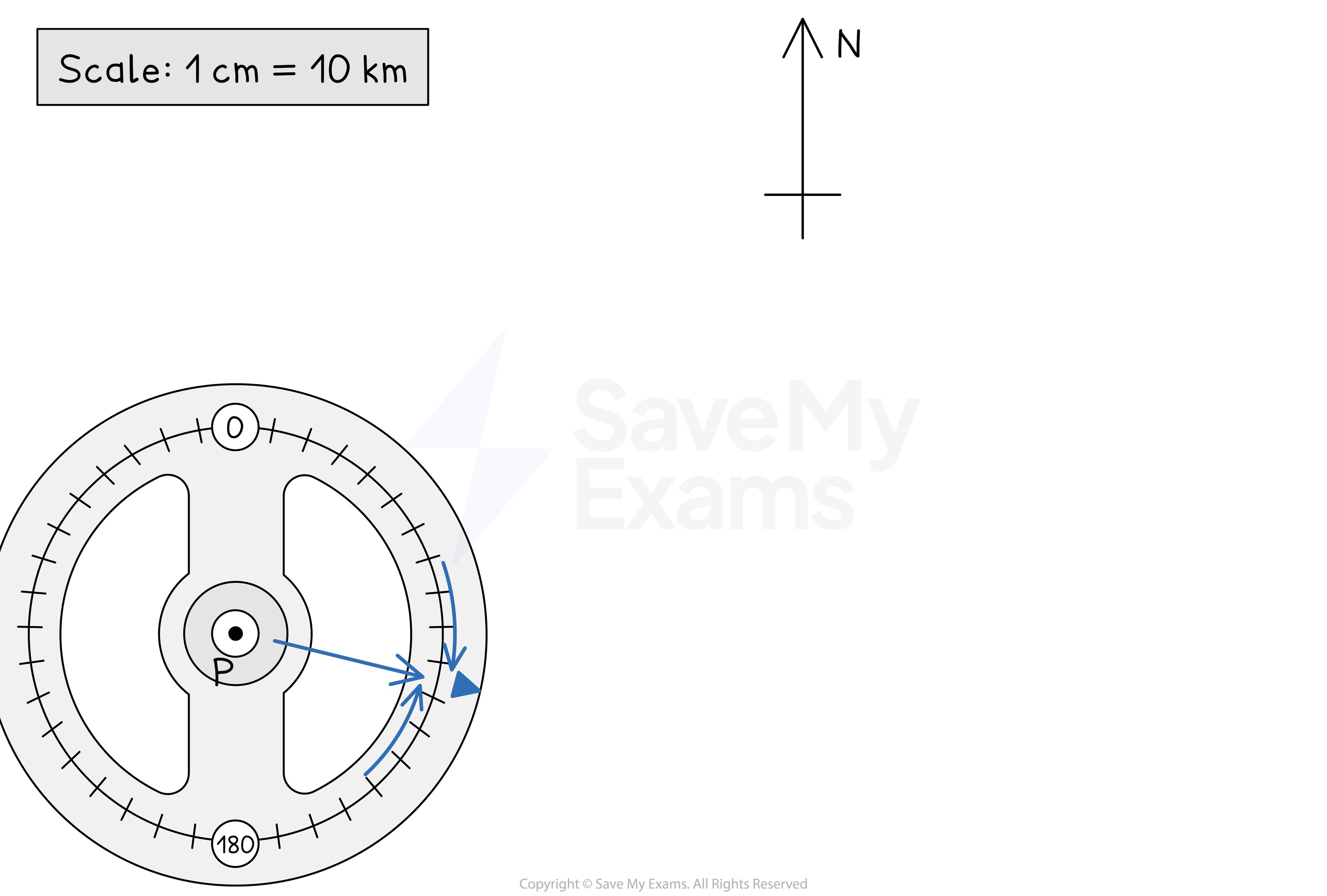
Measure an angle of 105° clockwise from the north line
Making sure you are accurate, carefully make a small but visible mark on the map
Draw a line from P through the mark you have made. Make this line long so that you can easily measure along it accurately
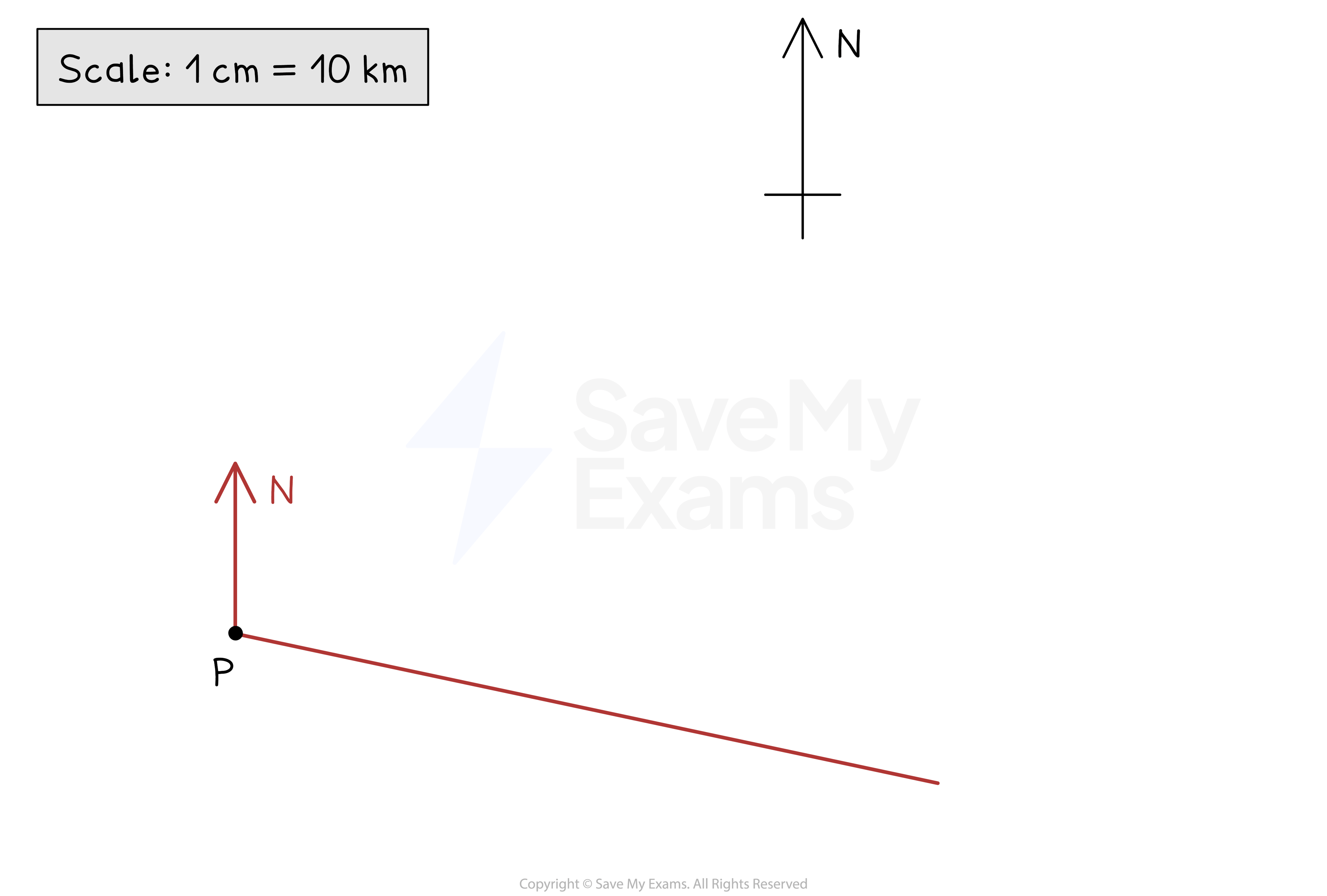
Use the scale given on the map (1 cm = 10 km) to work out the number of cm that would represent 70 km
70 km = 70 ÷ 10 = 7 cm
Accurately measure 7 cm from the point P along the line and make a clear mark on the line
Label this point Q
A bearing of 065 means 65° clockwise from the North
First, draw a North line at the point Q, then carefully measure an angle of 65° clockwise from this line. Make a mark and then draw a line from Q through this mark
Using the scale, find the distance in cm along the line you will need to measure.
35 km = 35 ÷ 10 = 3.5 cm
Accurately measure 3.5 cm from the point Q along this new line and make a clear mark on the line
This is the final position of the ship.

Unlock more, it's free!
Join the 100,000+ Students that ❤️ Save My Exams
the (exam) results speak for themselves:

Was this revision note helpful?
Build on this topic
Questions students ask about Bearings
Real questions from students revising this topic on Save My Exams
What is a back bearing?
A back bearing is the bearing for the return journey: if you know the bearing of A from B, the back bearing is the bearing of B from A, and the two always differ by exactly 180°.
- If the original bearing is less than 180°, add 180°
- If it is more than 180°, subtract 180°
- Write the answer with 3 digits
It works because the two directions point opposite ways along the same line, and opposite directions are 180° apart.
Example using this page's ship: the ship sails from P to Q on a bearing of 105°.
- 105° is less than 180°, so add: 105° + 180° = 285°
- So the bearing of P from Q is 285°
Going back the other way: 285° is more than 180°, so 285° − 180° = 105°.
One more: a bearing of 260° gives 260° − 180° = 080° — keep the leading zero.
How do you measure a bearing?
Put a North line at the starting point, then measure the angle clockwise from that North line round to the line joining the two points, and write it with 3 digits.
- Work out where to start — “the bearing of B from A” means start at A
- Draw a North line at the starting point, straight up and parallel to the North arrow on the map
- Draw a straight line joining the two points
- Place the centre of your protractor exactly on the starting point, with 0 lined up along the North line
- Read the angle clockwise from North round to the joining line
- Write it with three digits — 59° becomes 059°
Example from this page: the ship sails from P on a bearing of 105°. Draw a North line at P, measure 105° clockwise, mark it and draw a long line from P through the mark. The scale is 1 cm = 10 km, so 70 km is 7 cm along that line, giving Q.
Compass points check your answer: East 090°, South 180°, West 270°.
How do you draw a bearing greater than 180°?
Measure it clockwise from North as usual, but a half-circle protractor only reaches 180°, so either use a full-circle protractor or measure from a South line instead.
With a 360° protractor:
- Centre on the point, 0 on the North line, then read clockwise all the way round — this is the protractor shown in this page's worked example
With a standard 180° protractor:
- Draw the North line and extend it straight down to make a South line
- Subtract 180° from your bearing
- Turn the protractor upside down, 0 on the South line
- Measure that angle clockwise from South, then mark and draw your line
Example: a bearing of 285°, the return bearing from Q to P in this page's ship question.
- 285° − 180° = 105°, so measure 105° clockwise from the South line
- Or measure 360° − 285° = 75° anticlockwise from North
- Sanity-check with compass points: 270° is West, so 285° points just past West, towards North