How to Answer an 8-Mark "Analyse" Question (Edexcel IGCSE Geography): Revision Note
Exam code: 4GE1

What is an 8-mark "analyse" question?
The 8-mark "analyse" question, often called an 8-marker, gives you a figure and asks you to break an issue into parts and explain how they connect
It is the last part of each Section A question on Paper 1 and Paper 2, so you answer two on each paper
On Paper 1, they are worth 16 of the 70 marks (23%)
On Paper 2, they are worth 16 of the 105 marks (15%)
You have about 8 minutes, with a figure from the Resource Booklet and your own understanding to use
Section B also has an 8-mark question, but it is about fieldwork and uses the command word "evaluate", so it is covered in How to Answer Fieldwork Questions
The question at a glance
Feature | Detail |
|---|---|
Marks | 8 |
Where it appears | Paper 1 and Paper 2, Section A, last part of each question |
Suggested time | about 8 minutes, including planning |
Suggested length | about 160–180 words |
Assessment objective 3 | 4 marks |
Assessment objective 4 | 4 marks |
Command word and assessment objectives
The command word is "analyse", which Pearson defines as investigating an issue by breaking it into individual components and making logical, evidence-based connections about the causes and effects, or the links, between them
Past paper questions include:
“Analyse the reasons for differences in river regimes.” (Paper 1, June 2025)
“Analyse the possible reasons for water shortages.” (Paper 1, June 2024)
“Analyse the different views on population growth and resources shown.” (Paper 2, June 2025)
“Analyse possible reasons for the differences in employment structure.” (Paper 2, November 2024)
Recent papers add "You must refer to the resource in your answer."
The question tests two assessment objectives (AOs), with 4 marks each:
AO3: what you do with your understanding, meaning interpreting information, making connections and reaching judgements
AO4: how you use the figure, meaning taking accurate information from it to support your argument
These are not case study questions, so the marks come from using the figure and your understanding, not from detailed examples you have learnt
How is an 8-mark question marked?
This is a levelled response question, so each point you make doesn't automatically earn a mark
The examiner reads your whole answer and decides which level it best fits, then places it within that level's mark range
Each level describes both AOs, so an answer that only describes the figure, or ignores it, is usually held in the lower levels
You can reach Level 3 without a perfect answer, so focus on linking each piece of evidence to a reason
The three levels
Level 3 (7–8 marks)
Logical connections between ideas throughout (AO3)
A balanced, well-developed argument that brings your understanding together clearly (AO3)
Judgements supported by evidence throughout (AO3)
Accurate information from the figure that supports every part of your argument (AO4)
Level 2 (4–6 marks)
Some logical connections between ideas (AO3)
An imbalanced argument that brings together mostly relevant understanding, but not always clearly (AO3)
Judgements supported by evidence only occasionally (AO3)
Accurate information from the figure that supports some parts of your argument (AO4)
Level 1 (1–3 marks)
An attempt to apply understanding, but the understanding and connections are flawed (AO3)
An unbalanced or incomplete argument that brings little understanding together (AO3)
Judgements supported by limited evidence (AO3)
Information from the figure with limited relevance or accuracy, which supports few parts of your argument (AO4)
What separates Level 2 from Level 3?
Level 2 answers often describe the figure first and explain it afterwards, so the evidence and the reasons sit apart
Level 3 answers link each piece of evidence to a reason, connect the reasons to each other and judge which matters most
You don't need a final concluding paragraph for an "analyse" question, as long as your judgements run through the answer
How to answer an 8-mark question
Step 1
Read the question carefully and highlight the command word
Analyse the importance of this dam for managing the demand and supply of water.
"Analyse the importance" means that you need to break the dam's effects into separate parts, explain each one and decide how important the dam is overall
Step 2
Highlight the key words, and study the figure before you write
Analyse the importance of this dam for managing the demand and supply of water.
In this example, your answer must:
use the figure, with values, to show what the dam does
explain how it affects both demand and supply, not just describe the dam
decide how important it is, and for whom
Step 3
Spend about 1 minute writing a short plan
An 8-marker structure for this question could be:
supply: the reservoirs store 74 billion cubic metres, so release can be controlled
demand: hydroelectric power for Ethiopia
downstream supply: 95% of the water consumed in Egypt comes from the Nile
judgement: the dam's importance depends on an agreement to share water
Step 4
In each paragraph, use the figure and then explain what it shows:
Figure only: "The reservoirs hold 74 billion cubic metres of water"
Figure and analysis: "The reservoirs hold 74 billion cubic metres of water, so Ethiopia can control how much is released and keep supply steady when rainfall is seasonal"
Make your judgement as you go, such as which reason matters most, rather than leaving it to the end
What if?
The figure shows a place you haven't studied: use what the figure shows and your understanding of the processes, because that is where the marks are
The figure seems to show only one reason: look for a value that doesn't fit, because explaining it gives your answer balance
Worked Example
Study Figure 1c.
Analyse the importance of this dam for managing the demand and supply of water.
[8 marks]
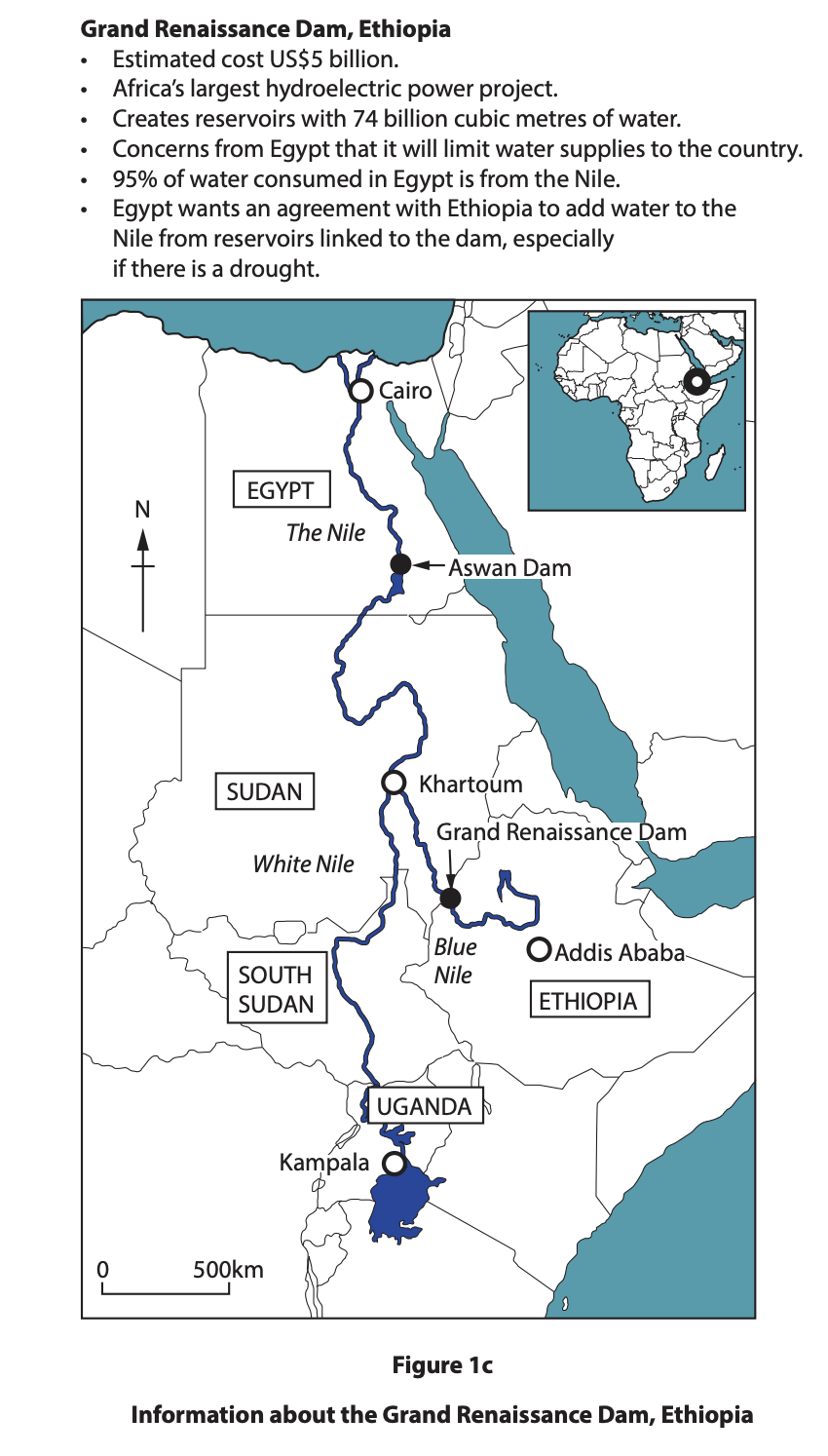
Model answer:
Figure 1c shows that the Grand Renaissance Dam is on the Blue Nile in Ethiopia, upstream of Sudan and Egypt, and that its reservoirs hold 74 billion cubic metres of water. [S] Storing this much water lets Ethiopia control how much is released, so supply can stay steady even when rainfall is seasonal. [Ap]
The dam is also Africa's largest hydroelectric power project. [S] This makes it important for meeting Ethiopia's growing demand for electricity from homes and industry, so its value goes beyond water supply alone. [Ap]
However, 95% of the water consumed in Egypt comes from the Nile. [S] Because the Nile flows north, water held back in Ethiopia could reduce supply downstream, especially while the reservoirs fill or during a drought. [Ap]
Egypt wants an agreement for water to be added to the Nile from the reservoirs during droughts. [S] This suggests the dam is most important for managing supply when the water is shared by agreement, because without one it could increase water insecurity downstream. [Ap]
[8 marks]
Mark allocation
This is a levelled response question. Each valid point made in the answer does not automatically earn a mark.
[Ap] shows application through interpretation, connections and judgement (AO3, 4 marks)
[S] shows skills in taking accurate information from the figure (AO4, 4 marks)
Commentary
This answer reaches Level 3 because it uses the figure in every paragraph, links it to demand and supply, and judges how important the dam is:
Paragraph 1: uses the location and reservoir size to explain how the dam controls supply
Paragraph 2: adds demand, through hydroelectric power
Paragraph 3: shows the effect downstream, using the direction the Nile flows
Paragraph 4: uses Egypt's request for an agreement to reach a judgement
Common errors
Common errors that hold answers below the top level include:
Thinking that the Nile flows south, so that Egypt controls the water rather than Ethiopia
Describing the dam without linking it to the demand and supply of water
Copying the figure's information without explaining it
Writing only about Egypt, or only about Ethiopia
Listing effects without deciding how important the dam is
Alternative content
The answer above is just one example of a response to this question. Other information that could be used in the answer includes:
How controlled releases could reduce flooding downstream, or cause problems if a large release reaches smaller dams and rivers in Sudan
How the reservoir could reduce water insecurity in Ethiopia, where rainfall is seasonal
Why control of a river that crosses international borders can lead to disagreement over who manages the supply
How the cost of US$5 billion compares with the benefits of hydroelectric power
Examiner Tips and Tricks
Quote values with their units every time you use the figure, such as "74 billion cubic metres" or "95%". Precise values show that you have taken accurate information from the figure.

Unlock more, it's free!
Join the 100,000+ Students that ❤️ Save My Exams
the (exam) results speak for themselves:

Was this revision note helpful?