Similar Areas & Volumes (Edexcel IGCSE Maths A: Higher): Revision Note
Exam code: 4MA1

Similar areas & volumes
How do I find the length, area or volume scale factors of similar shapes?
The scale factor (SF) for a given quantity (length, area or volume) between two similar shapes can be found by dividing the quantity on one shape by the quantity on the other shape
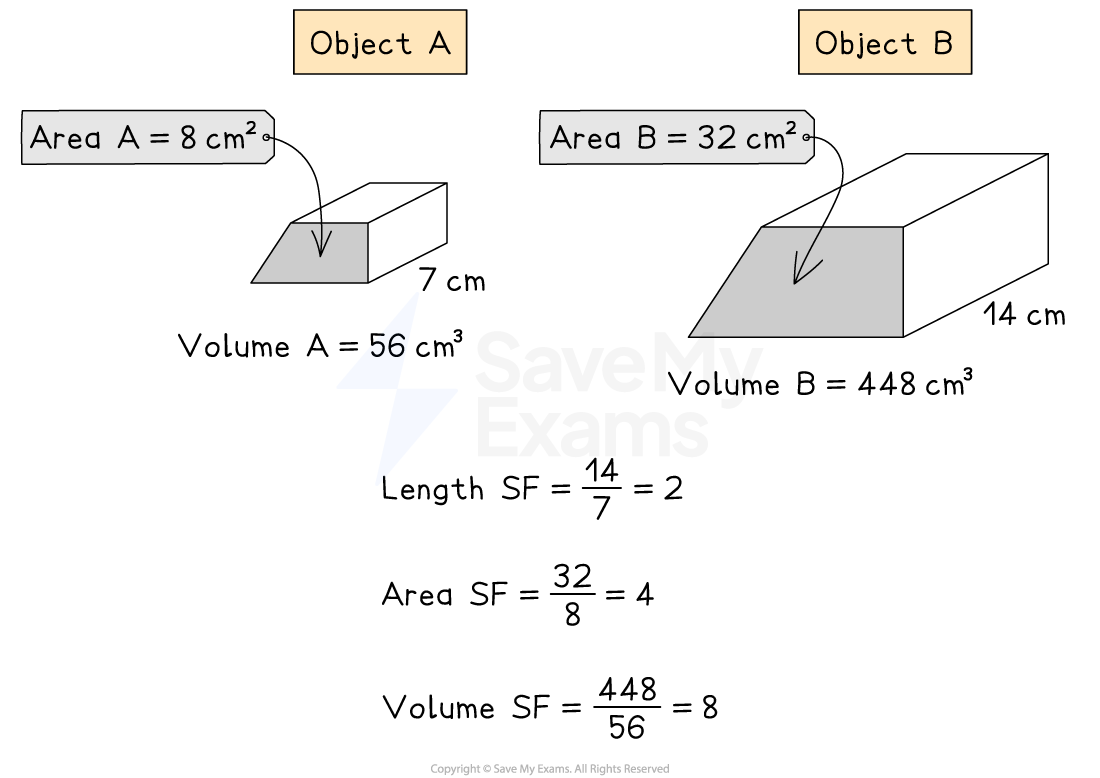
An object could be made either bigger or smaller by a scale factor
The object gets bigger if the scale factor is bigger than 1
The object gets smaller if the scale factor is bigger than 0 and less than 1
What is the connection between the scale factors for lengths, areas and volumes of similar shapes?
The length, area and volume scale factors are powers with the same base number
If the length scale factor is k then
The area scale factor is k2
The volume scale factor is k3
If you know one scale factor, you can find the scale factors
If you have the length scale factor
If you have the area scale factor
If you have the volume scale factor
How do I find missing lengths, areas and volumes for similar shapes?
STEP 1
Identify the equivalent known quantitiesRecognise if the quantities are lengths, areas or volumes
STEP 2
Find the scale factor from two known lengths, areas or volumesSTEP 3
Use the scale factor you have found to find other required scale factor(s)STEP 4
Multiply or divide by relevant scale factor to find the missing quantityThink about whether the quantity should be bigger or smaller than the given quantity
Examiner Tips and Tricks
Take extra care not to mix up which shape is which when you have started carrying out the calculations, It can help to label the shapes and write an equation.
Worked Example
Solid A and solid B are mathematically similar.
The volume of solid A is 32 cm3.
The volume of solid B is 108 cm3.
The height of solid A is 10 cm.
Find the height of solid B.
Answer:
Calculate , the scale factor of enlargement for the volumes, using:
Or
Find the length scale factor by taking the cube root of the volume scale factor
Substitute the value for into formula for the heights of the similar shapes:
Height of B = 15 cm

Unlock more, it's free!
Join the 100,000+ Students that ❤️ Save My Exams
the (exam) results speak for themselves:

Was this revision note helpful?
Build on this topic
Questions students ask about Similar Areas & Volumes
Real questions from students revising this topic on Save My Exams
How do you find a missing length, area, or volume when given a ratio?
Treat a ratio exactly like a scale factor: divide one side by the other, then square-root an area ratio or cube-root a volume ratio to get back to lengths.
If the length ratio is 1 : k, then:
- Area ratio = 1 : k²
- Volume ratio = 1 : k³
Going the other way:
- Area ratio → length ratio: square root both sides
- Volume ratio → length ratio: cube root both sides
Example from this page: solids A and B are similar, with volumes 32 cm³ and 108 cm³, and A has height 10 cm. Find the height of B.
- Volume ratio 32 : 108 = 8 : 27
- Volume scale factor k³ = 108 ÷ 32 = 27/8
- Cube root: k = ∛(27/8) = 3/2, so the lengths are in the ratio 2 : 3
- Height of B = 10 × 3/2 = 15 cm
From 2 : 3 you can also get the area ratio, 2² : 3² = 4 : 9.
Always check whether a ratio describes lengths, areas or volumes before you use it.
How do you know whether to multiply or divide by the scale factor for similar shapes?
The “first” shape is the one you are going from and the “second” is the one you are going to, so work out scale factor = second ÷ first, then multiply the first shape's quantity by it.
- Label the shapes, say A and B; the first is the one you already know about
- Scale factor = corresponding quantity on the second ÷ quantity on the first
- Missing quantity = first shape's quantity × scale factor
- Sense check: if the second shape is bigger, the answer must be bigger
Done this way you always multiply — the scale factor is simply less than 1 when the shape is shrinking.
Example from this page: volumes A = 32 cm³ and B = 108 cm³, height of A = 10 cm.
- Going A → B: k³ = 108 ÷ 32 = 27/8, so k = 3/2
- Height of B = 10 × 3/2 = 15 cm
- B has the larger volume, so it should be taller ✓
Reverse it and the scale factor flips: B → A gives k = 2/3, and 15 × 2/3 = 10 cm.