Intersecting Chord Theorem (Edexcel IGCSE Maths A: Higher): Revision Note
Exam code: 4MA1

Intersecting chord theorem
What is the intersecting chord theorem?
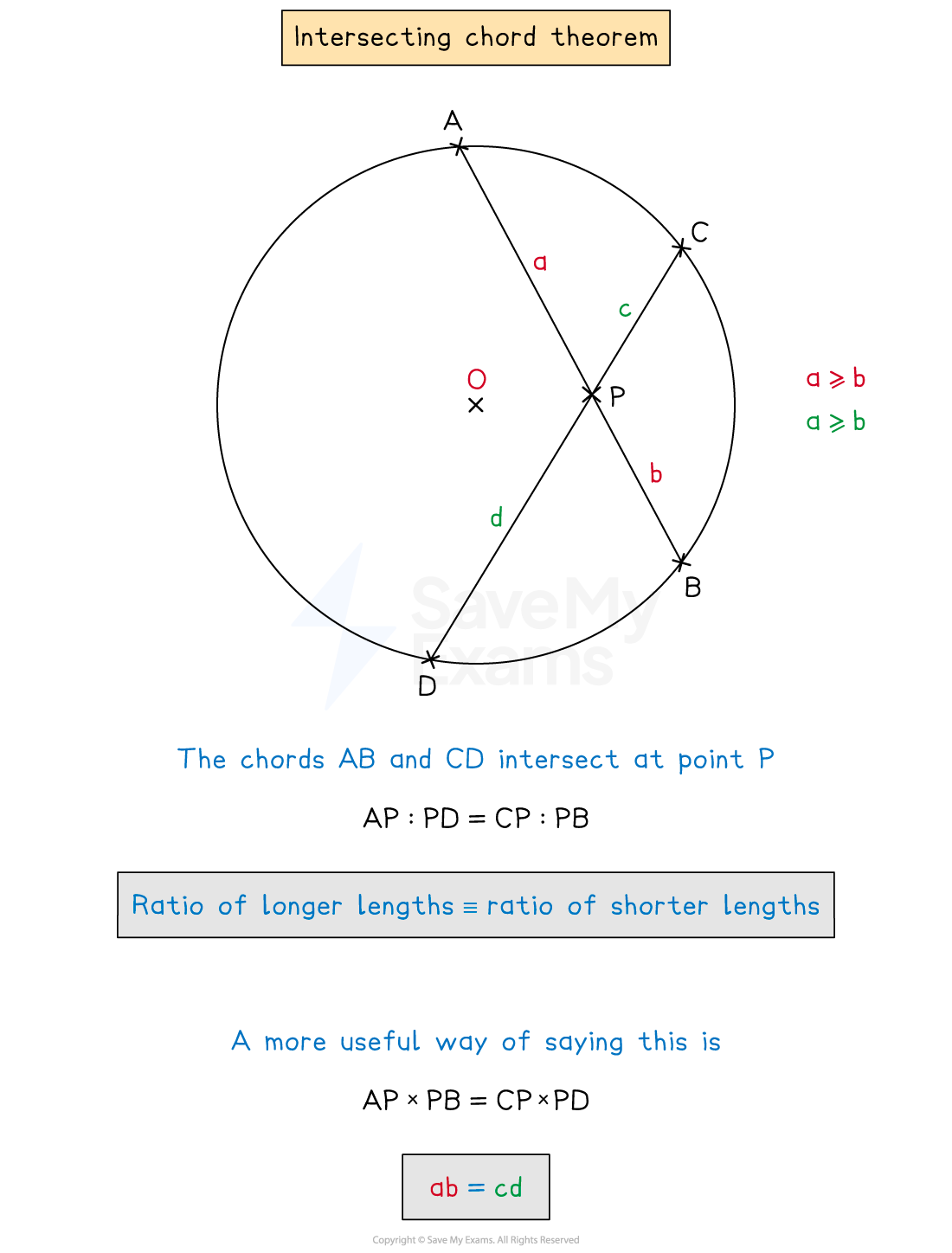
For two chords, AB and CD that meet at point P
AP : PD ≡ CP : PB
Ratio of longer lengths (of chords) ≡ Ratio of shorter lengths (of chords)
This can also be written as AP × PB = CP × PD
You do not need to know the proof of this theorem
This theorem is closely related to similar shapes
How do I use the intersecting chord theorem to solve problems?
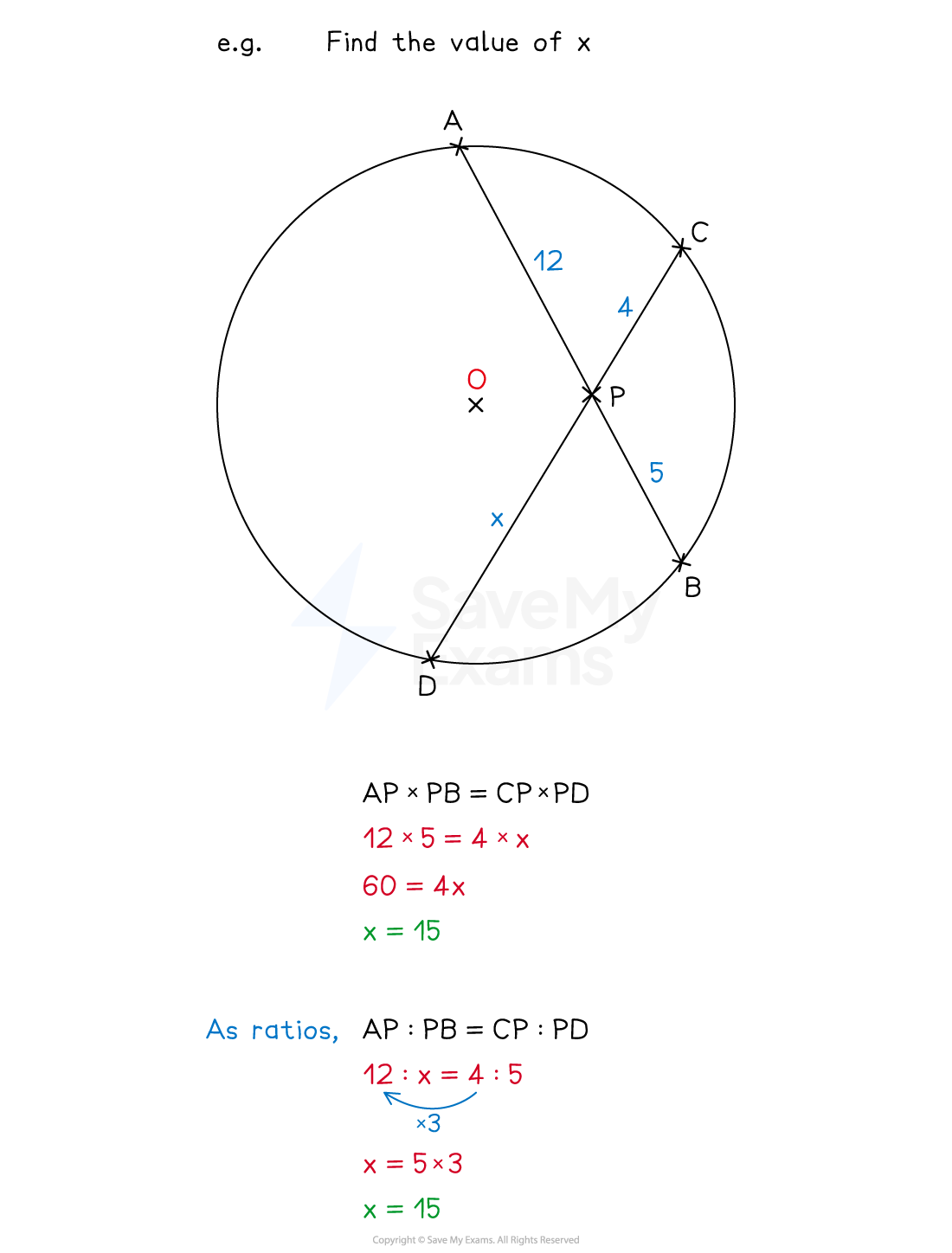
If two chords intersect, you can find a missing length using the intersecting chord theorem
You can usually choose to solve the problem either using multiplication (AP × PB = CP × PD) or using ratio (AP : PD ≡ CP : PB)
Carefully keep track of which distance is associated with each part of each chord
What if the lengths are algebraic?
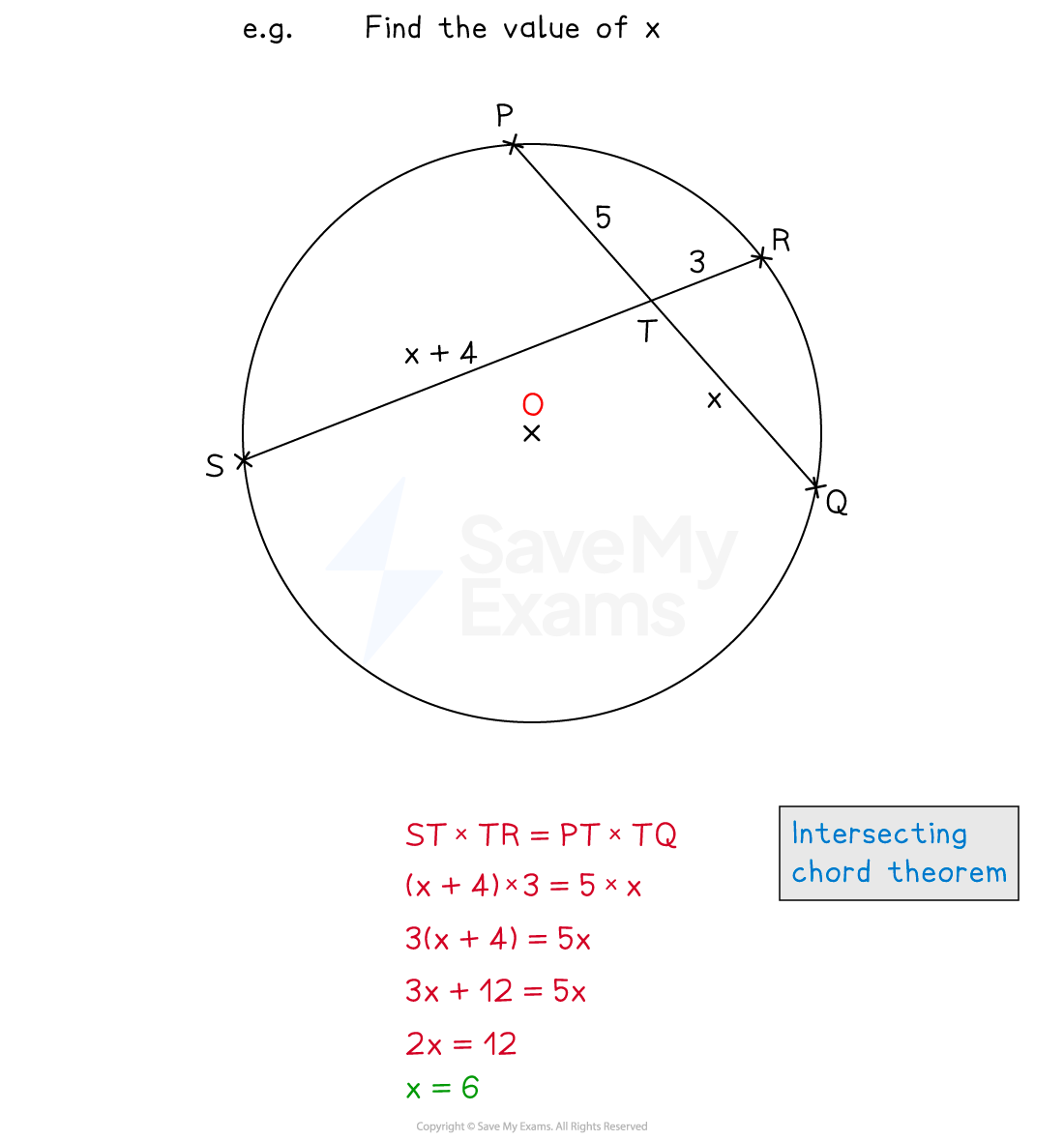
If any of the lengths are algebraic expressions, use the fact that AP × PB = CP × PD to form an equation and then solve it
Worked Example
The diagram below shows a circle with centre O and two chords, PQ and RS.
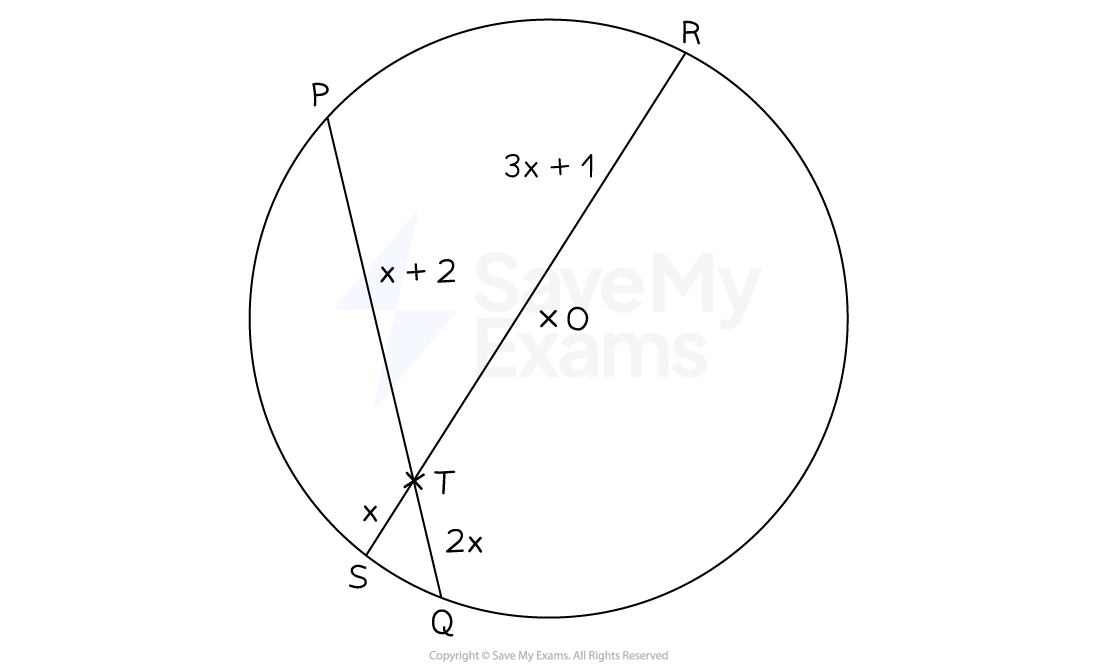
The chords PQ and RS meet at the point T.
(a) Find the possible value(s) of .
Answer:
Using the intersecting chord theorem which states that
Fill in the information from the diagram
Simplify
Solve by factorising
Consider if both answers are possible
refers to a length, so cannot be zero
(b) Hence, or otherwise, write down the simplified ratio of PT:RT.
Answer:
Method 1
Substitute the found value of into the expressions on the diagram for PT and RT
Write as a ratio PT:RT
Simplify
Method 2
Using the ratio form of the intersecting chord theorem, and the expressions on the diagram
This shows that the ratio of PT:RT is the same as the ratio of TS:TQ
Intersecting Chord Theorem (External)
What is the external case of the intersecting chord theorem?
The intersecting secant theorem is the mathematical name given to the external case of the intersecting chord theorem
A secant is a line which extends through a circle cutting the circumference at two points
It occurs when two chords intersect outside of the circle
For two chords, AB and CD that extend and meet at point P outside of the circle
AP : PD ≡ CP : PB where AP = AB + BP and CP = CD + DP
Therefore (AB + BP) : PD ≡ (CD + DP) : PB
A more practical way to deal with most problems involving the intersecting secant theorem is
BP(AB + BP) = DP(CD + DP)
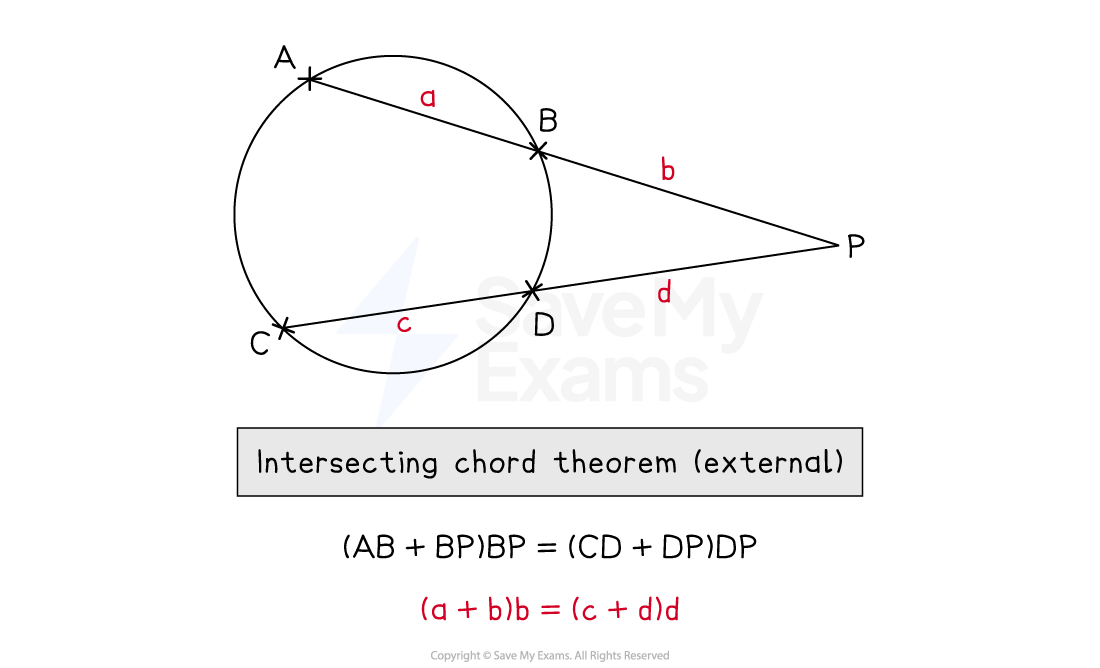
How do I use the intersecting secant theorem to solve problems?
If two chords intersect outside of a circle, you can find a missing length using the intersecting secant theorem
Substitute the values into the multiplication formula
BP(AB + BP) = DP(CD + DP)
If any of the lengths are algebraic expressions, an equation will be formed which can then be solved
Worked Example
In the diagram below, A, B, C and D are points on a circle.
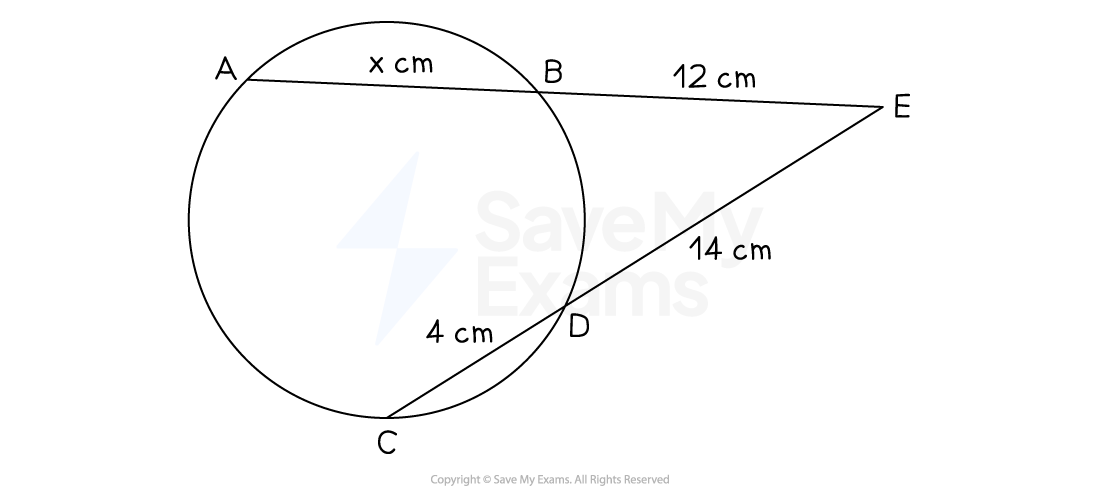
ABE and CDE are straight lines.
AB = cm
BE = 12 cm
CD = 4 cm
DE = 14 cm
Work out the value of .
Answer:
Using the properties of Intersecting Chords (external intersection)
Or equivalently
Substitute the values from the diagram
Solve for
What if one of the lines is a tangent?
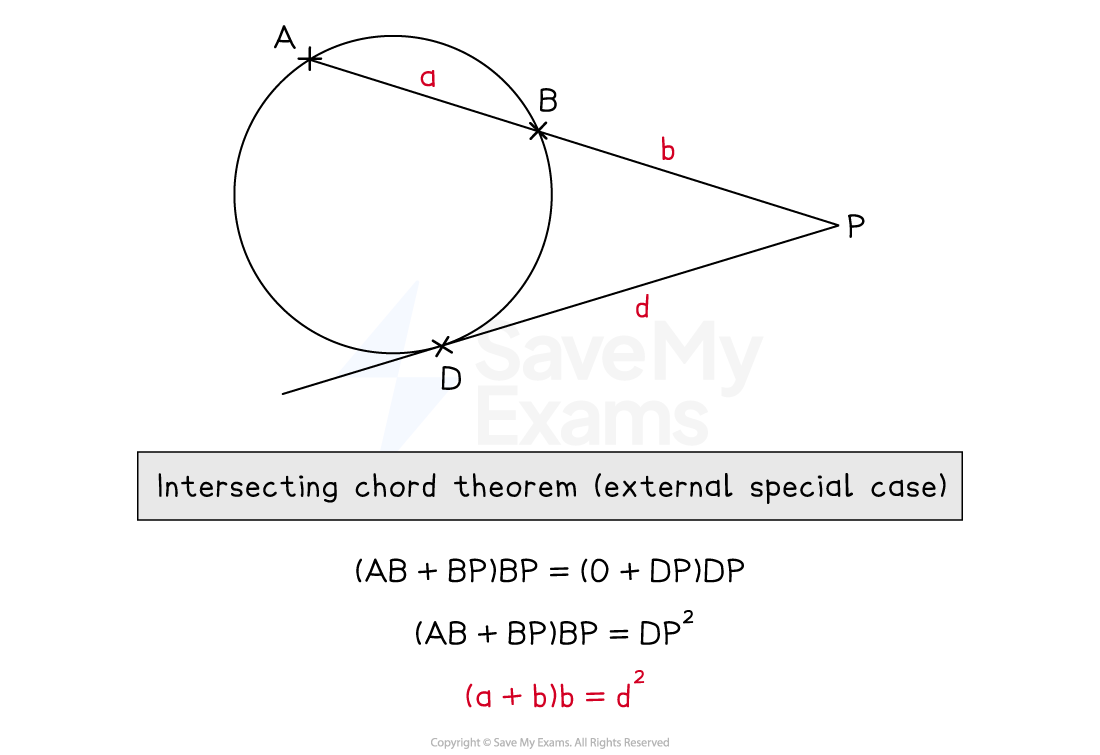
A special case of the intersecting secant theorem is when one of the lines is a tangent, rather than a secant
A tangent touches the circumference of the circle once, rather than intersecting it
In this case, one of the lengths becomes zero
BP(AB + BP) = DP(0 + DP)
BP(AB + BP) = DP2
Worked Example
In the diagram below, A, B, and C are points on a circle.
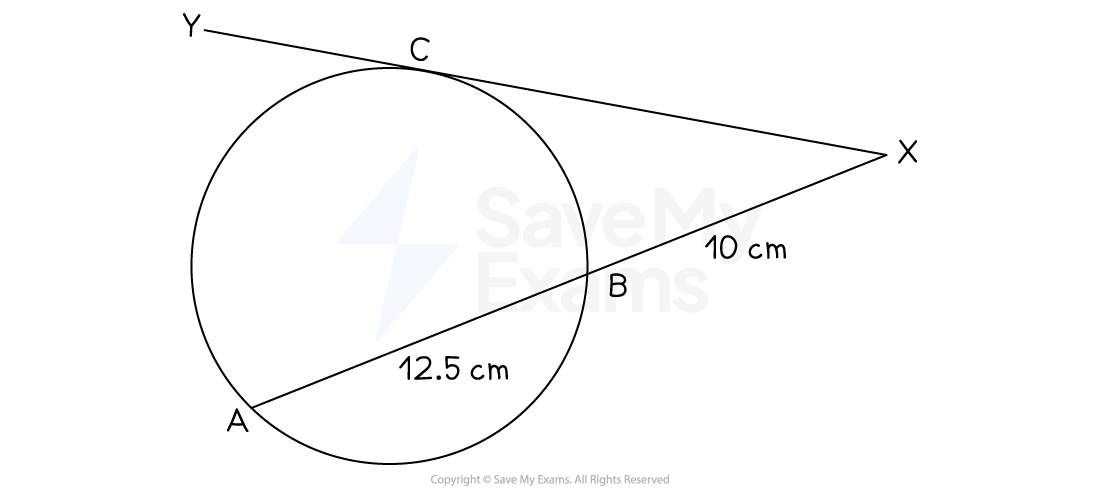
ABX is a straight line.
YCX is a tangent to the circle.
AB = 12.5 cm
BE = 10 cm
Work out the length of CX.
Answer:
This is a special case of the properties of Intersecting Chords (external intersection), where one of the lines is a tangent, and therefore one of the line segments has length zero
Substitute the values from the diagram
Simplify and solve for
CX = 15 cm

Unlock more, it's free!
Join the 100,000+ Students that ❤️ Save My Exams
the (exam) results speak for themselves:

Was this revision note helpful?
Build on this topic
Questions students ask about Intersecting Chord Theorem
Real questions from students revising this topic on Save My Exams
Why does the intersecting chord theorem work?
The products are equal because the two chords create a pair of similar triangles, and cross-multiplying their side ratio gives AP × PB = CP × PD.
You don't need the proof for the exam — the page just notes the theorem is closely related to similar shapes — but this is why it works. Take chords AB and CD meeting at P, and join A to C and D to B:
- Angle APC = angle DPB (vertically opposite angles)
- Angle CAB = angle CDB (angles in the same segment, both standing on arc CB)
- So triangles APC and DPB are similar
- Corresponding sides are in the same ratio: AP : PD = CP : PB
- Cross-multiply: AP × PB = CP × PD
Step 4 is the page's ratio form — the ratio of the longer lengths equals the ratio of the shorter lengths.
Check with the page's example: AP = 12, PB = 5, CP = 4, PD = x
- 12 × 5 = 4 × x, so 60 = 4x and x = 15
When do you use the intersecting chord theorem versus the intersecting secant theorem?
Use the intersecting chord theorem when the chords cross inside the circle, and the intersecting secant theorem when the two lines meet at a point outside it.
Inside the circle (P inside)
- Multiply the two parts of each chord: AP × PB = CP × PD
Outside the circle (P outside) — the external case, or intersecting secant theorem
- For each line, multiply the outside part by the whole line: BP(AB + BP) = DP(CD + DP)
- It is the same relationship, but AP and CP are now whole lengths from P to the far side of the circle
Worked example (from this page): ABE and CDE meet at E outside the circle, AB = x, BE = 12, CD = 4, DE = 14.
- 12(12 + x) = 14(4 + 14) = 252
- 12 + x = 21, so x = 9
If one line is a tangent, its inside part is zero, so the formula becomes BX(AB + BX) = CX². With AB = 12.5 and BX = 10: CX² = 225, so CX = 15 cm.
What reason should you write in an exam when using the intersecting secant theorem?
Name the theorem and show the equation you used — for example "intersecting secant theorem (external case of the intersecting chord theorem): BE × AE = DE × CE".
- The page gives two names for one and the same result: it states that the intersecting secant theorem is the mathematical name for the external case of the intersecting chord theorem.
- In the page's own worked example the reason is given as "using the properties of intersecting chords (external intersection)".
- Write the reason next to the line of working it justifies, as you would for any other circle theorem, then substitute your values so it is clear which lengths you used.
Worked example (from this page): ABE and CDE meet at E, with AB = x, BE = 12, CD = 4, DE = 14.
- Reason: intersecting secant theorem, so BE(AB + BE) = DE(CD + DE)
- 12(12 + x) = 14 × 18, so 12 + x = 21 and x = 9
If one line is a tangent, say it is the tangent case, then write BX(AB + BX) = CX².