Malcolm X & the Nation of Islam (Edexcel IGCSE History: Paper 1: Depth Studies): Revision Note
Exam code: 4HI1

Summary
By the mid-1960s, not all Black Americans agreed with the methods of the civil rights movement, such as:
peaceful protest
integration
working with the government
Some groups argued for Black nationalism
This means the desire to form an independent Black country
Black nationalists felt that violence could be justified as a means of achieving equality
The Nation of Islam (NOI) was one Black nationalist group
It grew from about 500 members in 1952 to over 40,000 within ten years
Many people believe that this growth was due to Malcolm X
Malcolm X criticised the civil rights movement and leaders like Martin Luther King
He won supporters because he seemed to understand the social and financial problems that the movement had failed to address
In 1964, Malcolm X left the NOI and began to change his views
He was assassinated in February 1965
His approach differed from King's in its aims, methods and attitude to White people
The Nation of Islam and the work of Malcolm X
Why did some Black Americans want a different approach to civil rights?
Not all Black Americans agreed with the methods of the civil rights movement
Some civil rights activists worried about:
the speed of change
The 1957 and 1960 Civil Rights Acts raised Black voter registration by only 3%
Some people felt they were being asked to wait
the extent of change
Even after the Civil Rights Act of 1964 and the Voting Rights Act of 1965, the laws did little to tackle poverty, poor housing and unemployment in the ghettos
Discrimination in the North came from wages and housing and not from laws
the violence that protestors faced
Peaceful protestors were beaten, jailed and killed
Some people felt non-violence left Black Americans defenceless
relying too much on the government and White American support
The federal government often acted only after violence and publicity forced it to
Some activists felt integration meant depending on others’ goodwill
Some groups argued for Black nationalism
This means the desire by certain Black Americans to form an independent country
These groups felt that violence could be justified as a means of achieving equality
Examiner Tips and Tricks
Do not confuse Black nationalism with Black Power. Black nationalism was the idea of a separate Black nation, whereas Black Power was a wider movement about pride and power.
The Nation of Islam
One Black nationalist group was the Nation of Islam (NOI), which had been set up in July 1930
The NOI was led by Elijah Muhammad, who taught that Black Americans should separate from white society
Along with some Muslim beliefs, it had always argued that racial integration would not bring equality or end discrimination
They stated that White people would always consider themselves superior
Instead, it argued that:
Black Americans should be separated from White Americans
Until Black Americans had their own state, they should receive the same standard of facilities as White Americans
The Nation of Islam only had 500 members in 1952
Within ten years, it had grown massively to over 40,000 members
Malcolm X's early life and role
Malcolm X was born Malcolm Little in Omaha, Nebraska, in 1925
When Malcolm X was only six years old, his father was hit by a streetcar and killed
It is possible that this was an attack by White supremacists, though it was never proven
After his father’s death, his mother was admitted to a psychiatric hospital
Malcolm X and his siblings were placed in foster care or with family members
In 1946, aged 20, Malcolm X was sent to prison for burglary and sentenced to eight to ten years
In prison, he joined the Nation of Islam
After his release in 1952, he changed his name to Malcolm X, rejecting 'Little' as the name given to his family by slave owners
Malcolm X's criticism of the civil rights movement
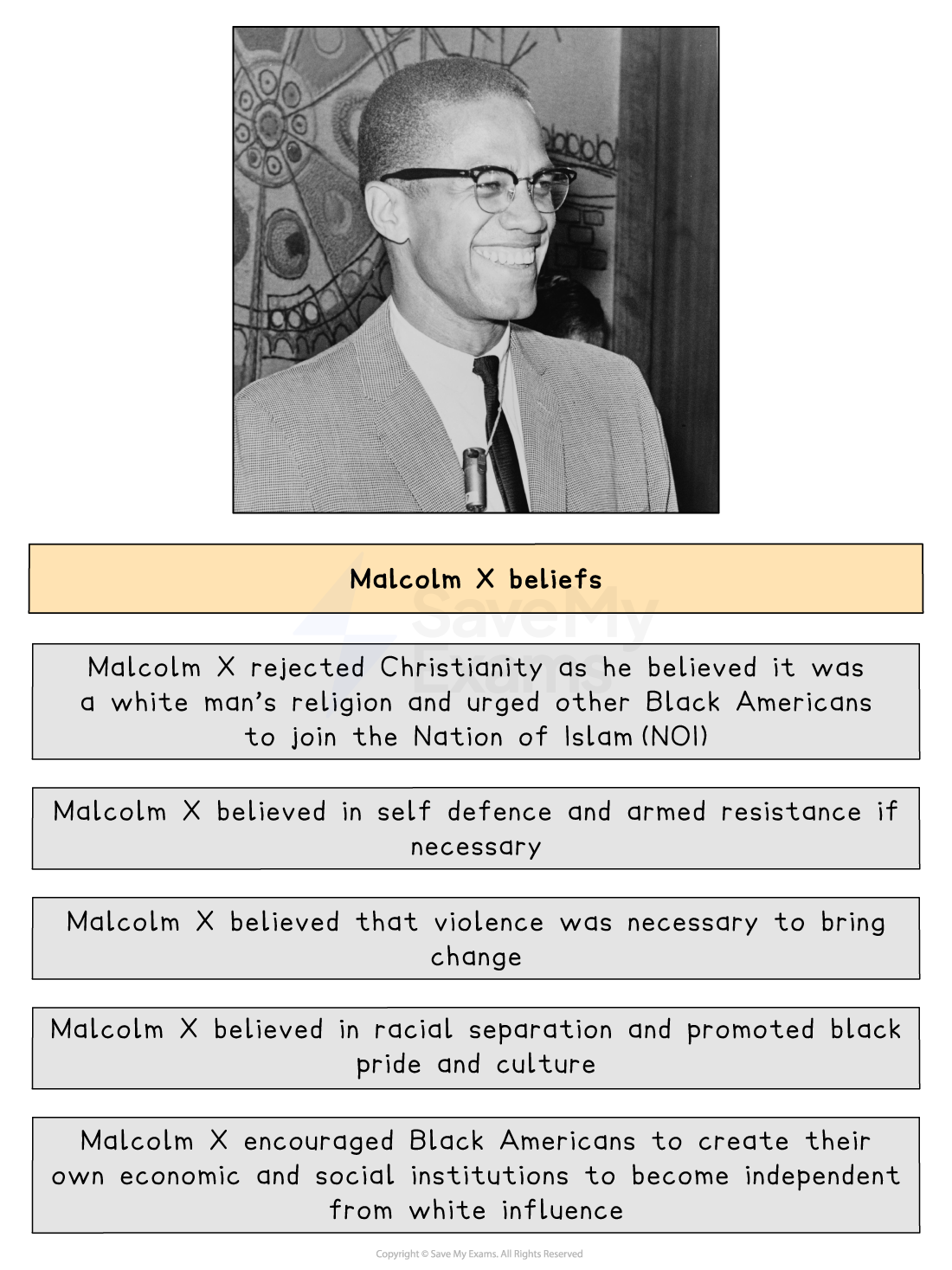
Malcolm X influenced the Black Power movement and held many strong beliefs, such as:
racial separation
promotion of Black pride and culture
self-defence and armed resistance, when necessary
that non-violent protest was ineffective
Malcolm X's later views and legacy
By 1964, Malcolm X's views were changing
After his pilgrimage to Mecca, he began to change his views on Black nationalism
In March 1964, he left the NOI after disagreements with Elijah Muhammad
He created the Organization of Afro-American Unity (OAAU) to work with other civil rights groups, even those with many White American members
However, he never got the chance to build the OAAU
He was assassinated in 1965
He was shot while giving a speech in New York
Thomas Hagan, a member of the NOI, was among those convicted of his murder
Malcolm X's influence increased after his death
His ideas of Black pride, violence in self-defence and rejection of the civil rights movement inspired many others
They became the basis of more radical groups
He also had an impact on all civil rights groups
He highlighted the huge economic and social problems facing many Black Americans
How did Malcolm X's approach differ from Martin Luther King's?
Differences in aims
King wanted integration and equal rights within the existing system, such as desegregation and the vote
He used the US Constitution and American values to make his case
Malcolm X, in his Nation of Islam years, argued that integration would not bring equality, because White people would always consider themselves superior
He wanted separation until Black Americans could have their own state
Differences in methods
King used non-violent direct action, such as marches and boycotts
He planned protests that he knew would provoke violence, but he never retaliated, as shown during 'Project C' in Birmingham
Malcolm X thought that not retaliating was foolish and felt that violence could be justified
His motto was 'by any means necessary'
Differences in attitudes to the government and to White people
King continually showed respect for the US system of government and the Constitution
He worked with presidents and with people of all races
Malcolm X saw the March on Washington as an attempt to please White people
He said that Black Americans should not wait for politicians in Washington DC
King was a Baptist minister who used Christian values and teachings from the Bible
Malcolm X was a minister of the Nation of Islam
Similarities and changes to approach
Both were:
skilful speakers who travelled widely
popular with Black Americans who wanted change
Malcolm X and Martin Luther King adapted their positions over time
After his trip to Mecca, Malcolm X began to change his views on Black nationalism
He said that his new group would work with civil rights groups that had White members
After 1965, King became disappointed that protest and negotiation had failed to make much progress in ending discrimination
His campaigns focused more on poverty, unemployment and housing
Both were assassinated in the 1960s
Malcolm X in 1965
Martin Luther King in 1968
Conclusions
On aims and methods, they differed sharply in the early 1960s
King wanted integration through non-violence
Malcolm X wanted separation and accepted violence
On how far their approaches changed, the gap between their opinions narrowed
Malcolm X moved towards working with others
King moved towards tackling poverty
Worked Example
Study Extract G.
Extract G: From an online encyclopaedia entry on Malcolm X
"Although Malcolm rejected King’s message of non-violence, he respected King as a “fellow-leader of our people,” sending King NOI articles as early as 1957 and inviting him to participate in mass meetings throughout the early 1960s. Although Malcolm was particularly interested that King hear Elijah Muhammad’s message, he also sought to create an open forum for Black leaders to explore solutions to the 'race problem.'"
What impression does the author give about the relationship between Malcolm X and Martin Luther King?
You must use Extract G to explain your answer.
(6)
Partial answer:
The author gives the impression that Malcolm X respected Martin Luther King and wanted to work with him despite their disagreement. Calling King a "fellow-leader of our people" suggests that Malcolm X saw him as an equal in the same struggle. The author also highlights that Malcolm X sent him articles from 1957, which makes this respect seem long-lasting and genuine. The phrase "open forum" suggests that he wanted Black leaders to discuss solutions together, so he seems cooperative and not hostile.
Examiner Tips and Tricks
Keep your answer focused on the extract, because this question is only about the interpretation in front of you.
You should avoid stating if you agree or disagree with the extract as this is not what the question requires. You simply need to show the author's opinion through the words that they use and the evidence they select.

Unlock more, it's free!
Join the 100,000+ Students that ❤️ Save My Exams
the (exam) results speak for themselves:

Was this revision note helpful?