The Black Panther Party (Edexcel IGCSE History: Paper 1: Depth Studies): Revision Note
Exam code: 4HI1

Summary
Huey Newton and Bobby Seale set up the Black Panther Party in October 1966 in Oakland, California
The Panthers were probably the best-known Black Power group and one of the most feared
However, they never had more than about 5,000 members in 25 cities
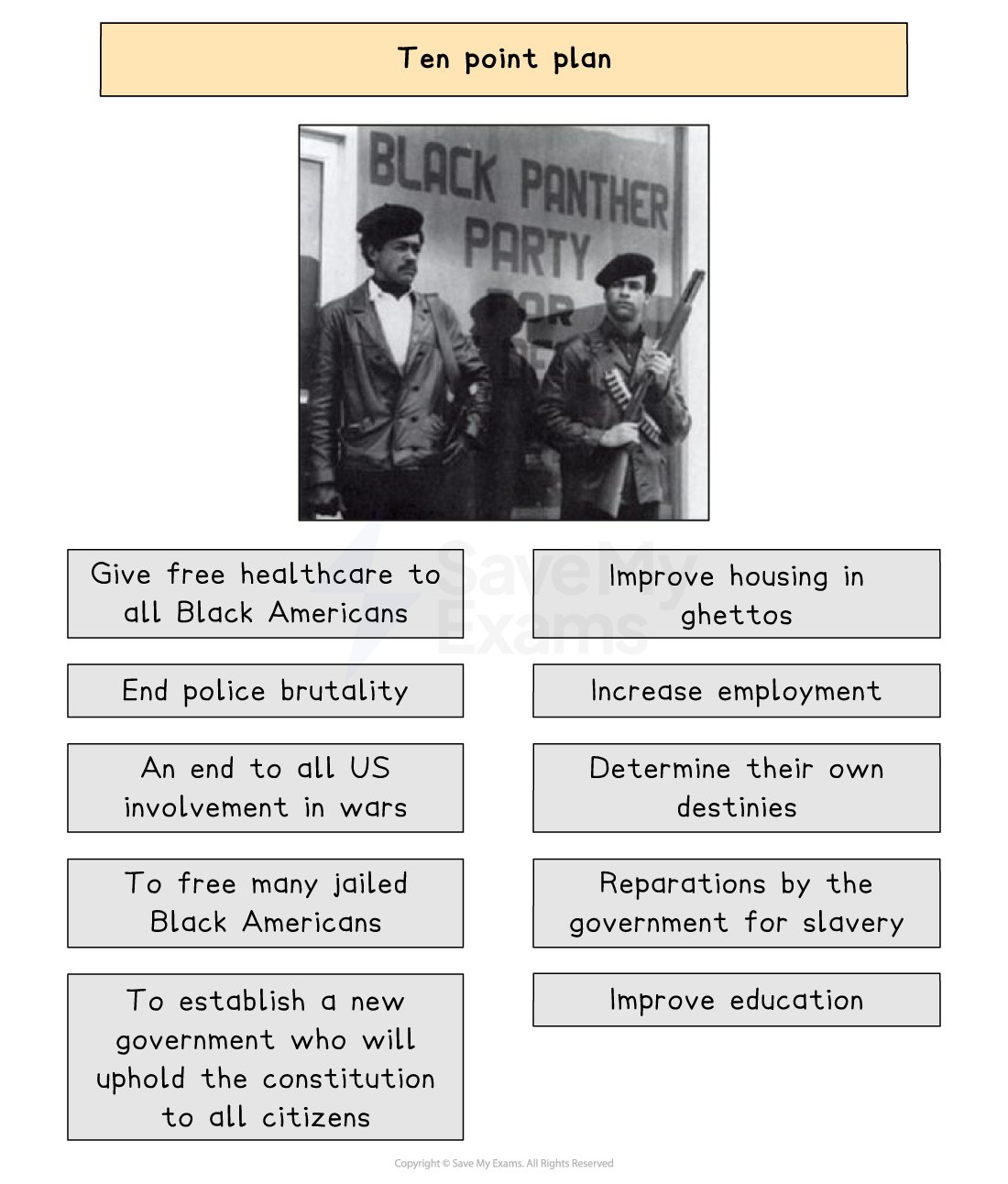
Their Ten-Point Plan set out their aims
The media was most interested in their campaign of 'patrolling the pigs'
This meant following police officers to prevent abuse
They ran clinics, breakfast clubs and classes in the ghettos
These were particularly successful
The government saw them as a great threat because of their socialist beliefs
The FBI watched their members closely
What was the Black Panther movement?
Who were the Black Panthers?
The Black Panthers were created in 1966 by Huey Newton and Bobby Seale
The Black Panthers were inspired by
Communist revolutionaries such as Che Guevara and Mao Zedong
Members wore black berets, trousers and leather jackets
They were highly visible
They often carried guns
Unlike most other Black Power groups, the party was willing to work with White people who shared its beliefs
The Ten-Point Plan
The Black Panthers' Ten-Point Plan manifesto outlined the party's aims
Examiner Tips and Tricks
Aim to learn two or three points from the Ten-Point Plan, such as police brutality, jobs and housing. These points show that the Panthers had social and economic aims, and not just aims to do with violence.
'Patrolling the pigs'
The media was most interested in the campaign that became known as 'patrolling the pigs'
'Pigs' was an insulting word for the police
In this campaign, Panthers would follow police officers to prevent abuse of Black Americans
Many people in the ghettos saw the Panthers as a more effective police force than the actual police
However, there were frequent shoot-outs and violence that attracted negative publicity
Community programmes
Black Panther groups were particularly successful with some of their schemes to try to improve life in the ghettos
They organised medical clinics to give Black people free healthcare
They ran breakfast clubs for Black children to attend before school
They provided free shoes for poor Black families
They ran classes on Black history
They encouraged co-operation between different Black gangs to reduce violence
The money for their projects was raised from donations, mostly given by Black businesses
It was sometimes gained through theft
The government's response to the Black Panthers
The roles of Bobby Seale and Huey Newton
Bobby Seale
Seale was the party's chairman
He is usually credited with developing its community programmes, such as the free breakfast clubs
In 1969, he was one of the protestors put on trial in Chicago
He was accused of encouraging riots at the 1968 Democratic Party convention
The judge had him bound and gagged in court
This brought more publicity to the party
In 1973, he stood for mayor of Oakland
He reached the run-off
This showed the party's move towards politics
Huey Newton
Newton was the party's Minister of Defense
This meant that he was responsible for its policy of armed self-defence against police abuse
In October 1967, he was arrested after a shoot-out in which a police officer died
The party ran a 'Free Huey' campaign
His conviction was overturned on appeal in 1970 and he was released
The charges were dropped in 1971
The campaign is often seen as a success for the party as it brought national attention
Working together
Newton is usually seen as the party's thinker and its public face
Seale is seen as its organiser
Together, they combined the party's image of defiance with its practical work in the ghettos
How effective was the Black Panther Party in advancing civil rights?
Evidence of effectiveness
The community programmes improved daily life in the ghettos
Many people in the ghettos saw the Panthers as a more effective police force than the actual police
They encouraged co-operation between different Black gangs to reduce violence
Their classes gave young people pride in Black history, which fitted the wider Black Power message
The Panthers campaigned on local issues, which often got results
Their projects were funded by the communities that they served, so they met local needs
Evidence of limited effectiveness
The party never had more than about 5,000 members in 25 cities
Its reach was small
Its shoot-outs and violence attracted negative publicity
Many White Americans feared the Black Panthers
The government saw it as a great threat because of its socialist beliefs
The FBI heavily watched its members
Some of its money was gained through theft
Its Ten-Point Plan demanded jobs, housing and an end to police brutality across the country
A group of this size could not achieve these aims alone
Conclusions
In the ghettos, the Black Panthers were effective
Their programmes made a real difference to daily life
Beyond the ghettos, they were much less effective
They were a small group
Their violence attracted negative publicity
The FBI watched them closely
Therefore, the Black Panthers were effective in giving practical help locally, but less effective in advancing civil rights nationally
Worked Example
'The Black Panthers achieved little for Black Americans.'
How far do you agree? Explain your answer.
You may use the following in your answer:
the 'patrolling the pigs' campaign
the free breakfast clubs.
You must also use information of your own.
(16)
Partial answer:
The community programmes were the Panthers' greatest success. They ran free medical clinics to ensure Black communities had access to healthcare. They also improved the lives of children by running breakfast clubs so that Black children could eat before school. The money came from donations, mostly from Black businesses, so the programmes were funded by the communities that they served. These programmes gave poor families healthcare, food and clothing that they could not afford, so they tackled the poverty in the ghettos that laws alone had not solved. This suggests that the Panthers achieved much more than the statement allows. They made a practical difference to daily life in the ghettos, where the authorities had failed to act.
Examiner Tips and Tricks
You can have a strong opinion in a 16-mark question. However, your answer should never only look at one side of the argument.
For this question, you can strongly agree that the Black Panthers achieved little for Black Americans. However, you must consider how their work, such as their community programmes, positively impacted Black Americans.
If you want to distance yourself from the other side of the argument, you can use the phrase "Some historians argue that…" This allows you to present a balanced answer without undermining your judgement.

Unlock more, it's free!
Join the 100,000+ Students that ❤️ Save My Exams
the (exam) results speak for themselves:

Was this revision note helpful?