The Montgomery Bus Boycott, 1955–56 (Edexcel IGCSE History: Paper 1: Depth Studies): Revision Note
Exam code: 4HI1

Written by: Zoe Wade
Updated on
Timeline and Summary
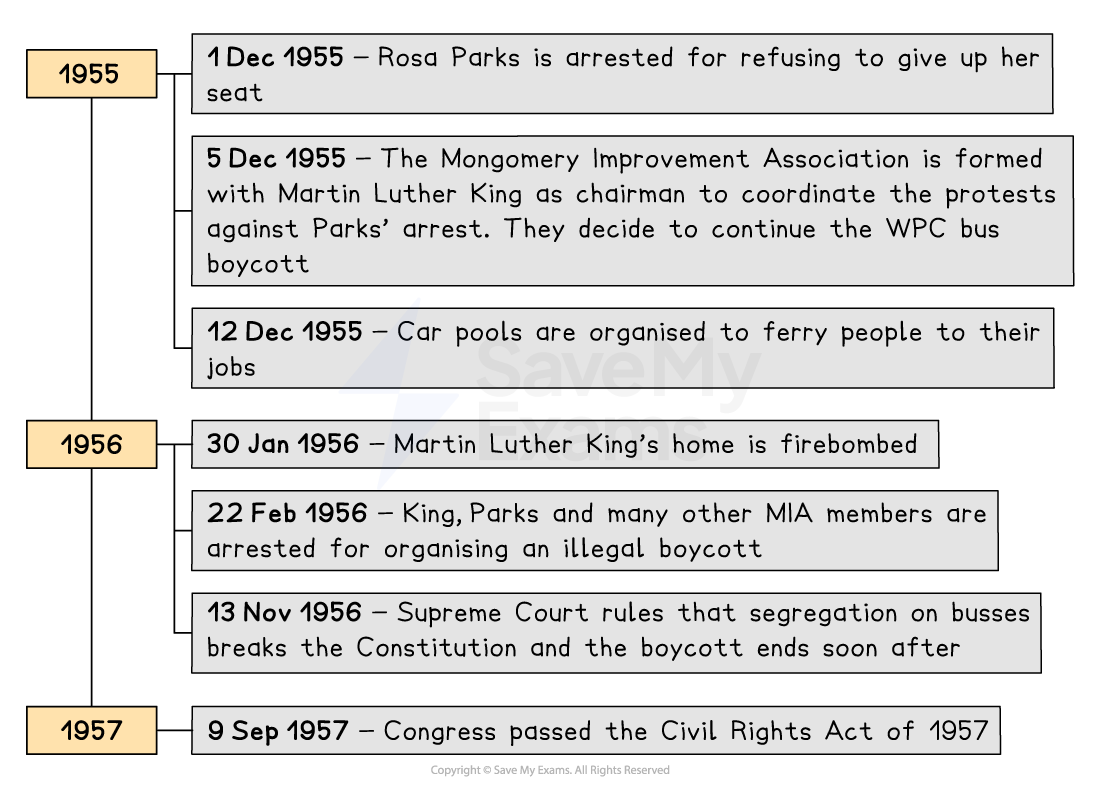
On 1 December 1955, Rosa Parks was arrested for refusing to give up her seat on a bus in Montgomery, Alabama
The Women's Political Council (WPC) and church groups called a one-day boycott
This was a huge success
The Montgomery Improvement Association (MIA), led by Martin Luther King, was set up
The boycott lasted 381 days
It was kept going by car pools and the support of churches, despite harassment and bombings
The Supreme Court ruled in Browder v. Gayle that bus segregation was unconstitutional
Black Americans returned to the buses on 21 December 1956
The boycott was significant because it showed that non-violent direct action could work
However, it only changed one small area and triggered a violent backlash
Key events of the Montgomery Bus Boycott
Causes of the Montgomery Bus Boycott
The Montgomery Bus Company segregated its buses
The front rows were reserved for white people
Black people had to sit in the back rows
If the bus was full, Black Americans had to give up their seats for white people
The Women’s Political Council (WPC) had demanded an end to this, but the bus company ignored them
Claudette Colvin, aged 15, was arrested in March 1955 for refusing to give up her seat, nine months before Rosa Parks
On 1 December 1955, Rosa Parks refused to give up her seat for a white passenger
Born in 1913, she joined the NAACP in 1943 and took part in several civil rights campaigns
At the time of her arrest, she was secretary of the NAACP chapter in Montgomery, Alabama
Parks was arrested and fined $14
Her arrest triggered outrage
Parks was a non-violent, hard-working, middle-aged woman
This made it very difficult for opponents of desegregation to attack or criticise her
The WPC launched a boycott of the Montgomery Bus Company
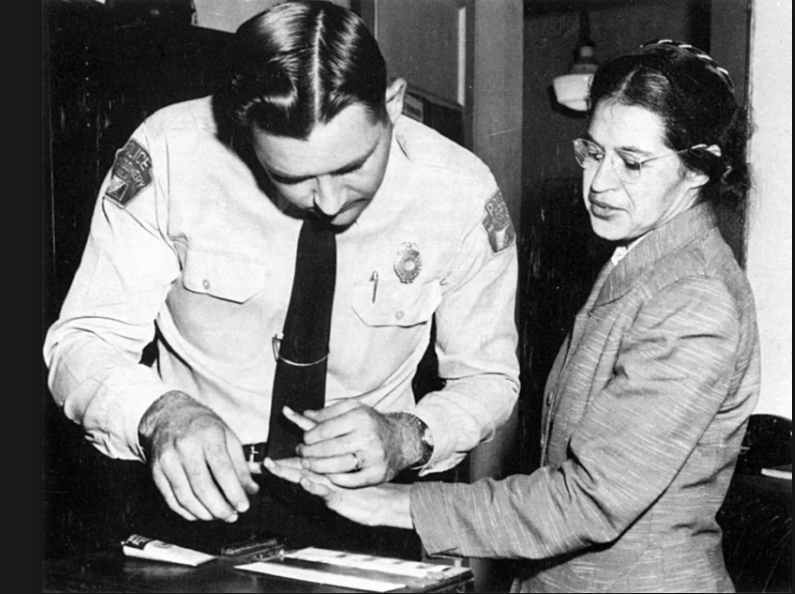
The Montgomery Improvement Association (MIA) and Martin Luther King
Civil rights leaders met in Montgomery on 2 December to discuss their response to Parks’ arrest
On 5 December, after the first day of the boycott, they formed the Montgomery Improvement Association (MIA)
Martin Luther King was elected as its president
He was the pastor of Dexter Avenue Baptist Church in Montgomery, Alabama
After meeting with the MIA on 8 December, the bus company still refused to desegregate, so Black passengers continued with the boycott
Examiner Tips and Tricks
Martin Luther King is also known as MLK or Doctor King. Any version is acceptable in your exam answers. Whilst there are many abbreviations in this course, it may help in your exam answers to shorten King’s name. When writing an answer, write “Martin Luther King (MLK)” once. This will allow you to write “MLK” throughout the rest of your answer.
Events of the Montgomery Bus Boycott
On 5 December, 90% of the Black residents of Montgomery supported the boycott by refusing to use the buses
However, many Black people in Montgomery relied upon the bus to get to work, so alternatives had to be provided
The MIA made a deal with taxi companies to charge each passenger the same amount as individual bus tickets
This was eventually declared illegal
On 12 December, a car pool of over 300 vehicles was organised by MIA to ferry people to the city centre
Keeping the boycott going
The boycott showed no signs of stopping in 1956, so opponents of desegregation increased the intimidation of its leaders
On 30 January 1956, Martin Luther King’s home was firebombed with his wife and daughter narrowly avoiding injury
On 22 February, around 90 boycott leaders, including Parks and King, were arrested for organising an illegal boycott
Only King was tried, and in March 1956 he was found guilty and fined $500
The legal route and the end of the boycott
As the boycott continued, the MIA went to court to argue that segregation on buses went against the Constitution
On 1 February 1956, the case of Browder v. Gayle began in the federal district court
On 5 June, it ruled that bus segregation, just like segregation in schools, was unconstitutional
The bus company appealed the decision and it went to the Supreme Court
When the Supreme Court reached its verdict on 13 November 1956
It upheld the federal district court’s decision
The bus company was ordered to desegregate
On 20 December 1956, the MIA called an end to the boycott
After 381 days, the boycott had succeeded
Martin Luther King, Rosa Parks and others travelled on a desegregated bus
Examiner Tips and Tricks
Remember that there were two routes to success, which were economic pressure from the boycott and the legal case. Examiners reward answers that show how they worked together.
Why was the Montgomery Bus Boycott significant for the civil rights movement?
Evidence that it was significant
The boycott can be regarded as very successful
Buses in Montgomery were integrated
Seating was on a first-come, first-served basis
Drivers no longer ordered Black Americans to make room for white passengers
After the boycott, some other places also began to integrate public transport
It provided an example of a form of protest that worked
It showed that changing the law was not enough
When large numbers of Black Americans took direct action, this brought about real change
It showed the effectiveness of non-violence in gaining support and publicity for civil rights
The boycott had economic power, because the bus company's revenue fell sharply and local businesses lost custom
This put pressure on white businessmen to resolve the dispute
It showed how well Black Americans could organise themselves
It demonstrated the power of churches in bringing people together for a cause
Perhaps its most lasting impact was that it brought Martin Luther King to public attention
He would become very important in raising awareness of civil rights and attracting supporters
Evidence of limits
The boycott only led to change in one small area
Other facilities in Montgomery remained segregated for many years
Membership numbers for racist groups rose
The boycott marked an increase in violence against Black communities
There was a serious backlash after 20 December, when bus integration began
Patrols of the Ku Klux Klan drove around Montgomery trying to intimidate people and sometimes attacking Black residents
Some integrated bus passengers were attacked by snipers
There was a wave of bombings of Black churches and the homes of civil rights leaders
This led to a complete suspension of bus services for a few weeks, but the violence eventually died down
Conclusions
At the time, the boycott achieved a clear victory
However, it was only in one city, and it provoked violence
For later events, it was very significant because it gave campaigners a method that worked
A model of non-violent protest
A national leader in Martin Luther King
Therefore, the boycott was more significant for what it started than for what it achieved in Montgomery itself
Worked Example
Extract G: From a history of the civil rights movement from 1945–1965, published in 2026
"Everything else in Montgomery was still segregated. And the boycott had revealed the depth of racism and determination of some Whites. Rosa and her husband lost their jobs. She received death threats, and had to move to Detroit."
What impression does the author give about the results of the Montgomery Bus Boycott?
You must use Extract G to explain your answer.
(6)
Partial answer:
However, the author selects only the negative results. The extract leaves out that the boycott ended segregation on Montgomery's buses after the Supreme Court ruled in Browder v. Gayle, which was the aim of the protest. It also leaves out that the boycott inspired other campaigns against segregated transport across the country, and brought Martin Luther King to national attention. Including these would make the boycott seem a success that came with a cost, rather than a disappointment.
Examiner Tips and Tricks
Keep your answer focused on the extract, because this question is only about the interpretation in front of you.
You should avoid stating if you agree or disagree with the extract as this is not what the question requires. You simply need to show the author's opinion through the words that they use and the evidence they select. When you point out what the author leaves out, only use evidence relevant to the topic in the question.

Unlock more, it's free!
Join the 100,000+ Students that ❤️ Save My Exams
the (exam) results speak for themselves:

Was this revision note helpful?