Selma & the Voting Rights Act, 1965 (Edexcel IGCSE History: Paper 1: Depth Studies): Revision Note
Exam code: 4HI1

Summary
In January 1965, Martin Luther King and the Southern Christian Leadership Conference (SCLC) campaigned in Selma, Alabama
This was because very few Black Americans were registered to vote
On Bloody Sunday, 7 March, state troops and police attacked marchers at the Edmund Pettus Bridge
The footage was shown around the world
President Johnson used the outrage to persuade Congress
He submitted a voting rights bill on 17 March
The Voting Rights Act became law on 6 August 1965
The Act:
ended literacy tests
banned states from setting their own voting qualifications without approval
appointed federal examiners
Black voter registration rose sharply
Selma marked the point where some people began to question non-violence
Selma and voting rights
Segregation in Selma, Alabama
The Civil Rights Act of 1964 left many people unsatisfied because it did not completely ban voter discrimination in individual states
Different rules could still apply to Black American voters compared to White American voters
The Southern Christian Leadership Conference (SCLC) and the SNCC decided to publicise and challenge this remaining discrimination in the town of Selma, Alabama, in 1965
It had just 383 registered Black American voters out of a population of 15,000
This was one of the lowest rate of Black voter registration in Alabama
For two months, there were protests and attempts to register Black Americans to vote
This led to violent confrontations with the police and many arrests
One protestor was murdered
The lack of success led the SCLC to change tactics
Bloody Sunday
On Sunday 7 March, a protest march left Selma, heading for the state capital, Montgomery
It involved 600 protestors
As they reached the Edmund Pettus Bridge just outside of Selma, the marchers were attacked by state troopers
They used horses, clubs and electric cattle prods
More than 50 demonstrators were hospitalised, and the march turned back to Selma
The day became known as ‘Bloody Sunday’
The marches to Montgomery
A second march was organised two days later
Martin Luther King would not let the marchers confront the state police
As a result, the marchers turned back at the bridge
The president used the events of the first march to persuade members of Congress to support a voting rights bill
Protestors from all over the USA set off for Selma, determined to show their support
On 17 March, Johnson submitted a voting rights bill to Congress
He then took control of the Alabama National Guard
The march from Selma to Montgomery finally took place from 21 March, escorted by the National Guard
On 25 March, King led around 25,000 people to the state capitol, in Montgomery
The Voting Rights Act, 1965
On 6 August 1965, President Lyndon B. Johnson signed the Voting Rights Act
The Voting Rights Act was quickly enacted by Congress due to:
the Freedom Summer
the success of the Selma to Montgomery march in 1965
long-term pressure from civil rights groups
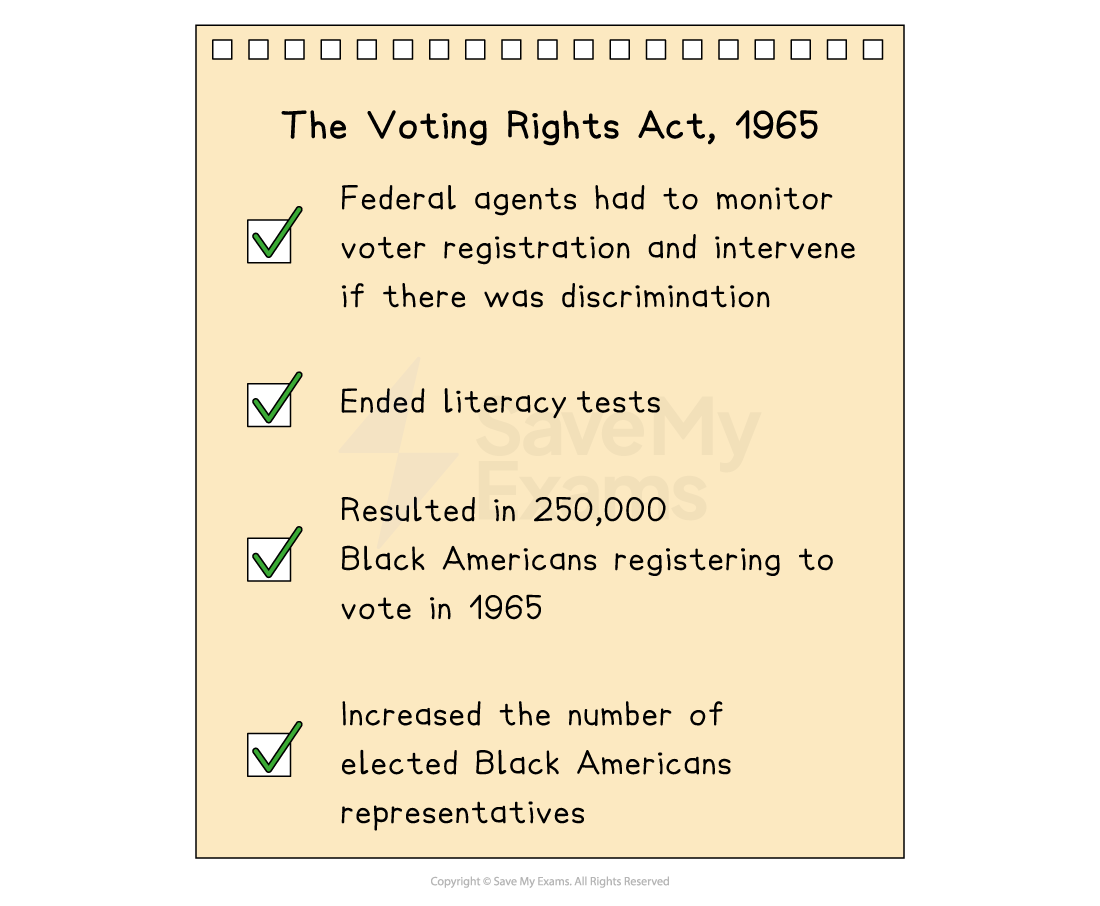
The Voting Rights Act:
ended literacy tests
introduced the monitoring and intervention of voter registration by Federal agents if there was discrimination
The Voting Rights Act resulted in:
250,000 Black Americans registering to vote in 1965
State | Alabama | Georgia | Louisiana | Mississippi |
|---|---|---|---|---|
% of registered Black American voters (1964) | 19.3 | 27.4 | 31.6 | 6.7 |
% of registered Black American voters (1968) | 61.3 | 60.4 | 60.8 | 67.5 |
A table showing the increase in registered Black American voters between 1964 and 1968
Examiner Tips and Tricks
Use the figures to prove the Act worked. Mississippi rising from 6.7% to 67.5% is one of the most striking pieces of evidence of the impact of the Voting Rights Act.
Many historians believe that the Voting Rights Act was even more important than the Civil Rights Act of 1964
It meant that Black Americans began to gradually elect representatives from their own communities at local, city and then national level
For the first time, issues which affected Black Americans had to be considered by politicians who wanted to win their votes
A split in the movement
Many of the protestors, including SNCC members, wanted to confront the police directly
As a result, more people began to question non-violence as a strategy
It would lead to more militant protests in the years ahead
How important was Selma in achieving voting rights for Black Americans?
Evidence that Selma was important
Footage of the attack on Bloody Sunday was broadcast around the world
This shocked the public and increased support
Protestors from all over the USA came to Selma, which showed the scale of national support
The president used the events of the first march to persuade members of Congress to support a voting rights bill
Johnson submitted the bill on 17 March, within ten days of Bloody Sunday
It became law within five months
The Act produced a dramatic increase in Black voter registration
Evidence of other factors
The Freedom Summer had highlighted the many issues that prevented Black Americans from voting
The voting sections of the 1964 Act were weak
President Johnson knew that this would need to be dealt with at a later date
Johnson's political skill and his commitment to getting legislation passed were essential
Civil rights groups had campaigned on voter registration since 1961, with the support of Robert Kennedy
Evidence of Selma's limitations
The two months of protest in Selma did not succeed in registering many Black Americans
It led the SCLC to change tactics
The second march was turned back without reaching Montgomery
Selma alone did not change the law: Johnson and Congress still had to act
Selma also began a split in the movement, because some protestors began to question non-violence
Conclusions
Judge the importance of Selma based on whether it:
became the underlying cause of the Act
decided the timing and speed
As an underlying cause, Selma was less important
The need for a voting law had already been shown by years of campaigning and by the Freedom Summer
Johnson already knew that it was missing from the 1964 Act
As the trigger, Selma was crucial
The shocking footage gave Johnson the support he needed to act quickly
The bill was passed within months
Worked Example
Explain two effects of the events at Selma (1965) on the civil rights movement.
(8)
Partial answer:
A second effect was that the movement began to split. Many marchers, including SNCC members, wanted to confront the police directly after Bloody Sunday. When Martin Luther King would not let the marchers confront the state police on the second march, more people began to question non-violence as a strategy. This led to more aggressive protests in the years ahead, which divided the civil rights movement into those who supported King's approach from those who wanted a more confrontational one.
Examiner Tips and Tricks
Effects can be positive or negative.
A first effect might be that the events at Selma led to the Voting Rights Act, which is a positive effect.
Whether you decide to pursue a positive or negative effect, always ensure you create a chain of consequences, explaining fully what impact that effect had on the civil rights movement.

Unlock more, it's free!
Join the 100,000+ Students that ❤️ Save My Exams
the (exam) results speak for themselves:

Was this revision note helpful?