The Watergate Scandal (Edexcel IGCSE History: Paper 1: Depth Studies): Revision Note
Exam code: 4HI1

Summary
Richard Nixon became president in January 1969 after a long political career
He was deeply suspicious of anyone he thought was against him
Nixon set up the ‘White House Plumbers’ to stop leaks of information
The Committee to Re-elect the President (CREEP) raised funds for his 1972 re-election campaign
On 17 June 1972, five men were arrested after breaking into the offices of the Democratic National Committee (DNC) in the Watergate complex in Washington DC
They were quickly linked to CREEP and the White House
Two Washington Post reporters, Bob Woodward and Carl Bernstein, and the FBI found evidence linking the break-in to the White House
Nixon and others denied any involvement
In March 1973, the burglar James McCord accused White House officials of a cover-up in a letter to the trial judge
This turned the break-in into a scandal
In July 1974, the Supreme Court ordered Nixon to hand over the recordings
A recording from 23 June 1972 proved that Nixon had tried to stop the FBI investigating the break-in
Nixon resigned on 9 August 1974, before he could be impeached
Reasons for the Watergate Scandal
Richard Nixon's background
Richard Nixon's long political career began when he was elected to the House of Representatives in 1946
He became well known during the Red Scare, because he was largely responsible for sending Alger Hiss for trial
He very narrowly lost the 1960 presidential election to Kennedy
The Republicans chose him to run again in 1968
This time, he won and became president on 20 January 1969
Nixon had survived an earlier scandal
In 1952, when he was running for Vice President, he was accused of taking money from his campaign fund for personal use
He denied the charges in a television speech, known as the ‘Checkers’ speech
He remained the vice-presidential candidate
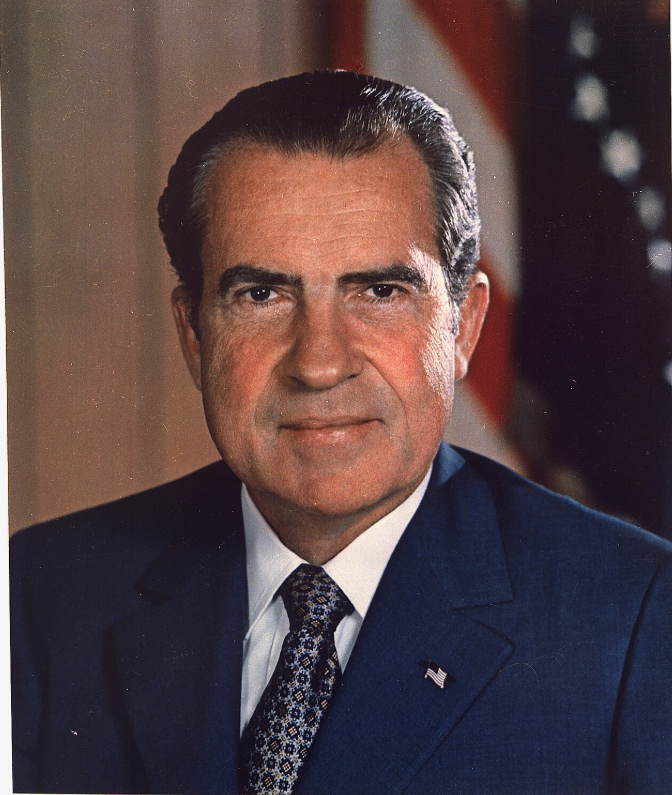
Nixon's character
Nixon was very intelligent and hard-working
However, he could be deeply suspicious, even paranoid
He was accused of holding resentments towards people he thought were against him, while rewarding people who showed loyalty
People who worked for him described him as:
extremely sensitive to criticism
impatient with opposition
frantic about leaks of information
The Pentagon Papers and the ‘White House Plumbers’
In June 1971, the New York Times published an article about the Vietnam War
It was based on a series of secret documents called the Pentagon Papers
The documents contained confidential information about the war
They had been leaked to the newspaper by Daniel Ellsberg, a former Pentagon analyst
The documents were not personally damaging to Nixon, but he was furious about the leak
This increased his suspicion of other people and made him worry about what else might be revealed
Nixon set up a group called the ‘White House Plumbers’
Their job was to prevent more leaks of sensitive information
In September 1971, some of the ‘Plumbers’ broke into the office of Ellsberg's psychiatrist
They looked for information that they could use to discredit him
They did not find anything useful, but the break-in showed that the ‘Plumbers’ were prepared to do anything to serve their president
Examiner Tips and Tricks
Treat Nixon's character as an underlying cause, because it made the other events more likely. Then treat the Pentagon Papers leak as a trigger, because it set those events off.
The Committee to Re-elect the President (CREEP)
Nixon decided to stand for re-election in 1972
He set up the Committee to Re-elect the President, which popularly became known as CREEP
Its aim was to raise funds for the campaign
John Mitchell, the former Attorney General, was made Director of the Committee
Nixon secretly gave Mitchell a fund within CREEP's budget
This was used to pay the ‘Plumbers’ to spy on and damage Nixon's potential opponents in the 1972 presidential election
Key features of the Watergate Scandal
The break-in
On 17 June 1972, five men were arrested after breaking in to the offices of the DNC in the Watergate complex in Washington DC
They were caught trying to repair bugging devices
It was later discovered that the devices had been installed during an earlier break-in on 28 May
The burglars
James McCord
The security coordinator of CREEP
A former FBI and CIA agent
Bernard Barker, Frank Sturgis and Eugenio Martinez
Former CIA agents
Barker and Sturgis had worked in Cuba
Virgilio Gonzalez
A locksmith
A Cuban exile
Accomplices
E. Howard Hunt and G. Gordon Liddy planned and directed the burglary
Both were White House ‘Plumbers’ and members of CREEP
The people involved in the cover-up were:
John Mitchell
The former Attorney General who became Director of CREEP
John Ehrlichman
The White House Assistant for Domestic Affairs and the head of the ‘Plumbers’
Bob Haldeman
The White House Chief of Staff
John Dean
The White House lawyer
President Richard Nixon
Uncovering the truth: the Washington Post and the FBI
The burglary initially received little attention from the press
Two reporters from the Washington Post, Bob Woodward and Carl Bernstein, were suspicious
They found connections to CREEP
John Mitchell denied any link
With help from sources inside the FBI, they found more evidence that the break-in was linked to CREEP and then to the White House
Their reports were repeatedly denied by the White House
Woodward and Bernstein refused to give up
Their report persuaded the Democratic members of Congress to investigate Watergate further
At the same time, the FBI was carrying out its own investigation
They found links to CREEP
They discovered that Hunt and Liddy had played a role in planning the break-in
Over the next two years, the FBI revealed the full extent of the campaign to spy on and sabotage Democrats
CREEP’s donors believed they were legally supporting Nixon’s re-election
They had no idea their money was funding break-ins
Nixon publicly stated that the White House lawyer, John Dean, had investigated and found that no one from the White House staff had been involved
Most people believed him because:
they could not believe that government officials would do anything illegal
Nixon was widely seen as an effective president
The trial
On 8 January 1973, the trial of the five burglars, and Hunt and Liddy, began
They were charged with conspiracy, burglary and wiretapping
Five pleaded guilty
The other two were found guilty
All seven were due to be sentenced on 23 March
On 19 March, the trial judge received a letter from James McCord, one of the burglars
His letter claimed that:
political pressure had been applied to the defendants to plead guilty and stay silent
perjury had occurred during the trial
others involved in the Watergate operation had not been identified
Nixon denied all involvement
In April 1973, he announced a new investigation, and in May Archibald Cox was appointed as special prosecutor
On 30 April, he announced that he had sacked John Dean and that Bob Haldeman and John Ehrlichman had resigned
The cover-up unravels
The Senate created the Select Committee on Presidential Campaign Activities
It was led by Sam Ervin, a Democratic Senator and former constitutional lawyer
The Committee's investigation began in May 1973
The meetings were televised across the USA
The five days of testimony from John Dean revealed that the president was involved in the cover-up
Nixon refused to be questioned
The White House tapes
One of the witnesses told the Committee that all conversations and phone calls in the president's office had been recorded since 1971
A battle began as Archibald Cox and the Select Committee tried to get access to the recordings
Nixon constantly refused, on the grounds of national security
In April 1974, Nixon released edited transcripts of the recordings, with ‘expletive deleted’ replacing bad language and some passages left out
The public were shocked by the swearing and the content
Protestors mocked the president with ‘expletive deleted’ signs
Nixon's refusal to release the recordings themselves led the House of Representatives to begin impeachment proceedings against him
Nixon's fall
On 24 July 1974, the Supreme Court unanimously ordered Nixon to supply all the recordings
When they were played, there was enough evidence to show that Nixon:
had blocked the initial investigation of the Watergate break-in
abused his power
had tried to keep evidence from the investigators
On 9 August 1974, before he could be impeached, Nixon resigned
Vice President Gerald Ford became president
Why did the Watergate Scandal damage trust in the presidency?
The crimes
Members of the president's own team broke the law
The ‘Plumbers’ were paid from money raised for his re-election
Before the break-in, most Americans did not expect senior government officials to be involved in illegal activity, so the discovery was a shock
The lies and the cover-up
Nixon publicly stated in 1972 that no one on the White House staff had been involved
As a result, Americans learned that the president and his staff had lied to them for two years
The president's personal involvement
John Dean was the first to tell the Committee that the president was involved in the cover-up
Historians are unsure whether Nixon knew about the burglary in advance
The recording of 23 June 1972 proved that he had tried to stop the FBI investigation from the very beginning
The hearings and the recordings
The televised hearings meant that the public could watch the evidence being given
The nation was gripped and shocked
The recordings showed Americans what life and behaviour in the president's office were really like
Conclusions
The break-in was carried out by a small group of staff and former agents
It could have been blamed on the people who did it
The cover-up did more damage
It showed that the president himself had lied and abused his power
The hearings and the recordings made the damage worse
They made it impossible for Nixon to deny his involvement
Examiner Tips and Tricks
In a 16-mark question about why Watergate damaged trust in the presidency, decide whether the damage came from what happened, which was the crime, or from how the president reacted.
In your conclusion, explain which did more harm and why. You should consider short- and long-term impacts.
Worked Example
Study Extract G.
Extract G: From an academic journal about Nixon's presidency, published in 2011.
"On the day he resigned from the presidency, August 9, 1974, Richard M. Nixon gave an emotional farewell to his staff in which he inadvertently offered an explanation of the Watergate scandal: “Always remember that others may hate you, but those who hate you don’t win unless you hate them. And then you destroy yourself.” Nixon spent considerable effort until his death in 1994 denying the abuses of power and the subsequent cover-up that caused his downfall."
What impression does the author give about the reasons for Nixon's downfall?
You must use Extract G to explain your answer.
(6)
Partial answer:
The author gives the impression that Nixon brought about his own downfall and never accepted the blame. The author says that Nixon "inadvertently" explained Watergate in his farewell speech. ‘Inadvertently’ means by accident, which suggests that Nixon revealed the truth without meaning to, because he says that his own hatred destroyed him. The author also says that he spent "considerable effort" denying his abuses of power until his death, which makes him sound stubborn and unwilling to face what he had done.
Examiner Tips and Tricks
Use at most two short quotations and explain what each one makes the reader think. Do not retell the story of the Watergate Scandal. The question tests your reading of the extract, not everything you know about the Watergate Scandal.

Unlock more, it's free!
Join the 100,000+ Students that ❤️ Save My Exams
the (exam) results speak for themselves:

Was this revision note helpful?