Views on Devolution & Independence (Edexcel GCSE Citizenship Studies): Revision Note
Exam code: 1CS0

Should power be devolved to English regions?
England does not have its own devolved parliament or assembly
The UK Parliament at Westminster makes laws for England as well as the whole UK
Arguments for devolving power to English regions | Arguments against devolving power to English regions |
|---|---|
|
|
Regional and local powers
Strategic Mayoral Authorities (Combined Authorities) operate in some English regions
They have powers over transport, housing, economic development and skills
Police and emergency services
Police forces operate regionally and are now increasingly overseen by directly elected mayors
Health
The NHS in England is managed nationally but delivered locally through NHS bodies
Local government
England has unitary authorities, which provide all local services in their area.
Below this level are town and parish councils, which deal with very local issues
Case Study
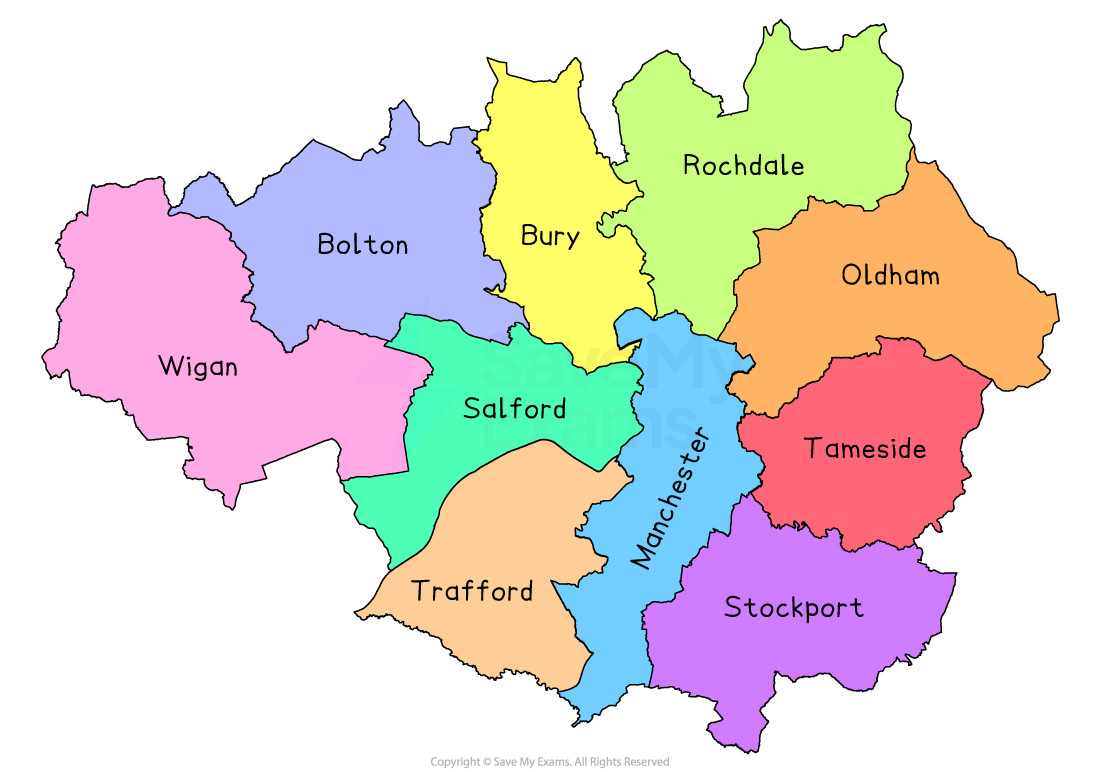
The Greater Manchester Combined Authority
What is the GMCA?
The Greater Manchester Combined Authority is a Strategic Mayoral Authority made up of 10 neighbouring local councils
It was created to allow decisions about the region to be made closer to local people rather than by central government
Powers and responsibilities
The GMCA is led by a directly elected Mayor of Greater Manchester, who works with the local councils
The authority has powers over transport, including buses and major roads, housing and planning, economic growth, and skills and employment
It also has responsibility for the police budget
Impact
Greater Manchester has used devolved powers to introduce bus franchising, improve transport links and coordinate economic development across the region
Should Scotland be independent?
In 2014, Scotland held a referendum asking voters whether they thought Scotland should be an independent country
All Scottish residents aged 16 and over were allowed to vote, extending the franchise below the usual age of 18
55.3% voted against independence, but the debate continues
Arguments in favour of Scottish independence | Arguments against Scottish independence |
|---|---|
|
|
Current polling and attitudes to independence
Recent surveys show Scotland remains divided on independence
Polls often find support very close to 50% for each side when undecided voters are excluded
The Scottish National Party (SNP) continues to argue for a second referendum
However, the UK Supreme Court has said the Scottish Parliament cannot legislate for it without UK government approval.
Scottish political leaders say another referendum could be possible if pro-independence parties win a majority in the Scottish Parliament
The West Lothian question
The West Lothian question asks whether MPs from Scotland, Wales and Northern Ireland should be allowed to vote on laws that only affect England
It highlights a fairness issue created by devolution, as English MPs cannot vote on devolved matters in Scotland
Many laws passed at Westminster apply only to England, such as education or health policy
MPs from devolved nations can still vote on these English-only laws
This can affect outcomes, even though those MPs’ own constituencies are not affected
Arguments that the situation is unfair | Arguments for keeping the current system |
|---|---|
|
|
Attempts to address the issue
The UK government introduced “English Votes for English Laws” (EVEL) in 2015
EVEL required English-only laws to be approved by English MPs as well as the whole House of Commons
However, it was abolished in 2021, returning all voting power to all MPs
The West Lothian question therefore remains unresolved
It continues to be debated alongside wider discussions about devolution, English identity and the future of the UK

Unlock more, it's free!
Join the 100,000+ Students that ❤️ Save My Exams
the (exam) results speak for themselves:

Was this revision note helpful?