Elections (Edexcel GCSE Citizenship Studies): Revision Note
Exam code: 1CS0

Representative and direct democracy
The word ‘democracy’ comes from the Greek - demos meaning people and -kratos meaning power
It was encapsulated by President Abraham Lincoln in 1863
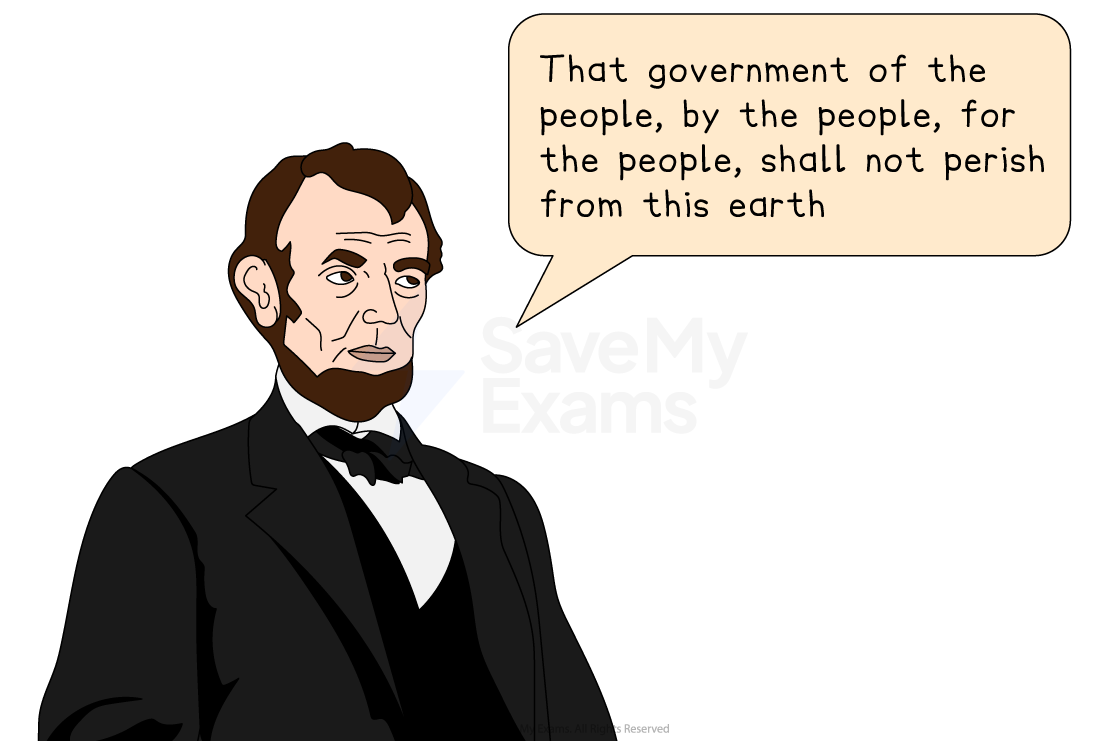
Democracy is a concept of government that has evolved over time
Key elements of democracy
If any of these elements are removed, democracy is undermined
Regular, fair and open public elections
A judiciary that is separate from government and that citizens can use to hold the government to account
Ability for citizens to stand for election
Ability to campaign for elected office on a fair and equal basis
A government that is elected and accountable
A media that is free to report on the actions of government
Secret voting, with the outcome reflecting the true views of voters
An electoral system that allows all voters to participate
Forms of democracy
The following are terms associated with democracy and are used to describe different democratic systems
Form of democracy | Explanation | Strengths | Weaknesses |
|---|---|---|---|
Direct democracy |
|
|
|
Representative democracy |
|
|
|
General elections
General elections are nationwide votes where people choose Members of Parliament to decide which political party will form the government
The date of a general election is normally decided by the Prime Minister
It must be within five years of the last election, but can be earlier than this
It is possible for Parliament to pass a vote of no confidence in the government and thereby force a general election to be called
Who can and can't vote?
A person must be registered to vote in a UK parliamentary constituency
Registration must be completed before the official deadline
A person must be old enough on polling day
The voting age is currently 18 in general elections
A person must be registered at a local address.
This determines where their vote is counted
A person must not be legally excluded from voting
Some groups, such as prisoners serving a custodial sentence, cannot vote
Members of the House of Lords cannot vote because they already take part in Parliament
In all parts of the UK, citizens are entitled to vote if
They are a British or Irish citizen
They have permission to remain in the UK, regardless of nationality
Extending the franchise
The voting age for UK general elections is currently 18
However, 16- and 17-year-olds can already vote in:
Scottish Parliament elections
Senedd (Welsh Parliament) elections
Local elections in Scotland and Wales
This means the UK already has different voting ages depending on the type of election, which has increased debate about consistency
Government plans and future developments
The current UK government has proposed lowering the voting age to 16 for UK general elections
This change would require new legislation passed by Parliament
The next general election must take place by June 2029, and the government has indicated it aims to introduce the change before then
If implemented, the reform would add over one million new eligible voters, significantly expanding the electorate
Arguments for and against lowering the voting age
Arguments for | Arguments against |
|---|---|
|
|
Public and political views
Public opinion on votes at 16 is divided, with support generally higher among younger people than older voters
Most left-leaning parties support lowering the voting age
The Conservative Party has traditionally opposed the change
Several countries, including Austria, already allow voting at 16 in national elections, providing an example of international success

Unlock more, it's free!
Join the 100,000+ Students that ❤️ Save My Exams
the (exam) results speak for themselves:

Was this revision note helpful?