Paper 2: Section A Reading (WJEC Eduqas GCSE English Language: Paper 2): Exam Questions

Exam code: C700

6 hours54 questions
1a
1 mark

Read the newspaper article in the Resource Material. (opens in a new tab)

How long did Sally Minty-Gravett’s eighth Channel swim take?

1b
1 mark

Who told Sally that she should attempt to swim the Channel?

1c
1 mark

Name one activity that Sally thinks she might like to learn to do after retiring from swimming.

2
10 marks

Read the newspaper article in the Resource Material. (opens in a new tab)

How does the writer try to show that Sally Minty-Gravett loves sea and Channel swimming?

You should comment on:

  • what readers are told about Sally Minty-Gravett’s sea and Channel swimming

  • the use of language, tone and structure

You must refer to the text to support your comments, using relevant subject terminology where appropriate.

3a
1 mark

In 1875, Captain Matthew Webb attempted to swim the English Channel. This account of the swim was written by Arthur Payne, who was in the support boat.

Our support boat was got ready and at one o’clock our brave Captain Webb, committed to becoming the first person to swim the English Channel and well smothered in thick grease for warmth, dived in from the end of the Admiralty Pier. As he swam away, his broad shoulders shooting through the water and gleaming in the sunshine, he very much resembled some large seal or huge fish, not merely in smell but in appearance, and swimming strongly with a stroke of twenty-two to the minute.

By 3pm quantities of dolphins were now swimming around us. Some in our boat thought these creatures may have been attracted by the smell of the grease with which Webb had covered himself. Soon after 7pm the sun set and all this time Webb continued with the same steady stroke. He rarely spoke, evidently determined to do or die. It began to grow dark and by 10pm he had been in the water nine hours when he suddenly cried out, “I am stung.” It startled all of us and we felt this might be the signal for giving up the attempt. Fortunately, however, a jelly-fish had only touched his shoulder and in a few minutes he reported himself as feeling all right.

In the early morning mist the chalk cliffs near Cape Gris-Nez in France were visible but Webb now showed evident symptoms of fatigue; he appeared very anxious as he knew the tide would shortly turn, carrying him away from the French coast. He was now only swimming sixteen strokes to the minute, and appeared to labour very much. Webb had thought he would complete the swim in about fourteen hours but he had already been in the water eighteen hours, and the tide had now turned, carrying him every moment further away from the goal he so longed to reach. He began to lose all hope and at that moment there was but one opinion, and that was that he had no chance.

Webb, fearfully exhausted, still toiled on bravely. He could do little more than keep himself up; his hands seemed to drop and his legs were so weak that he could barely bring them together at the end of each stroke. We had, however, now drifted till we were directly off Calais Pier and we could see that at last Webb was drawing slowly into shore. He could not have been more than 200 yards from shore but he was barely keeping afloat after more than twenty-one hours in the sea. It was now or never – twelve strokes a minute, and barely that. Although rain clouds had begun to form, a crowd had gathered on the sands near the pier and cheered till they were hoarse. He was within 100 yards of shore and some men struck up “Rule Britannia”. Finally, Webb touched ground in about three feet of water, a triumph of his endurance. He tried to stand up but fell heavily forward. In a second, two men were by his side and each took an arm. They assisted him to shore where he was covered in a blanket and driven off to the Paris Hotel, Calais.

What is Captain Webb compared to when he begins his swim?

3b
1 mark

How long did Captain Webb think his Channel swim would take?

3c
1 mark

What could be heard as Captain Webb came close to completing his swim?

4
10 marks

In 1875, Captain Matthew Webb attempted to swim the English Channel. This account of the swim was written by Arthur Payne, who was in the support boat.

Our support boat was got ready and at one o’clock our brave Captain Webb, committed to becoming the first person to swim the English Channel and well smothered in thick grease for warmth, dived in from the end of the Admiralty Pier. As he swam away, his broad shoulders shooting through the water and gleaming in the sunshine, he very much resembled some large seal or huge fish, not merely in smell but in appearance, and swimming strongly with a stroke of twenty-two to the minute.

By 3pm quantities of dolphins were now swimming around us. Some in our boat thought these creatures may have been attracted by the smell of the grease with which Webb had covered himself. Soon after 7pm the sun set and all this time Webb continued with the same steady stroke. He rarely spoke, evidently determined to do or die. It began to grow dark and by 10pm he had been in the water nine hours when he suddenly cried out, “I am stung.” It startled all of us and we felt this might be the signal for giving up the attempt. Fortunately, however, a jelly-fish had only touched his shoulder and in a few minutes he reported himself as feeling all right.

In the early morning mist the chalk cliffs near Cape Gris-Nez in France were visible but Webb now showed evident symptoms of fatigue; he appeared very anxious as he knew the tide would shortly turn, carrying him away from the French coast. He was now only swimming sixteen strokes to the minute, and appeared to labour very much. Webb had thought he would complete the swim in about fourteen hours but he had already been in the water eighteen hours, and the tide had now turned, carrying him every moment further away from the goal he so longed to reach. He began to lose all hope and at that moment there was but one opinion, and that was that he had no chance.

Webb, fearfully exhausted, still toiled on bravely. He could do little more than keep himself up; his hands seemed to drop and his legs were so weak that he could barely bring them together at the end of each stroke. We had, however, now drifted till we were directly off Calais Pier and we could see that at last Webb was drawing slowly into shore. He could not have been more than 200 yards from shore but he was barely keeping afloat after more than twenty-one hours in the sea. It was now or never – twelve strokes a minute, and barely that. Although rain clouds had begun to form, a crowd had gathered on the sands near the pier and cheered till they were hoarse. He was within 100 yards of shore and some men struck up “Rule Britannia”. Finally, Webb touched ground in about three feet of water, a triumph of his endurance. He tried to stand up but fell heavily forward. In a second, two men were by his side and each took an arm. They assisted him to shore where he was covered in a blanket and driven off to the Paris Hotel, Calais.

“We are never sure that Captain Webb’s attempt to swim the English Channel will be successful, until the very end of Arthur Payne’s account.”

To what extent do you agree with this view?

You should comment on:

  • what the writer says

  • how the writer says it.

You must refer to the text to support your comments.

5
4 marks

Read the newspaper article in the Resource Material. (opens in a new tab)

In 1875, Captain Matthew Webb attempted to swim the English Channel. This account of the swim was written by Arthur Payne, who was in the support boat.

Our support boat was got ready and at one o’clock our brave Captain Webb, committed to becoming the first person to swim the English Channel and well smothered in thick grease for warmth, dived in from the end of the Admiralty Pier. As he swam away, his broad shoulders shooting through the water and gleaming in the sunshine, he very much resembled some large seal or huge fish, not merely in smell but in appearance, and swimming strongly with a stroke of twenty-two to the minute.

By 3pm quantities of dolphins were now swimming around us. Some in our boat thought these creatures may have been attracted by the smell of the grease with which Webb had covered himself. Soon after 7pm the sun set and all this time Webb continued with the same steady stroke. He rarely spoke, evidently determined to do or die. It began to grow dark and by 10pm he had been in the water nine hours when he suddenly cried out, “I am stung.” It startled all of us and we felt this might be the signal for giving up the attempt. Fortunately, however, a jelly-fish had only touched his shoulder and in a few minutes he reported himself as feeling all right.

In the early morning mist the chalk cliffs near Cape Gris-Nez in France were visible but Webb now showed evident symptoms of fatigue; he appeared very anxious as he knew the tide would shortly turn, carrying him away from the French coast. He was now only swimming sixteen strokes to the minute, and appeared to labour very much. Webb had thought he would complete the swim in about fourteen hours but he had already been in the water eighteen hours, and the tide had now turned, carrying him every moment further away from the goal he so longed to reach. He began to lose all hope and at that moment there was but one opinion, and that was that he had no chance.

Webb, fearfully exhausted, still toiled on bravely. He could do little more than keep himself up; his hands seemed to drop and his legs were so weak that he could barely bring them together at the end of each stroke. We had, however, now drifted till we were directly off Calais Pier and we could see that at last Webb was drawing slowly into shore. He could not have been more than 200 yards from shore but he was barely keeping afloat after more than twenty-one hours in the sea. It was now or never – twelve strokes a minute, and barely that. Although rain clouds had begun to form, a crowd had gathered on the sands near the pier and cheered till they were hoarse. He was within 100 yards of shore and some men struck up “Rule Britannia”. Finally, Webb touched ground in about three feet of water, a triumph of his endurance. He tried to stand up but fell heavily forward. In a second, two men were by his side and each took an arm. They assisted him to shore where he was covered in a blanket and driven off to the Paris Hotel, Calais.

To answer the following questions you must use both texts.

Using information from both texts, explain briefly the weather conditions faced by Captain Webb and Sally Minty-Gravett on their Channel swims.

You should make it clear which text you are referring to.
6
10 marks

Read the newspaper article in the Resource Material. (opens in a new tab)

In 1875, Captain Matthew Webb attempted to swim the English Channel. This account of the swim was written by Arthur Payne, who was in the support boat.

Our support boat was got ready and at one o’clock our brave Captain Webb, committed to becoming the first person to swim the English Channel and well smothered in thick grease for warmth, dived in from the end of the Admiralty Pier. As he swam away, his broad shoulders shooting through the water and gleaming in the sunshine, he very much resembled some large seal or huge fish, not merely in smell but in appearance, and swimming strongly with a stroke of twenty-two to the minute.

By 3pm quantities of dolphins were now swimming around us. Some in our boat thought these creatures may have been attracted by the smell of the grease with which Webb had covered himself. Soon after 7pm the sun set and all this time Webb continued with the same steady stroke. He rarely spoke, evidently determined to do or die. It began to grow dark and by 10pm he had been in the water nine hours when he suddenly cried out, “I am stung.” It startled all of us and we felt this might be the signal for giving up the attempt. Fortunately, however, a jelly-fish had only touched his shoulder and in a few minutes he reported himself as feeling all right.

In the early morning mist the chalk cliffs near Cape Gris-Nez in France were visible but Webb now showed evident symptoms of fatigue; he appeared very anxious as he knew the tide would shortly turn, carrying him away from the French coast. He was now only swimming sixteen strokes to the minute, and appeared to labour very much. Webb had thought he would complete the swim in about fourteen hours but he had already been in the water eighteen hours, and the tide had now turned, carrying him every moment further away from the goal he so longed to reach. He began to lose all hope and at that moment there was but one opinion, and that was that he had no chance.

Webb, fearfully exhausted, still toiled on bravely. He could do little more than keep himself up; his hands seemed to drop and his legs were so weak that he could barely bring them together at the end of each stroke. We had, however, now drifted till we were directly off Calais Pier and we could see that at last Webb was drawing slowly into shore. He could not have been more than 200 yards from shore but he was barely keeping afloat after more than twenty-one hours in the sea. It was now or never – twelve strokes a minute, and barely that. Although rain clouds had begun to form, a crowd had gathered on the sands near the pier and cheered till they were hoarse. He was within 100 yards of shore and some men struck up “Rule Britannia”. Finally, Webb touched ground in about three feet of water, a triumph of his endurance. He tried to stand up but fell heavily forward. In a second, two men were by his side and each took an arm. They assisted him to shore where he was covered in a blanket and driven off to the Paris Hotel, Calais.

To answer the following questions you must use both texts.

Both of these texts are about swimmers who have successfully swum the English Channel.

Compare:

  • what makes Sally Minty-Gravett and Captain Webb successful Channel swimmers

  • how the writers show what makes them successful Channel swimmers.

You must use the text to support your answers and make it clear which text you are referring to.

7a
1 mark

Read the newspaper article ‘The schoolboy who conquered the Matterhorn’ in the Resource Material. (opens in a new tab)

The Matterhorn is in which mountain range?

7b
1 mark

Why do climbers set off early in the morning to climb the Matterhorn?

7c
1 mark

According to Jules Molyneaux, what is the most dangerous part of a climb?

8
10 marks

Read the newspaper article ‘The schoolboy who conquered the Matterhorn’ in the Resource Material. (opens in a new tab)

How does the writer try to show that it was a remarkable achievement for Jules Molyneaux to climb the Matterhorn?

You should comment on:

  • what the writer says

  • his use of language, tone and structure

  • other ways the writer tries to show that climbing the Matterhorn was a remarkable achievement

You must refer to the text to support your comments, using relevant subject terminology where appropriate.

9a
1 mark

Read the account from ‘A Lady’s Life in the Rocky Mountains’

Isabella Bird was a writer and explorer. In 1886 she published a book called, ‘A Lady’s Life in the Rocky Mountains’, which included this account of her climbing the mountain, Long’s Peak.

Long’s Peak, 14,700 feet high, dwarfs all the surrounding mountains. Some call it ‘the American Matterhorn’, and it was climbed five years ago for the first time. I thought I should like to attempt it and had a local guide, Jim Nugent, to accompany me.

I have no head for heights and never ought to dream of mountaineering; and had I known that the ascent was a real mountaineering feat I should not have felt the slightest ambition to perform it. As it is, I am only embarrassed by my success, for where I found it impossible to continue, Jim dragged me up, like a sack of goods, by sheer force of muscle.

At the outcrop of rock called the Notch the real business of the climb began. Two thousand feet of rock towered above us, and many of the rocks were loose, and tumbled down when touched. To me it was a time of extreme terror. I was roped to Jim, but it was of no use; my feet were paralysed and slipped on the bare rock.

My fatigue and pain from bruised ankles were so great that I should have given up had not Jim dragged me along with patience and skill, and with an unfailing determination that I should reach the top. We got into a deep gorge with inaccessible sides, partly filled with ice and snow and partly with large fragments of rock, which were constantly giving way, making the footing very insecure. That part of the climb took two hours of painful scrambling, of trembling and slipping, of smooth ice appearing when it was least expected, and my weak requests to return. Jim always said that there was no danger, that there was only a short bad bit ahead, and that I should get there even if he carried me!

Slipping and gasping from the exhausting toil in the thin air, with throbbing hearts and panting lungs, we reached the top of the gorge and squeezed ourselves between two gigantic fragments of rock. Above, Long’s Peak looked nearly vertical for 400 feet; and below, the most terrifying cliff face I had ever seen descended in one unbroken fall. This, I thought, was the worst part of the climb: one slip, and a breathing, thinking, human being would lie 3,000 feet below, a shapeless, bloody heap!

It took one hour to accomplish the final 200 feet, pausing for breath every minute or two, and all the while tortured with thirst and gasping and struggling for breath. The boulders were of enormous size, and the steepness of the climb fearful. Sometimes I drew myself up on hands and knees, sometimes I crawled and sometimes Jim pulled me up by my arms or the rope. He was gentle and considerate beyond anything, although I knew that he must be grievously disappointed, both in my courage and strength. This was the climb but at last Long’s Peak was won. From the summit were seen all the views which had rejoiced our eyes during the ascent and it was wonderful at last to stand upon the top of this noblest of mountains of the Rocky Range, on the backbone of the North American continent and well deserving the name of ‘the American Matterhorn’.

How do we know that Long’s Peak is higher than the mountains around it?

9b
1 mark

According to the text, where did the real business of the climb begin?

9c
1 mark

How long did it take Isabella Bird and Jim Nugent to reach the top of the gorge?

10
10 marks

Read the account from ‘A Lady’s Life in the Rocky Mountains’

Isabella Bird was a writer and explorer. In 1886 she published a book called, ‘A Lady’s Life in the Rocky Mountains’, which included this account of her climbing the mountain, Long’s Peak.

Long’s Peak, 14,700 feet high, dwarfs all the surrounding mountains. Some call it ‘the American Matterhorn’, and it was climbed five years ago for the first time. I thought I should like to attempt it and had a local guide, Jim Nugent, to accompany me.

I have no head for heights and never ought to dream of mountaineering; and had I known that the ascent was a real mountaineering feat I should not have felt the slightest ambition to perform it. As it is, I am only embarrassed by my success, for where I found it impossible to continue, Jim dragged me up, like a sack of goods, by sheer force of muscle.

At the outcrop of rock called the Notch the real business of the climb began. Two thousand feet of rock towered above us, and many of the rocks were loose, and tumbled down when touched. To me it was a time of extreme terror. I was roped to Jim, but it was of no use; my feet were paralysed and slipped on the bare rock.

My fatigue and pain from bruised ankles were so great that I should have given up had not Jim dragged me along with patience and skill, and with an unfailing determination that I should reach the top. We got into a deep gorge with inaccessible sides, partly filled with ice and snow and partly with large fragments of rock, which were constantly giving way, making the footing very insecure. That part of the climb took two hours of painful scrambling, of trembling and slipping, of smooth ice appearing when it was least expected, and my weak requests to return. Jim always said that there was no danger, that there was only a short bad bit ahead, and that I should get there even if he carried me!

Slipping and gasping from the exhausting toil in the thin air, with throbbing hearts and panting lungs, we reached the top of the gorge and squeezed ourselves between two gigantic fragments of rock. Above, Long’s Peak looked nearly vertical for 400 feet; and below, the most terrifying cliff face I had ever seen descended in one unbroken fall. This, I thought, was the worst part of the climb: one slip, and a breathing, thinking, human being would lie 3,000 feet below, a shapeless, bloody heap!

It took one hour to accomplish the final 200 feet, pausing for breath every minute or two, and all the while tortured with thirst and gasping and struggling for breath. The boulders were of enormous size, and the steepness of the climb fearful. Sometimes I drew myself up on hands and knees, sometimes I crawled and sometimes Jim pulled me up by my arms or the rope. He was gentle and considerate beyond anything, although I knew that he must be grievously disappointed, both in my courage and strength. This was the climb but at last Long’s Peak was won. From the summit were seen all the views which had rejoiced our eyes during the ascent and it was wonderful at last to stand upon the top of this noblest of mountains of the Rocky Range, on the backbone of the North American continent and well deserving the name of ‘the American Matterhorn’.

“Isabella Bird’s account convincingly shows the difficulties Long’s Peak presents to climbers.”

To what extent do you agree with this view?

You should comment on:

  • what the writer says

  • how the writer says it

You must refer to the text to support your comments.

11
4 marks

Read the newspaper article ‘The schoolboy who conquered the Matterhorn’ in the (opens in a new tab)Resource Material. (opens in a new tab)

Read the account from ‘A Lady’s Life in the Rocky Mountains’

Isabella Bird was a writer and explorer. In 1886 she published a book called, ‘A Lady’s Life in the Rocky Mountains’, which included this account of her climbing the mountain, Long’s Peak.

Long’s Peak, 14,700 feet high, dwarfs all the surrounding mountains. Some call it ‘the American Matterhorn’, and it was climbed five years ago for the first time. I thought I should like to attempt it and had a local guide, Jim Nugent, to accompany me.

I have no head for heights and never ought to dream of mountaineering; and had I known that the ascent was a real mountaineering feat I should not have felt the slightest ambition to perform it. As it is, I am only embarrassed by my success, for where I found it impossible to continue, Jim dragged me up, like a sack of goods, by sheer force of muscle.

At the outcrop of rock called the Notch the real business of the climb began. Two thousand feet of rock towered above us, and many of the rocks were loose, and tumbled down when touched. To me it was a time of extreme terror. I was roped to Jim, but it was of no use; my feet were paralysed and slipped on the bare rock.

My fatigue and pain from bruised ankles were so great that I should have given up had not Jim dragged me along with patience and skill, and with an unfailing determination that I should reach the top. We got into a deep gorge with inaccessible sides, partly filled with ice and snow and partly with large fragments of rock, which were constantly giving way, making the footing very insecure. That part of the climb took two hours of painful scrambling, of trembling and slipping, of smooth ice appearing when it was least expected, and my weak requests to return. Jim always said that there was no danger, that there was only a short bad bit ahead, and that I should get there even if he carried me!

Slipping and gasping from the exhausting toil in the thin air, with throbbing hearts and panting lungs, we reached the top of the gorge and squeezed ourselves between two gigantic fragments of rock. Above, Long’s Peak looked nearly vertical for 400 feet; and below, the most terrifying cliff face I had ever seen descended in one unbroken fall. This, I thought, was the worst part of the climb: one slip, and a breathing, thinking, human being would lie 3,000 feet below, a shapeless, bloody heap!

It took one hour to accomplish the final 200 feet, pausing for breath every minute or two, and all the while tortured with thirst and gasping and struggling for breath. The boulders were of enormous size, and the steepness of the climb fearful. Sometimes I drew myself up on hands and knees, sometimes I crawled and sometimes Jim pulled me up by my arms or the rope. He was gentle and considerate beyond anything, although I knew that he must be grievously disappointed, both in my courage and strength. This was the climb but at last Long’s Peak was won. From the summit were seen all the views which had rejoiced our eyes during the ascent and it was wonderful at last to stand upon the top of this noblest of mountains of the Rocky Range, on the backbone of the North American continent and well deserving the name of ‘the American Matterhorn’.

To answer the following questions you must use both texts.

Using information from both texts, explain briefly what readers learn about:

  • Jules Molyneaux’s father

  • Isabella Bird’s guide, Jim Nugent

12
10 marks

Read the newspaper article ‘The schoolboy who conquered the Matterhorn’ in the Resource Material. (opens in a new tab)

Read the account from ‘A Lady’s Life in the Rocky Mountains’

Isabella Bird was a writer and explorer. In 1886 she published a book called, ‘A Lady’s Life in the Rocky Mountains’, which included this account of her climbing the mountain, Long’s Peak.

Long’s Peak, 14,700 feet high, dwarfs all the surrounding mountains. Some call it ‘the American Matterhorn’, and it was climbed five years ago for the first time. I thought I should like to attempt it and had a local guide, Jim Nugent, to accompany me.

I have no head for heights and never ought to dream of mountaineering; and had I known that the ascent was a real mountaineering feat I should not have felt the slightest ambition to perform it. As it is, I am only embarrassed by my success, for where I found it impossible to continue, Jim dragged me up, like a sack of goods, by sheer force of muscle.

At the outcrop of rock called the Notch the real business of the climb began. Two thousand feet of rock towered above us, and many of the rocks were loose, and tumbled down when touched. To me it was a time of extreme terror. I was roped to Jim, but it was of no use; my feet were paralysed and slipped on the bare rock.

My fatigue and pain from bruised ankles were so great that I should have given up had not Jim dragged me along with patience and skill, and with an unfailing determination that I should reach the top. We got into a deep gorge with inaccessible sides, partly filled with ice and snow and partly with large fragments of rock, which were constantly giving way, making the footing very insecure. That part of the climb took two hours of painful scrambling, of trembling and slipping, of smooth ice appearing when it was least expected, and my weak requests to return. Jim always said that there was no danger, that there was only a short bad bit ahead, and that I should get there even if he carried me!

Slipping and gasping from the exhausting toil in the thin air, with throbbing hearts and panting lungs, we reached the top of the gorge and squeezed ourselves between two gigantic fragments of rock. Above, Long’s Peak looked nearly vertical for 400 feet; and below, the most terrifying cliff face I had ever seen descended in one unbroken fall. This, I thought, was the worst part of the climb: one slip, and a breathing, thinking, human being would lie 3,000 feet below, a shapeless, bloody heap!

It took one hour to accomplish the final 200 feet, pausing for breath every minute or two, and all the while tortured with thirst and gasping and struggling for breath. The boulders were of enormous size, and the steepness of the climb fearful. Sometimes I drew myself up on hands and knees, sometimes I crawled and sometimes Jim pulled me up by my arms or the rope. He was gentle and considerate beyond anything, although I knew that he must be grievously disappointed, both in my courage and strength. This was the climb but at last Long’s Peak was won. From the summit were seen all the views which had rejoiced our eyes during the ascent and it was wonderful at last to stand upon the top of this noblest of mountains of the Rocky Range, on the backbone of the North American continent and well deserving the name of ‘the American Matterhorn’.

To answer the following questions you must use both texts.

Both of these texts are about people who have climbed mountains.

Compare:

  • Jules Molyneaux’s and Isabella Bird’s thoughts and feelings while they were climbing the mountains

  • how they get their thoughts and feelings across to their readers

You must use the text to support your comments and make it clear which text you are referring to.

13a
1 mark

Read the newspaper article, ‘We save people. It’s just our job’ in the Resource Material. (opens in a new tab)

What was the date of the rescue that Aileen Jones was involved in?

13b
1 mark

What was the name of the boat that got into trouble?

13c
1 mark

How long did the rescue last?

14
10 marks

Read the newspaper article, ‘We save people. It’s just our job’ in the Resource Material. (opens in a new tab)

How does the writer, Louise France, try to show the rescue was both dangerous and dramatic?

You should comment on:

  • what is said

  • the use of language, tone and structure

You must refer to the text to support your comments, using relevant subject terminology where appropriate.

15a
1 mark

Read the newspaper article from the New York Tribune.

Ida Lewis lived with her family at the Lime Rock lighthouse in Newport, America and became famous for the many rescues she carried out over many years. The article below appeared in the New York Tribune newspaper in 1869.

Two weeks ago, towards the end of a stormy, cold March afternoon, the brave daughter of the Lime Rock lighthouse keeper in Newport harbour performed a deed of great heroism, although quite unwell at the time and suffering from a severe cold. The heroine of this daring rescue was Ida Lewis, whose first rescue dates back to when she was only 17. On that occasion, four lads capsized a small boat and were in imminent danger of perishing. When Ida saw their situation, she set out in her rowboat and succeeded in picking them all up and taking them safely back to shore.

Ida Lewis’ most recent rescue saved the lives of two soldiers. The rain fell that day in blinding torrents, and a gale drove the waves across the harbour with a fury that taxed the full strength and skill of the most experienced boatmen. In the midst of this storm, a reckless boy, scarcely fourteen years old, had somehow gained possession of one of the smallest and most unsafe sail-boats in the harbour. He then persuaded two soldiers to let him sail them across from Newport to Fort Adams where they were stationed. Anxious to avoid the dreary three-mile tramp by land in the ferocious storm, and believing the lad could manage the boat, they trusted themselves to him.

Halfway across the harbour a sudden squall struck the sail and the boat capsized in an instant, throwing all three into the foaming water, the huge waves rolling the boat over twice and then dashing against the upturned boat. For a long half-hour the luckless occupants clung desperately to the boat and wrestled against the rain and the fierce salt waves with all the energy of despair; but finally the boy’s strength was exhausted, his hold relaxed and he was gone, swept away in an instant.

Fortunately for the two men, Ida’s mother, looking out to sea from the lighthouse, had seen the perilous situation the soldiers were in, clinging to the small boat in an exhausted condition. She immediately reported the fact to Ida, who rushed outside without covering on her head or feet and grabbed a coil of rope. The sea was heavy and a fearful gale was raging, but jumping into her boat with little thought of her own safety, she called to her younger brother to go with and aid her. In the perilous conditions the management of the boat was extremely difficult, even to an experienced oarswoman like Ida.

In the water, fast becoming paralysed with cold and almost bereft of hope, the two soldiers saw no choice but to clasp each other in a last embrace and sink to a watery grave – when suddenly they saw the little rowboat, driven by Ida’s rapid strokes, coming over the bounding waves toward them. On came Ida’s boat and as it reached the men, the quickwitted woman turned the boat with a well-timed stroke, backing it up so that one man was pulled to safety over the back of the boat by Ida’s younger brother. With another strong backward pull on the oars, the other soldier was lifted aboard. The next moment, the boat with its freight of rescued lives was scudding swiftly through the spray back to the Lime Rock again. One of the soldiers was able to stagger ashore but the other had to be carried into the lighthouse from where they were safely conveyed to Fort Adams the next day

How many people did Ida Lewis save in her first rescue?

15b
1 mark

How long were the soldiers in the water before the boy was swept away?

15c
1 mark

Give one piece of evidence to show that the soldiers were in a poor condition after the rescue.

16
10 marks

Read the newspaper article from the New York Tribune.

Ida Lewis lived with her family at the Lime Rock lighthouse in Newport, America and became famous for the many rescues she carried out over many years. The article below appeared in the New York Tribune newspaper in 1869.

Two weeks ago, towards the end of a stormy, cold March afternoon, the brave daughter of the Lime Rock lighthouse keeper in Newport harbour performed a deed of great heroism, although quite unwell at the time and suffering from a severe cold. The heroine of this daring rescue was Ida Lewis, whose first rescue dates back to when she was only 17. On that occasion, four lads capsized a small boat and were in imminent danger of perishing. When Ida saw their situation, she set out in her rowboat and succeeded in picking them all up and taking them safely back to shore.

Ida Lewis’ most recent rescue saved the lives of two soldiers. The rain fell that day in blinding torrents, and a gale drove the waves across the harbour with a fury that taxed the full strength and skill of the most experienced boatmen. In the midst of this storm, a reckless boy, scarcely fourteen years old, had somehow gained possession of one of the smallest and most unsafe sail-boats in the harbour. He then persuaded two soldiers to let him sail them across from Newport to Fort Adams where they were stationed. Anxious to avoid the dreary three-mile tramp by land in the ferocious storm, and believing the lad could manage the boat, they trusted themselves to him.

Halfway across the harbour a sudden squall struck the sail and the boat capsized in an instant, throwing all three into the foaming water, the huge waves rolling the boat over twice and then dashing against the upturned boat. For a long half-hour the luckless occupants clung desperately to the boat and wrestled against the rain and the fierce salt waves with all the energy of despair; but finally the boy’s strength was exhausted, his hold relaxed and he was gone, swept away in an instant.

Fortunately for the two men, Ida’s mother, looking out to sea from the lighthouse, had seen the perilous situation the soldiers were in, clinging to the small boat in an exhausted condition. She immediately reported the fact to Ida, who rushed outside without covering on her head or feet and grabbed a coil of rope. The sea was heavy and a fearful gale was raging, but jumping into her boat with little thought of her own safety, she called to her younger brother to go with and aid her. In the perilous conditions the management of the boat was extremely difficult, even to an experienced oarswoman like Ida.

In the water, fast becoming paralysed with cold and almost bereft of hope, the two soldiers saw no choice but to clasp each other in a last embrace and sink to a watery grave – when suddenly they saw the little rowboat, driven by Ida’s rapid strokes, coming over the bounding waves toward them. On came Ida’s boat and as it reached the men, the quickwitted woman turned the boat with a well-timed stroke, backing it up so that one man was pulled to safety over the back of the boat by Ida’s younger brother. With another strong backward pull on the oars, the other soldier was lifted aboard. The next moment, the boat with its freight of rescued lives was scudding swiftly through the spray back to the Lime Rock again. One of the soldiers was able to stagger ashore but the other had to be carried into the lighthouse from where they were safely conveyed to Fort Adams the next day

“The newspaper article paints a vivid picture of the difficult conditions faced by Ida and her brother on the day they rescued the soldiers.”

To what extent do you agree with this view?

You should comment on:

  • what is said

  • how it is said

You must refer to the text to support your comments.

17
4 marks

Read the newspaper article, ‘We save people. It’s just our job’ in the Resource Material. (opens in a new tab)

Read the newspaper article from the New York Tribune.

Ida Lewis lived with her family at the Lime Rock lighthouse in Newport, America and became famous for the many rescues she carried out over many years. The article below appeared in the New York Tribune newspaper in 1869.

Two weeks ago, towards the end of a stormy, cold March afternoon, the brave daughter of the Lime Rock lighthouse keeper in Newport harbour performed a deed of great heroism, although quite unwell at the time and suffering from a severe cold. The heroine of this daring rescue was Ida Lewis, whose first rescue dates back to when she was only 17. On that occasion, four lads capsized a small boat and were in imminent danger of perishing. When Ida saw their situation, she set out in her rowboat and succeeded in picking them all up and taking them safely back to shore.

Ida Lewis’ most recent rescue saved the lives of two soldiers. The rain fell that day in blinding torrents, and a gale drove the waves across the harbour with a fury that taxed the full strength and skill of the most experienced boatmen. In the midst of this storm, a reckless boy, scarcely fourteen years old, had somehow gained possession of one of the smallest and most unsafe sail-boats in the harbour. He then persuaded two soldiers to let him sail them across from Newport to Fort Adams where they were stationed. Anxious to avoid the dreary three-mile tramp by land in the ferocious storm, and believing the lad could manage the boat, they trusted themselves to him.

Halfway across the harbour a sudden squall struck the sail and the boat capsized in an instant, throwing all three into the foaming water, the huge waves rolling the boat over twice and then dashing against the upturned boat. For a long half-hour the luckless occupants clung desperately to the boat and wrestled against the rain and the fierce salt waves with all the energy of despair; but finally the boy’s strength was exhausted, his hold relaxed and he was gone, swept away in an instant.

Fortunately for the two men, Ida’s mother, looking out to sea from the lighthouse, had seen the perilous situation the soldiers were in, clinging to the small boat in an exhausted condition. She immediately reported the fact to Ida, who rushed outside without covering on her head or feet and grabbed a coil of rope. The sea was heavy and a fearful gale was raging, but jumping into her boat with little thought of her own safety, she called to her younger brother to go with and aid her. In the perilous conditions the management of the boat was extremely difficult, even to an experienced oarswoman like Ida.

In the water, fast becoming paralysed with cold and almost bereft of hope, the two soldiers saw no choice but to clasp each other in a last embrace and sink to a watery grave – when suddenly they saw the little rowboat, driven by Ida’s rapid strokes, coming over the bounding waves toward them. On came Ida’s boat and as it reached the men, the quickwitted woman turned the boat with a well-timed stroke, backing it up so that one man was pulled to safety over the back of the boat by Ida’s younger brother. With another strong backward pull on the oars, the other soldier was lifted aboard. The next moment, the boat with its freight of rescued lives was scudding swiftly through the spray back to the Lime Rock again. One of the soldiers was able to stagger ashore but the other had to be carried into the lighthouse from where they were safely conveyed to Fort Adams the next day.

To answer the following questions you must use both texts.

Using information from both texts, explain briefly the immediate reactions of Aileen Jones and Ida Lewis when they heard that the fishermen and the soldiers were in danger

18
10 marks

Read the newspaper article, ‘We save people. It’s just our job’ in the Resource Material. (opens in a new tab)

Read the newspaper article from the New York Tribune.

Ida Lewis lived with her family at the Lime Rock lighthouse in Newport, America and became famous for the many rescues she carried out over many years. The article below appeared in the New York Tribune newspaper in 1869.

Two weeks ago, towards the end of a stormy, cold March afternoon, the brave daughter of the Lime Rock lighthouse keeper in Newport harbour performed a deed of great heroism, although quite unwell at the time and suffering from a severe cold. The heroine of this daring rescue was Ida Lewis, whose first rescue dates back to when she was only 17. On that occasion, four lads capsized a small boat and were in imminent danger of perishing. When Ida saw their situation, she set out in her rowboat and succeeded in picking them all up and taking them safely back to shore.

Ida Lewis’ most recent rescue saved the lives of two soldiers. The rain fell that day in blinding torrents, and a gale drove the waves across the harbour with a fury that taxed the full strength and skill of the most experienced boatmen. In the midst of this storm, a reckless boy, scarcely fourteen years old, had somehow gained possession of one of the smallest and most unsafe sail-boats in the harbour. He then persuaded two soldiers to let him sail them across from Newport to Fort Adams where they were stationed. Anxious to avoid the dreary three-mile tramp by land in the ferocious storm, and believing the lad could manage the boat, they trusted themselves to him.

Halfway across the harbour a sudden squall struck the sail and the boat capsized in an instant, throwing all three into the foaming water, the huge waves rolling the boat over twice and then dashing against the upturned boat. For a long half-hour the luckless occupants clung desperately to the boat and wrestled against the rain and the fierce salt waves with all the energy of despair; but finally the boy’s strength was exhausted, his hold relaxed and he was gone, swept away in an instant.

Fortunately for the two men, Ida’s mother, looking out to sea from the lighthouse, had seen the perilous situation the soldiers were in, clinging to the small boat in an exhausted condition. She immediately reported the fact to Ida, who rushed outside without covering on her head or feet and grabbed a coil of rope. The sea was heavy and a fearful gale was raging, but jumping into her boat with little thought of her own safety, she called to her younger brother to go with and aid her. In the perilous conditions the management of the boat was extremely difficult, even to an experienced oarswoman like Ida.

In the water, fast becoming paralysed with cold and almost bereft of hope, the two soldiers saw no choice but to clasp each other in a last embrace and sink to a watery grave – when suddenly they saw the little rowboat, driven by Ida’s rapid strokes, coming over the bounding waves toward them. On came Ida’s boat and as it reached the men, the quickwitted woman turned the boat with a well-timed stroke, backing it up so that one man was pulled to safety over the back of the boat by Ida’s younger brother. With another strong backward pull on the oars, the other soldier was lifted aboard. The next moment, the boat with its freight of rescued lives was scudding swiftly through the spray back to the Lime Rock again. One of the soldiers was able to stagger ashore but the other had to be carried into the lighthouse from where they were safely conveyed to Fort Adams the next day.

To answer the following questions you must use both texts.

Both of these texts are about women who were involved in rescues at sea.

Compare:

  • the impressions the writers create of Aileen Jones and Ida Lewis

  • how the writers create these impressions

You must use the text to support your comments and make it clear which text you are referring to.
19a
1 mark

Read the newspaper article in the Resource Material. (opens in a new tab)

Where is the skeleton of Jumbo kept?

19b
1 mark

Why was Jumbo sold to the Barnum Circus?

19c
1 mark

Give one piece of evidence that showed people did not want Jumbo to go to America.

20
10 marks

Read the newspaper article in the separate Resource Material. (opens in a new tab)

How does the writer, Alan Lee, try to show that Jumbo was a much-loved ‘Victorian sensation’?

You should comment on:

  • what he says

  • his use of language, tone and structure

  • other ways he tries to show Jumbo was a much-loved elephant.

You must refer to the text to support your comments, using relevant subject terminology where appropriate.

21a
1 mark

Read the passage taken from Matthew Scott’s autobiography.

When Jumbo the elephant was brought to England and to London Zoo in 1865, he was looked after by Matthew Scott, his keeper. The passage below is taken from Scott’s autobiography, published in 1885.

When I first saw Jumbo and he was given into my care, the poor thing was full of disease, and his whole hide covered with sores. However, I undertook to be his doctor, his nurse and general servant. I watched and nursed him night and day with all the care and affection of a mother and I am now rewarded by having a fine-looking creature in a perfectly sound state of mind and body. He is the largest, most intelligent and certainly the most powerful living creature in creation. Jumbo’s daily diet is composed of hay, oats and bread; his drink is chiefly water but as a treat he can cope with a big dram of whisky. He weighs nearly eight tons and he stands today over twelve feet high. All the experience I share with him is a pleasure to me and is a great reward, which I am thankful for in these, my older days but so long as I am permitted the company of dear old Jumbo, I shall be quite contented. I am happy in his company and do not wish to leave it.

Jumbo has been a busy, industrious creature all his life, especially since I brought him from his sick bed. He has no idle days for ‘loafing’ or otherwise wasting his time. He has been engaged in carrying around children almost daily for twenty years, and I suppose no animal has ever carried so many on his back as Jumbo. Certainly, I can claim for him that no animal ever did his work more affectionately or tenderly, and without accident. Once when I was riding him around in the Zoological Gardens, sitting on his neck with about a dozen children on his broad back, we were proceeding down the path when all at once Jumbo came to a standstill. I shouted to him to go along but for once he did not obey the order. As I turned round to see what was the matter, there was a lady running on to the path screaming and shouting, “Oh, my poor child! Oh, he will be killed, he will be killed!” When I looked down, I saw Jumbo deliberately and coolly putting his trunk around the body of an infant that had escaped its mother’s apronstrings and had run and fallen in front of him. He just stopped right there, gently picked up the child by the waist with his trunk and laid it beside its screaming mother, more tenderly than the mother afterward took up the frightened child in her excitement.

Jumbo never gets excited when he is attending to children, who love to see him eat the cakes they give him. He might get mad once in a while when provoked by some drunken fool but I want you to think of Jumbo as a kind, affectionate creature and remember, when you see anyone in trouble, you should go instantly to the rescue, and remember that Jumbo did the same thing.

How much did Jumbo weigh?

21b
1 mark

How long had Jumbo been giving children rides in London Zoo?

21c
1 mark

Give the detail from the text that shows Jumbo would usually do what Matthew Scott asked him.

22
10 marks

Read the passage taken from Matthew Scott’s autobiography.

When Jumbo the elephant was brought to England and to London Zoo in 1865, he was looked after by Matthew Scott, his keeper. The passage below is taken from Scott’s autobiography, published in 1885.

When I first saw Jumbo and he was given into my care, the poor thing was full of disease, and his whole hide covered with sores. However, I undertook to be his doctor, his nurse and general servant. I watched and nursed him night and day with all the care and affection of a mother and I am now rewarded by having a fine-looking creature in a perfectly sound state of mind and body. He is the largest, most intelligent and certainly the most powerful living creature in creation. Jumbo’s daily diet is composed of hay, oats and bread; his drink is chiefly water but as a treat he can cope with a big dram of whisky. He weighs nearly eight tons and he stands today over twelve feet high. All the experience I share with him is a pleasure to me and is a great reward, which I am thankful for in these, my older days but so long as I am permitted the company of dear old Jumbo, I shall be quite contented. I am happy in his company and do not wish to leave it.

Jumbo has been a busy, industrious creature all his life, especially since I brought him from his sick bed. He has no idle days for ‘loafing’ or otherwise wasting his time. He has been engaged in carrying around children almost daily for twenty years, and I suppose no animal has ever carried so many on his back as Jumbo. Certainly, I can claim for him that no animal ever did his work more affectionately or tenderly, and without accident. Once when I was riding him around in the Zoological Gardens, sitting on his neck with about a dozen children on his broad back, we were proceeding down the path when all at once Jumbo came to a standstill. I shouted to him to go along but for once he did not obey the order. As I turned round to see what was the matter, there was a lady running on to the path screaming and shouting, “Oh, my poor child! Oh, he will be killed, he will be killed!” When I looked down, I saw Jumbo deliberately and coolly putting his trunk around the body of an infant that had escaped its mother’s apronstrings and had run and fallen in front of him. He just stopped right there, gently picked up the child by the waist with his trunk and laid it beside its screaming mother, more tenderly than the mother afterward took up the frightened child in her excitement.

Jumbo never gets excited when he is attending to children, who love to see him eat the cakes they give him. He might get mad once in a while when provoked by some drunken fool but I want you to think of Jumbo as a kind, affectionate creature and remember, when you see anyone in trouble, you should go instantly to the rescue, and remember that Jumbo did the same thing.

“Matthew Scott writes about Jumbo in a way that shows feelings of pride and affection for the elephant.”

To what extent do you agree with this view?

You should comment on:

  • what the writer says

  • how the writer says it.

You must refer to the text to support your comments.

23
4 marks

Read the newspaper article in the Resource Material. (opens in a new tab)

Read the passage taken from Matthew Scott’s autobiography.

When Jumbo the elephant was brought to England and to London Zoo in 1865, he was looked after by Matthew Scott, his keeper. The passage below is taken from Scott’s autobiography, published in 1885.

When I first saw Jumbo and he was given into my care, the poor thing was full of disease, and his whole hide covered with sores. However, I undertook to be his doctor, his nurse and general servant. I watched and nursed him night and day with all the care and affection of a mother and I am now rewarded by having a fine-looking creature in a perfectly sound state of mind and body. He is the largest, most intelligent and certainly the most powerful living creature in creation. Jumbo’s daily diet is composed of hay, oats and bread; his drink is chiefly water but as a treat he can cope with a big dram of whisky. He weighs nearly eight tons and he stands today over twelve feet high. All the experience I share with him is a pleasure to me and is a great reward, which I am thankful for in these, my older days but so long as I am permitted the company of dear old Jumbo, I shall be quite contented. I am happy in his company and do not wish to leave it.

Jumbo has been a busy, industrious creature all his life, especially since I brought him from his sick bed. He has no idle days for ‘loafing’ or otherwise wasting his time. He has been engaged in carrying around children almost daily for twenty years, and I suppose no animal has ever carried so many on his back as Jumbo. Certainly, I can claim for him that no animal ever did his work more affectionately or tenderly, and without accident. Once when I was riding him around in the Zoological Gardens, sitting on his neck with about a dozen children on his broad back, we were proceeding down the path when all at once Jumbo came to a standstill. I shouted to him to go along but for once he did not obey the order. As I turned round to see what was the matter, there was a lady running on to the path screaming and shouting, “Oh, my poor child! Oh, he will be killed, he will be killed!” When I looked down, I saw Jumbo deliberately and coolly putting his trunk around the body of an infant that had escaped its mother’s apronstrings and had run and fallen in front of him. He just stopped right there, gently picked up the child by the waist with his trunk and laid it beside its screaming mother, more tenderly than the mother afterward took up the frightened child in her excitement.

Jumbo never gets excited when he is attending to children, who love to see him eat the cakes they give him. He might get mad once in a while when provoked by some drunken fool but I want you to think of Jumbo as a kind, affectionate creature and remember, when you see anyone in trouble, you should go instantly to the rescue, and remember that Jumbo did the same thing.

To answer the following questions you must use both texts.

Using information from both texts, explain briefly what the two writers tell readers about Jumbo’s food and drink.

24
10 marks

Read the newspaper article in the Resource Material. (opens in a new tab)

Read the passage taken from Matthew Scott’s autobiography.

When Jumbo the elephant was brought to England and to London Zoo in 1865, he was looked after by Matthew Scott, his keeper. The passage below is taken from Scott’s autobiography, published in 1885.

When I first saw Jumbo and he was given into my care, the poor thing was full of disease, and his whole hide covered with sores. However, I undertook to be his doctor, his nurse and general servant. I watched and nursed him night and day with all the care and affection of a mother and I am now rewarded by having a fine-looking creature in a perfectly sound state of mind and body. He is the largest, most intelligent and certainly the most powerful living creature in creation. Jumbo’s daily diet is composed of hay, oats and bread; his drink is chiefly water but as a treat he can cope with a big dram of whisky. He weighs nearly eight tons and he stands today over twelve feet high. All the experience I share with him is a pleasure to me and is a great reward, which I am thankful for in these, my older days but so long as I am permitted the company of dear old Jumbo, I shall be quite contented. I am happy in his company and do not wish to leave it.

Jumbo has been a busy, industrious creature all his life, especially since I brought him from his sick bed. He has no idle days for ‘loafing’ or otherwise wasting his time. He has been engaged in carrying around children almost daily for twenty years, and I suppose no animal has ever carried so many on his back as Jumbo. Certainly, I can claim for him that no animal ever did his work more affectionately or tenderly, and without accident. Once when I was riding him around in the Zoological Gardens, sitting on his neck with about a dozen children on his broad back, we were proceeding down the path when all at once Jumbo came to a standstill. I shouted to him to go along but for once he did not obey the order. As I turned round to see what was the matter, there was a lady running on to the path screaming and shouting, “Oh, my poor child! Oh, he will be killed, he will be killed!” When I looked down, I saw Jumbo deliberately and coolly putting his trunk around the body of an infant that had escaped its mother’s apronstrings and had run and fallen in front of him. He just stopped right there, gently picked up the child by the waist with his trunk and laid it beside its screaming mother, more tenderly than the mother afterward took up the frightened child in her excitement.

Jumbo never gets excited when he is attending to children, who love to see him eat the cakes they give him. He might get mad once in a while when provoked by some drunken fool but I want you to think of Jumbo as a kind, affectionate creature and remember, when you see anyone in trouble, you should go instantly to the rescue, and remember that Jumbo did the same thing.

To answer the following questions you must use both texts.

Both of these texts are about Jumbo the elephant and his life in London Zoo.

Compare:

  • what the two writers tell readers about Jumbo’s life in London Zoo

  • how the writers get their views about Jumbo’s life across to their readers.

You must use the text to support your answers and make it clear which text you are referring to

25a
1 mark

Read the newspaper article, ‘Knockout Punch’ in the Resource Material. (opens in a new tab)

How old was Mark Poulton when he watched his first Punch and Judy show?

25b
1 mark

Where did Mark Poulton perform his first summer season?

25c
1 mark

When did Mark Poulton announce he might stop performing?

26
10 marks

Read the newspaper article, ‘Knockout Punch’ in the Resource Material. (opens in a new tab)

How does the writer try to show that Mark Poulton loves his work as a Punch and Judy man?

You should comment on:

  • what is said

  • the use of language, tone and structure

  • other ways the writer tries to show that Mark Poulton loves his work

You must refer to the text to support your comments, using relevant subject terminology where appropriate.

27a
1 mark

Read the account from ‘London Labour and the London Poor’

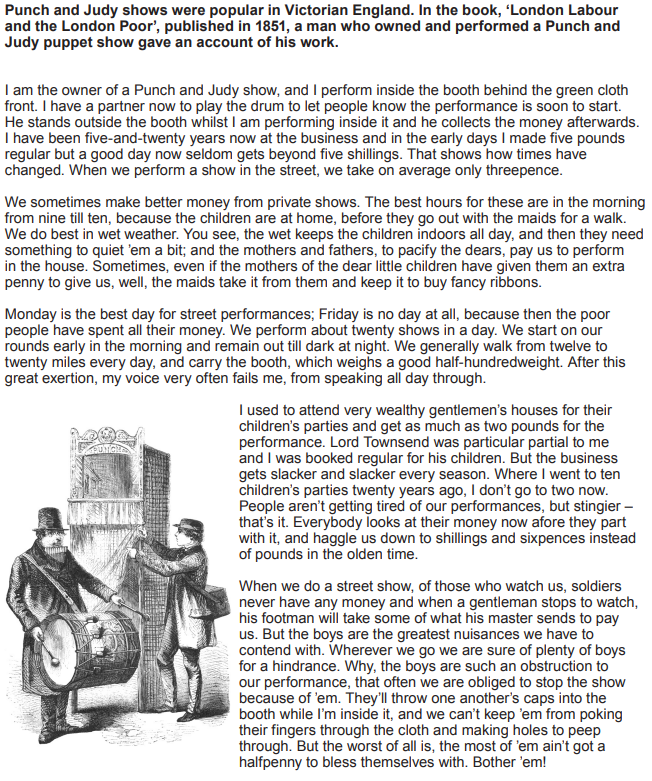
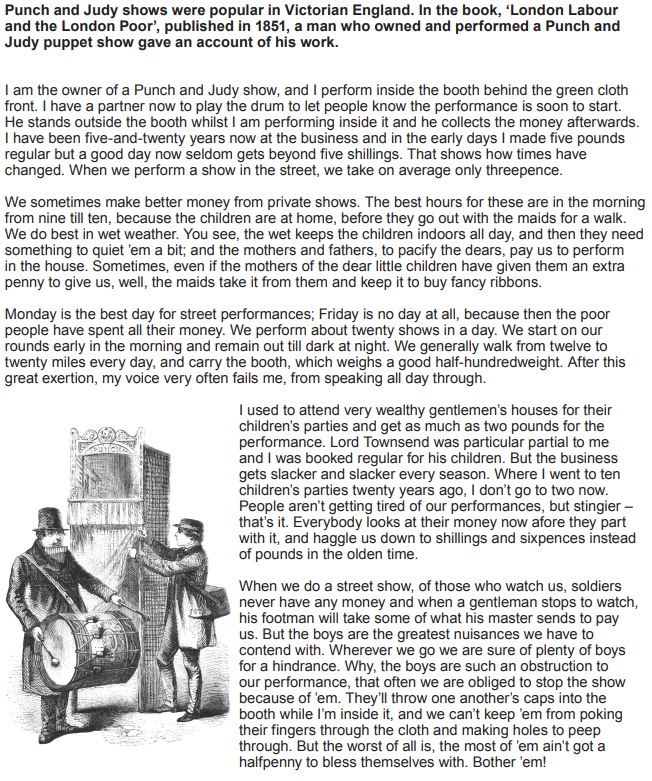
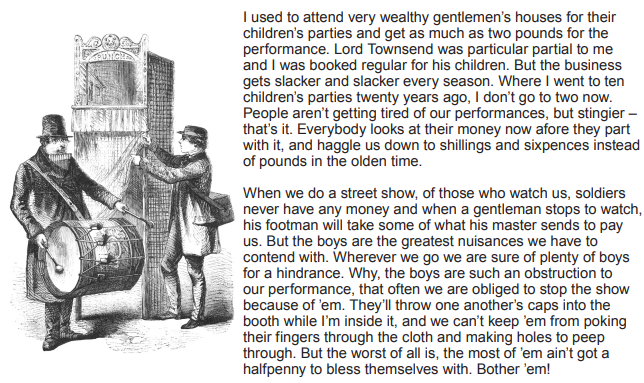
Text describes a Punch and Judy performer detailing street performances, earnings, and challenges. Includes an illustration of two men with puppets and a drum.

Name one of the jobs of the Punch and Judy man’s partner.

27b
1 mark

How much was the Punch and Judy man paid for performing at children’s parties?

27c
1 mark

Give one detail to show that not everyone paid to watch a performance.

28
10 marks

Read the account from ‘London Labour and the London Poor’

Victorian-era Punch and Judy puppeteer recalls performances, earnings, and challenges. Illustration shows two men with drums and a puppet booth.

“The account shows that making a living as a Punch and Judy man was hard and unrewarding work.”

To what extent do you agree with this view?

You should comment on:

  • what the Punch and Judy man says

  • how he says it

You must refer to the text to support your comments.

29
4 marks

Read the newspaper article, ‘Knockout Punch’ in the Resource Material. (opens in a new tab)

Read the account from ‘London Labour and the London Poor’

Text excerpt about Punch and Judy shows from 'London Labour and the London Poor' (1851), describing performances, earnings, and challenges faced by puppeteers.
Two men in Victorian attire perform with a large drum and a puppet theatre. Text beside them narrates a story about performing for wealthy households and street shows.

To answer the following questions you must use both texts.

Using information from both texts, explain briefly how the Punch and Judy performers make their money.

30
10 marks

Read the newspaper article, ‘Knockout Punch’ in the Resource Material. (opens in a new tab)

Read the account from ‘London Labour and the London Poor’

Text excerpt from "London Labour and the London Poor" (1851) describing a Punch and Judy show owner's account of performing, earnings, and challenges.
Two men perform; one plays a drum, the other a hurdy-gurdy. Text beside them describes challenges of street performances and audience interactions.

To answer the following questions you must use both texts.

Both of these texts are about men who work as Punch and Judy performers.

Compare:

  • the impressions the Punch and Judy men give of the children who have watched their performances

  • how they create these impressions

You must use the text to support your comments and make it clear which text you are referring to.
31a
1 mark

Read the passage from ‘Ask an Astronaut’ in the Resource Material. (opens in a new tab)

What job did Tim Peake have to do on his spacewalk?

31b
1 mark

Why did Mission Control end the spacewalk?

31c
1 mark

Who did Tim Peake receive a message of support from?

32
10 marks

Read the passage from ‘Ask an Astronaut’ in the Resource Material. (opens in a new tab)

How does Tim Peake try to make his account of his spacewalk vivid and interesting for his readers?

You should comment on:

  • what he says

  • his use of language, tone and structure

  • other ways he tries to make his account vivid and interesting

You must refer to the text to support your comments.

33a
1 mark

Read the article by Robert Wood

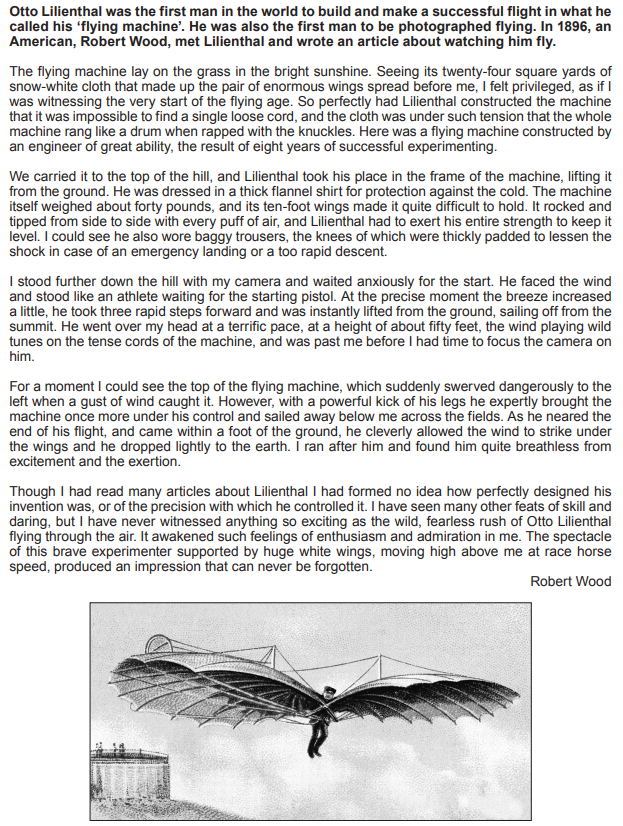
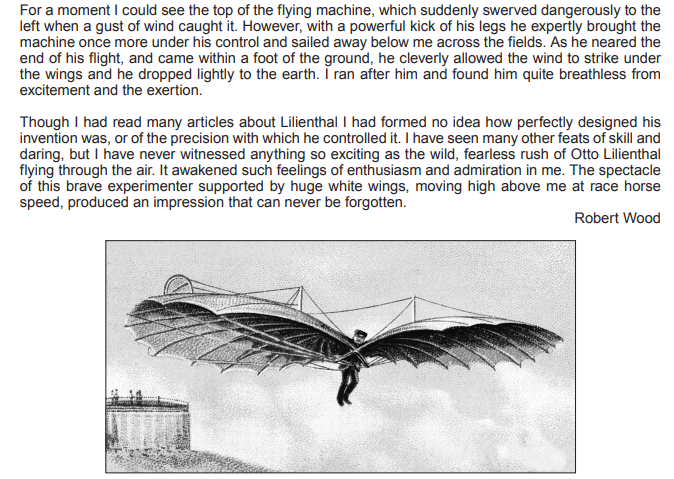
Black and white illustration of Otto Lilienthal flying his glider with large wings over a field. Text describes his pioneering flight and the scene observed.

How long had Otto Lilienthal been experimenting with flying machines?

33b
1 mark

How high did Otto Lilienthal go in his flying machine?

33c
1 mark

What evidence is there that Otto Lilienthal was pleased with his flight?

34
10 marks

Read the article by Robert Wood

Black and white illustration of Otto Lilienthal flying his monoplane glider, showing large wings and a person hanging beneath, with onlookers in the background.

“Robert Wood admires Otto Lilienthal’s skill in building and flying his ‘flying machine’.”

How far do you agree with this statement?

You should comment on:

  • what the writer says

  • how the writer says it

You must refer to the text to support your comments.

35
4 marks

Read the passage from ‘Ask an Astronaut’ in the Resource Material. (opens in a new tab)

Read the article by Robert Wood

Black-and-white illustration of Otto Lilienthal flying his glider, resembling bird-like wings, with spectators in the background on a grassy field.

To answer the following questions you must use both texts.

Using information from both texts, identify what Tim Peake and Otto Lilienthal wore for the spacewalk and the flight in the flying machine.

36
10 marks

Read the passage from ‘Ask an Astronaut’ in the separate Resource Material. (opens in a new tab)

Read the article by Robert Wood

Text describes Otto Lilienthal, the first to fly a successful machine, witnessed by Robert Wood documenting the flight's technical details and challenges.
A black-and-white illustration of Otto Lilienthal gliding in a bat-like flying machine above a field, demonstrating early aviation efforts with descriptive text above.

To answer the following questions you must use both texts.

Both of these texts are about remarkable achievements in the history of flight.

Compare:

  • the difficulties and dangers faced by Tim Peake and Otto Lilienthal

  • how the two writers show these difficulties and dangers

You must use the text to support your comments and make it clear which text you are referring to.
37a
1 mark

Read the newspaper article ‘Trekking with the Gorillas of Rwanda’ in the Resource Material. (opens in a new tab)

How many gorillas are now living in Rwanda’s National Park?

37b
1 mark

How long can visitors spend with the gorillas?

37c
1 mark

Name another animal that is found in Rwanda’s National Park.

38
10 marks

Read the newspaper article ‘Trekking with the Gorillas of Rwanda’ in the Resource Material. (opens in a new tab)

How does the writer try to make his trip to see gorillas sound like a very tiring but memorable experience?

You should comment on:

  • what he says

  • his use of language, tone and structure

  • other ways the writer tries to show that the visit was very tiring but memorable

You must refer to the text to support your comments.

39a
1 mark

Read the extract from ‘Travels in West Africa’

Mary Kingsley was an explorer and writer who travelled to parts of Africa that few Europeans had visited. She wrote about her experiences in her book, ‘Travels in West Africa’, published in 1897. In the extract below she describes what happened during one of her journeys.

On one occasion during our walk between villages, our guide, Joseph, wanted me to see something. We crept down into a rocky ravine and when we got to the edge of some cleared ground, we lay down and wormed our way forward, with great caution. After about fifty yards of this, Joseph sank flat, and I saw before me some thirty yards off, busily employed in pulling down bananas, six gorillas: one old male, one young male, and three females, one with a baby clinging to her. The big male was crouching on his haunches, with his long arms hanging down on either side, with the backs of his hands on the ground, the palms upwards. The elder female was tearing to pieces and eating a pineapple, while the others were noisily attacking the bananas, destroying more than they ate.

They kept up a sort of a shrill, whinnying, chattering noise, quite different from the sound I have heard gorillas give when angry. I noticed that their reach of arm was immense, and that when they went from one tree to another, they moved awkwardly across the open ground in a most inelegant style, dragging their knuckles downwards. I should think the big male and female were over six feet each. Although fearful of an attack, I put out my hand and laid it on Joseph’s gun to prevent him from firing.

I have no hesitation in saying that the gorilla is the most horrible wild animal I have seen. I have seen at close quarters specimens of the most important big game of Central Africa, and I have run away from all of them; but although elephants, leopards, and pythons give you a feeling of alarm, they do not give that feeling of horrible disgust that an old gorilla gives on account of its hideousness of appearance.

I watched the gorillas with great interest for a few seconds, until I heard Joseph make a peculiar small sound, as he clutched his throat with his hand violently. He rolled his head to and fro, clasped his hands over his face, and gave an explosive sneeze. The gorillas stopped, as still as stone then gave a sound between a bark and a howl. They then turned and started back into the forest. The old male, however, rose to his full height and began to move towards us. At this threat, Joseph clapped his hands and went off into a set of high-pitched screeches the like of which I have never heard; nor evidently had the gorilla, who went off after his family with a swiftness that was amazing the moment he touched the forest. He disappeared, swinging himself from bough to bough. I have seen many wild animals in their native lands, but never have I seen anything to equal gorillas going through the forest. It is a graceful, powerful, superbly perfect hand-trapeze performance.

How far away was Mary Kingsley from the gorillas?

39b
1 mark

Name one other animal that Mary Kingsley came across in Africa.

39c
1 mark

What disturbed the gorillas when Mary Kingsley was watching them?

40
10 marks

Read the extract from ‘Travels in West Africa’

Mary Kingsley was an explorer and writer who travelled to parts of Africa that few Europeans had visited. She wrote about her experiences in her book, ‘Travels in West Africa’, published in 1897. In the extract below she describes what happened during one of her journeys.

On one occasion during our walk between villages, our guide, Joseph, wanted me to see something. We crept down into a rocky ravine and when we got to the edge of some cleared ground, we lay down and wormed our way forward, with great caution. After about fifty yards of this, Joseph sank flat, and I saw before me some thirty yards off, busily employed in pulling down bananas, six gorillas: one old male, one young male, and three females, one with a baby clinging to her. The big male was crouching on his haunches, with his long arms hanging down on either side, with the backs of his hands on the ground, the palms upwards. The elder female was tearing to pieces and eating a pineapple, while the others were noisily attacking the bananas, destroying more than they ate.

They kept up a sort of a shrill, whinnying, chattering noise, quite different from the sound I have heard gorillas give when angry. I noticed that their reach of arm was immense, and that when they went from one tree to another, they moved awkwardly across the open ground in a most inelegant style, dragging their knuckles downwards. I should think the big male and female were over six feet each. Although fearful of an attack, I put out my hand and laid it on Joseph’s gun to prevent him from firing.

I have no hesitation in saying that the gorilla is the most horrible wild animal I have seen. I have seen at close quarters specimens of the most important big game of Central Africa, and I have run away from all of them; but although elephants, leopards, and pythons give you a feeling of alarm, they do not give that feeling of horrible disgust that an old gorilla gives on account of its hideousness of appearance.

I watched the gorillas with great interest for a few seconds, until I heard Joseph make a peculiar small sound, as he clutched his throat with his hand violently. He rolled his head to and fro, clasped his hands over his face, and gave an explosive sneeze. The gorillas stopped, as still as stone then gave a sound between a bark and a howl. They then turned and started back into the forest. The old male, however, rose to his full height and began to move towards us. At this threat, Joseph clapped his hands and went off into a set of high-pitched screeches the like of which I have never heard; nor evidently had the gorilla, who went off after his family with a swiftness that was amazing the moment he touched the forest. He disappeared, swinging himself from bough to bough. I have seen many wild animals in their native lands, but never have I seen anything to equal gorillas going through the forest. It is a graceful, powerful, superbly perfect hand-trapeze performance.

‘Mary Kingsley’s account captures her mixed feelings about the gorillas she sees on this trip.’

How far do you agree with this view?

You should comment on:

  • what the writer says

  • how the writer says it

You must refer to the text to support your comments.

41
4 marks

Read the newspaper article ‘Trekking with the Gorillas of Rwanda’ in the Resource Material. (opens in a new tab)

Read the extract from ‘Travels in West Africa’

Mary Kingsley was an explorer and writer who travelled to parts of Africa that few Europeans had visited. She wrote about her experiences in her book, ‘Travels in West Africa’, published in 1897. In the extract below she describes what happened during one of her journeys.

On one occasion during our walk between villages, our guide, Joseph, wanted me to see something. We crept down into a rocky ravine and when we got to the edge of some cleared ground, we lay down and wormed our way forward, with great caution. After about fifty yards of this, Joseph sank flat, and I saw before me some thirty yards off, busily employed in pulling down bananas, six gorillas: one old male, one young male, and three females, one with a baby clinging to her. The big male was crouching on his haunches, with his long arms hanging down on either side, with the backs of his hands on the ground, the palms upwards. The elder female was tearing to pieces and eating a pineapple, while the others were noisily attacking the bananas, destroying more than they ate.

They kept up a sort of a shrill, whinnying, chattering noise, quite different from the sound I have heard gorillas give when angry. I noticed that their reach of arm was immense, and that when they went from one tree to another, they moved awkwardly across the open ground in a most inelegant style, dragging their knuckles downwards. I should think the big male and female were over six feet each. Although fearful of an attack, I put out my hand and laid it on Joseph’s gun to prevent him from firing.

I have no hesitation in saying that the gorilla is the most horrible wild animal I have seen. I have seen at close quarters specimens of the most important big game of Central Africa, and I have run away from all of them; but although elephants, leopards, and pythons give you a feeling of alarm, they do not give that feeling of horrible disgust that an old gorilla gives on account of its hideousness of appearance.

I watched the gorillas with great interest for a few seconds, until I heard Joseph make a peculiar small sound, as he clutched his throat with his hand violently. He rolled his head to and fro, clasped his hands over his face, and gave an explosive sneeze. The gorillas stopped, as still as stone then gave a sound between a bark and a howl. They then turned and started back into the forest. The old male, however, rose to his full height and began to move towards us. At this threat, Joseph clapped his hands and went off into a set of high-pitched screeches the like of which I have never heard; nor evidently had the gorilla, who went off after his family with a swiftness that was amazing the moment he touched the forest. He disappeared, swinging himself from bough to bough. I have seen many wild animals in their native lands, but never have I seen anything to equal gorillas going through the forest. It is a graceful, powerful, superbly perfect hand-trapeze performance.

To answer the following questions you must use both texts.

Using information from both texts, explain briefly how the guides helped to keep the writers safe when they came across the gorillas.

42
10 marks

Read the newspaper article ‘Trekking with the Gorillas of Rwanda’ in the Resource Material. (opens in a new tab)

Read the extract from ‘Travels in West Africa’

Mary Kingsley was an explorer and writer who travelled to parts of Africa that few Europeans had visited. She wrote about her experiences in her book, ‘Travels in West Africa’, published in 1897. In the extract below she describes what happened during one of her journeys.

On one occasion during our walk between villages, our guide, Joseph, wanted me to see something. We crept down into a rocky ravine and when we got to the edge of some cleared ground, we lay down and wormed our way forward, with great caution. After about fifty yards of this, Joseph sank flat, and I saw before me some thirty yards off, busily employed in pulling down bananas, six gorillas: one old male, one young male, and three females, one with a baby clinging to her. The big male was crouching on his haunches, with his long arms hanging down on either side, with the backs of his hands on the ground, the palms upwards. The elder female was tearing to pieces and eating a pineapple, while the others were noisily attacking the bananas, destroying more than they ate.

They kept up a sort of a shrill, whinnying, chattering noise, quite different from the sound I have heard gorillas give when angry. I noticed that their reach of arm was immense, and that when they went from one tree to another, they moved awkwardly across the open ground in a most inelegant style, dragging their knuckles downwards. I should think the big male and female were over six feet each. Although fearful of an attack, I put out my hand and laid it on Joseph’s gun to prevent him from firing.

I have no hesitation in saying that the gorilla is the most horrible wild animal I have seen. I have seen at close quarters specimens of the most important big game of Central Africa, and I have run away from all of them; but although elephants, leopards, and pythons give you a feeling of alarm, they do not give that feeling of horrible disgust that an old gorilla gives on account of its hideousness of appearance.

I watched the gorillas with great interest for a few seconds, until I heard Joseph make a peculiar small sound, as he clutched his throat with his hand violently. He rolled his head to and fro, clasped his hands over his face, and gave an explosive sneeze. The gorillas stopped, as still as stone then gave a sound between a bark and a howl. They then turned and started back into the forest. The old male, however, rose to his full height and began to move towards us. At this threat, Joseph clapped his hands and went off into a set of high-pitched screeches the like of which I have never heard; nor evidently had the gorilla, who went off after his family with a swiftness that was amazing the moment he touched the forest. He disappeared, swinging himself from bough to bough. I have seen many wild animals in their native lands, but never have I seen anything to equal gorillas going through the forest. It is a graceful, powerful, superbly perfect hand-trapeze performance.

To answer the following questions you must use both texts.

Both of these texts are about the experience the writers had when seeing gorillas in the wild.

Compare:

  • what impressions the two writers give of the gorillas they see

  • how they create these impressions

You must use the text to support your comments and make it clear which text you are referring to

43a
1 mark

Read the newspaper article in the Resource Material. (opens in a new tab)

Give one detail that suggests that Kingsland Road market used to be very busy

43b
1 mark

When did market trading begin at the Kingsland Road market?

43c
1 mark

What does Harry West’s grandson sell in the market?

44
10 marks

Read the newspaper article in the Resource Material. (opens in a new tab)

How does the writer try to show that Harry West is determined to continue working as a street seller?

You should comment on:

  • what is said

  • the use of language, tone and structure

  • other ways the writer tries to show that Harry West is determined to continue working as a street seller

45a
1 mark

Read the extract from a Victorian magazine, ‘London As It Is’.

Petticoat Lane Market is a famous street market in London. This passage is taken from a magazine, ‘London As It Is’, published in 1877.

Petticoat Lane Market

Petticoat Lane is long, narrow and filthy. Along this narrow lane the houses are small, and sanitary conditions are poor. The drainage here seems to be very inadequate and in the summertime the foul waste water remains in stagnant pools, much to the danger of the inhabitants.

But on a Sunday morning, what a din! The narrow lane is seething with life and almost every inch of the road you have to push your way through the crowd. There is good temper and humour here – but what keen bargaining is going on all along the lane.

“Who’ll buy?” is a general cry from shop and stall alike.

“All the new songs. Only a penny!” shouts a lanky youth, holding out a handful of flimsy song-sheets.

“Who’ll buy a hat for two shilling – worth five shilling, so help me!” calls another seller.

We pause for a moment in front of a stall. It is enough. A dozen pair of eyes are upon us, like those of vultures looking for prey; we must want something. One street seller insists on trying to sell us a large sea-chest and folding tent. Another directs our attention to a cold, shiny-looking couch, hard and faded, and three high-backed chairs, with weak legs. Then another man yells into our ears the praises of an eight-day clock. The pressure of the crowd increases. It is no easy matter to squeeze our way through without being crunched like snails. The thronged pavement is narrow, and the few feet of the roadway are occupied by a continuous string of stalls – an array of cheap jewellery, cheap tools, cheap hats, cheap cakes, cheap hot liquor sold in small glasses – cheap everything.

The public houses in Petticoat Lane are generally crammed to excess.Through the open doorways we look into the back rooms, where some dozen men are drinking and smoking, their faces lost in the clouds of smoke coming from their lips. These men are known as ‘Petticoat Lane fencers’, or receivers of stolen goods. Patiently they sit in these filthy rooms, waiting for news of the goods that will come their way.

Across the road are men and women, and beside them are spread out their varied goods, which demand our attention. A hand is laid on my arm, pulling me back and an oily voice persuasively says, “Like a nice coat, sir? I’ve one that’ll fit you nicely. Try it on. Fit you in a minute, sir.” Another man is sitting amid a pile of old iron, boots and shoes, shouting to passers-by of the excellence of a hand-saw and jack-plane. Rusty, dusty, cobwebby old metal lies upon the ground and, indeed, some of the boots and shoes seem about as wearable as lumps of coal.

Name one item of clothing the writer is invited to buy.

45b
1 mark

How do the street sellers react when the writer stops in front of a market stall?

45c
1 mark

What evidence is there that the public houses are busy?

46
10 marks

Read the extract from a Victorian magazine, ‘London As It Is’.

Petticoat Lane Market is a famous street market in London. This passage is taken from a magazine, ‘London As It Is’, published in 1877.

Petticoat Lane Market

Petticoat Lane is long, narrow and filthy. Along this narrow lane the houses are small, and sanitary conditions are poor. The drainage here seems to be very inadequate and in the summertime the foul waste water remains in stagnant pools, much to the danger of the inhabitants.

But on a Sunday morning, what a din! The narrow lane is seething with life and almost every inch of the road you have to push your way through the crowd. There is good temper and humour here – but what keen bargaining is going on all along the lane.

“Who’ll buy?” is a general cry from shop and stall alike.

“All the new songs. Only a penny!” shouts a lanky youth, holding out a handful of flimsy song-sheets.

“Who’ll buy a hat for two shilling – worth five shilling, so help me!” calls another seller.

We pause for a moment in front of a stall. It is enough. A dozen pair of eyes are upon us, like those of vultures looking for prey; we must want something. One street seller insists on trying to sell us a large sea-chest and folding tent. Another directs our attention to a cold, shiny-looking couch, hard and faded, and three high-backed chairs, with weak legs. Then another man yells into our ears the praises of an eight-day clock. The pressure of the crowd increases. It is no easy matter to squeeze our way through without being crunched like snails. The thronged pavement is narrow, and the few feet of the roadway are occupied by a continuous string of stalls – an array of cheap jewellery, cheap tools, cheap hats, cheap cakes, cheap hot liquor sold in small glasses – cheap everything.

The public houses in Petticoat Lane are generally crammed to excess. Through the open doorways we look into the back rooms, where some dozen men are drinking and smoking, their faces lost in the clouds of smoke coming from their lips. These men are known as ‘Petticoat Lane fencers’, or receivers of stolen goods. Patiently they sit in these filthy rooms, waiting for news of the goods that will come their way.

Across the road are men and women, and beside them are spread out their varied goods, which demand our attention. A hand is laid on my arm, pulling me back and an oily voice persuasively says, “Like a nice coat, sir? I’ve one that’ll fit you nicely. Try it on. Fit you in a minute, sir.” Another man is sitting amid a pile of old iron, boots and shoes, shouting to passers-by of the excellence of a hand-saw and jack-plane. Rusty, dusty, cobwebby old metal lies upon the ground and, indeed, some of the boots and shoes seem about as wearable as lumps of coal.

‘The writer paints a vivid picture of the sights and sounds of Petticoat Lane Market.’

How far do you agree with this statement?

You should comment on:

  • what the writer says

  • how the writer says it

You must refer to the text to support your comments.

47
4 marks

Read the newspaper article in the separate Resource Material. (opens in a new tab)

Read the extract from a Victorian magazine, ‘London As It Is’.

Petticoat Lane Market is a famous street market in London. This passage is taken from a magazine, ‘London As It Is’, published in 1877.

Petticoat Lane Market

Petticoat Lane is long, narrow and filthy. Along this narrow lane the houses are small, and sanitary conditions are poor. The drainage here seems to be very inadequate and in the summertime the foul waste water remains in stagnant pools, much to the danger of the inhabitants.

But on a Sunday morning, what a din! The narrow lane is seething with life and almost every inch of the road you have to push your way through the crowd. There is good temper and humour here – but what keen bargaining is going on all along the lane.

“Who’ll buy?” is a general cry from shop and stall alike.

“All the new songs. Only a penny!” shouts a lanky youth, holding out a handful of flimsy song-sheets.

“Who’ll buy a hat for two shilling – worth five shilling, so help me!” calls another seller

We pause for a moment in front of a stall. It is enough. A dozen pair of eyes are upon us, like those of vultures looking for prey; we must want something. One street seller insists on trying to sell us a large sea-chest and folding tent. Another directs our attention to a cold, shiny-looking couch, hard and faded, and three high-backed chairs, with weak legs. Then another man yells into our ears the praises of an eight-day clock. The pressure of the crowd increases. It is no easy matter to squeeze our way through without being crunched like snails. The thronged pavement is narrow, and the few feet of the roadway are occupied by a continuous string of stalls – an array of cheap jewellery, cheap tools, cheap hats, cheap cakes, cheap hot liquor sold in small glasses – cheap everything.

The public houses in Petticoat Lane are generally crammed to excess. Through the open doorways we look into the back rooms, where some dozen men are drinking and smoking, their faces lost in the clouds of smoke coming from their lips. These men are known as ‘Petticoat Lane fencers’, or receivers of stolen goods. Patiently they sit in these filthy rooms, waiting for news of the goods that will come their way.

Across the road are men and women, and beside them are spread out their varied goods, which demand our attention. A hand is laid on my arm, pulling me back and an oily voice persuasively says, “Like a nice coat, sir? I’ve one that’ll fit you nicely. Try it on. Fit you in a minute, sir.” Another man is sitting amid a pile of old iron, boots and shoes, shouting to passers-by of the excellence of a hand-saw and jack-plane. Rusty, dusty, cobwebby old metal lies upon the ground and, indeed, some of the boots and shoes seem about as wearable as lumps of coal.

To answer the following questions you must use both texts.

Briefly explain in your own words what we learn about Petticoat Lane and the area around Kingsland Road. Do not give details about the markets themselves.

48
10 marks

Read the newspaper article in the Resource Material. (opens in a new tab)

Read the extract from a Victorian magazine, ‘London As It Is’.

Petticoat Lane Market is a famous street market in London. This passage is taken from a magazine, ‘London As It Is’, published in 1877.

Petticoat Lane Market

Petticoat Lane is long, narrow and filthy. Along this narrow lane the houses are small, and sanitary conditions are poor. The drainage here seems to be very inadequate and in the summertime the foul waste water remains in stagnant pools, much to the danger of the inhabitants.

But on a Sunday morning, what a din! The narrow lane is seething with life and almost every inch of the road you have to push your way through the crowd. There is good temper and humour here – but what keen bargaining is going on all along the lane.

“Who’ll buy?” is a general cry from shop and stall alike.

“All the new songs. Only a penny!” shouts a lanky youth, holding out a handful of flimsy song-sheets.

“Who’ll buy a hat for two shilling – worth five shilling, so help me!” calls another seller.

We pause for a moment in front of a stall. It is enough. A dozen pair of eyes are upon us, like those of vultures looking for prey; we must want something. One street seller insists on trying to sell us a large sea-chest and folding tent. Another directs our attention to a cold, shiny-looking couch, hard and faded, and three high-backed chairs, with weak legs. Then another man yells into our ears the praises of an eight-day clock. The pressure of the crowd increases. It is no easy matter to squeeze our way through without being crunched like snails. The thronged pavement is narrow, and the few feet of the roadway are occupied by a continuous string of stalls – an array of cheap jewellery, cheap tools, cheap hats, cheap cakes, cheap hot liquor sold in small glasses – cheap everything.

The public houses in Petticoat Lane are generally crammed to excess. Through the open doorways we look into the back rooms, where some dozen men are drinking and smoking, their faces lost in the clouds of smoke coming from their lips. These men are known as ‘Petticoat Lane fencers’, or receivers of stolen goods. Patiently they sit in these filthy rooms, waiting for news of the goods that will come their way.

Across the road are men and women, and beside them are spread out their varied goods, which demand our attention. A hand is laid on my arm, pulling me back and an oily voice persuasively says, “Like a nice coat, sir? I’ve one that’ll fit you nicely. Try it on. Fit you in a minute, sir.” Another man is sitting amid a pile of old iron, boots and shoes, shouting to passers-by of the excellence of a hand-saw and jack-plane. Rusty, dusty, cobwebby old metal lies upon the ground and, indeed, some of the boots and shoes seem about as wearable as lumps of coal.

To answer the following questions you must use both texts.

Both of these texts are about markets and street sellers.

Compare:

  • the ways in which Harry West and the Petticoat Lane street sellers try to sell their goods

  • how the writers show what these street sellers are like

You must use the text to support your comments and make it clear which text you are referring to.
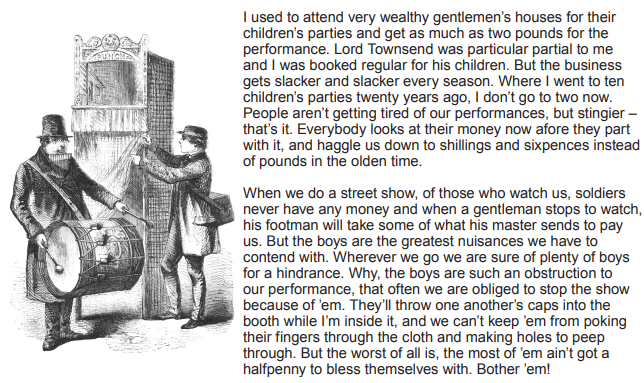
49a
1 mark

Read the newspaper article ‘Miners Rescued from Chilean Mine’ in the Resource Material. (opens in a new tab)

What was the nickname of the rescue capsule?

49b
1 mark

How did the miners let the rescuers know they were still alive?

49c
1 mark

Where were the men taken once they had been brought to the surface?

50
10 marks

Read the newspaper article ‘Miners Rescued from Chilean Mine’ in the Resource Material. (opens in a new tab)

How does Jeffrey Brown try to show how hard it was for the trapped miners during their ‘long ordeal underground’?

You should comment on:

  • what he says

  • his use of language, tone and structure

  • other ways he tries to show how hard it was for the trapped miners

51a
1 mark

Read the account in ‘The Penny Review’

In Victorian times, mining accidents were frequent, often resulting in many deaths. However, this article, which appeared in a magazine called ‘The Penny Review’, tells of the successful rescue of eleven miners trapped in a collapsed mine.

Extraordinary Rescue

On a Monday morning whilst the miners were in the coal mine underneath, a sudden collapse of the earth took place owing to the roof supports that were much too weak to support the enormous weight above. Eleven men were at work below and the tunnels were instantly filled with the falling earth and rock; consequently all hope of escape was cut off and the men’s lights extinguished by the violent blast of air that followed.

The alarm was given and spread like wildfire through all the surrounding villages. Thousands were seen rushing to the spot – fathers, mothers, wives and children – their dreadful cries adding to the misery of the scene. All work was suspended, all workmen assembling to offer assistance. The fate of the men buried in the mine was unknown: whether the collapse had buried them alive, or whether they could exist without food or fresh air until their rescue could be effected.

It was agreed that the only hope of saving the men was driving a new hole through the earth, through the solid coal and into the farther end of the mine. This was work of great labour and difficulty as near 100 yards of solid coal needed to be cut through. Working gangs were formed and this frantic work was instantly commenced by men cutting away with their picks, others clearing away the coal – each man immediately having his place taken by fresh hands when he began to tire. The hole became a tunnel and day and night the work proceeded with increasing desperation, though hope of saving the men diminished with every day that passed.

On the following Sunday morning, one week from the collapse, a rumour spread that the men working in the tunnel had heard sounds from within, like the distant tapping of hammers. All now was increased activity. All rescuers were now labouring with strong hopes of saving some of their fellow-miners. By the afternoon, voices could be heard and later that day the tunnel broke through to where the miners were trapped. The news was instantly communicated to the assembled crowd above and there was a joyous burst of feeling at this announcement. Ten men and one boy were found, alive indeed, but in the very last stage of exhaustion. It appeared that the trapped miners had taken a meal with them and had caught a little water in their caps, but this was their only sustenance during the time that they were trapped.

After a short interval, they were gradually brought out, enveloped in blankets, each carried to the surface by a sturdy miner. They were instantly put into coaches and conveyed to their homes. Following this extraordinary rescue, they all ultimately recovered.

What caused the coal mine to collapse?

51b
1 mark

What detail does the writer give that shows the rescue attempt never slowed or stopped?

51c
1 mark

What gave the rescuers hope that the miners were still alive?

52
10 marks

Read the account in ‘The Penny Review’

In Victorian times, mining accidents were frequent, often resulting in many deaths. However, this article, which appeared in a magazine called ‘The Penny Review’, tells of the successful rescue of eleven miners trapped in a collapsed mine.

Extraordinary Rescue

On a Monday morning whilst the miners were in the coal mine underneath, a sudden collapse of the earth took place owing to the roof supports that were much too weak to support the enormous weight above. Eleven men were at work below and the tunnels were instantly filled with the falling earth and rock; consequently all hope of escape was cut off and the men’s lights extinguished by the violent blast of air that followed.

The alarm was given and spread like wildfire through all the surrounding villages. Thousands were seen rushing to the spot – fathers, mothers, wives and children – their dreadful cries adding to the misery of the scene. All work was suspended, all workmen assembling to offer assistance. The fate of the men buried in the mine was unknown: whether the collapse had buried them alive, or whether they could exist without food or fresh air until their rescue could be effected.

It was agreed that the only hope of saving the men was driving a new hole through the earth, through the solid coal and into the farther end of the mine. This was work of great labour and difficulty as near 100 yards of solid coal needed to be cut through. Working gangs were formed and this frantic work was instantly commenced by men cutting away with their picks, others clearing away the coal – each man immediately having his place taken by fresh hands when he began to tire. The hole became a tunnel and day and night the work proceeded with increasing desperation, though hope of saving the men diminished with every day that passed.

On the following Sunday morning, one week from the collapse, a rumour spread that the men working in the tunnel had heard sounds from within, like the distant tapping of hammers. All now was increased activity. All rescuers were now labouring with strong hopes of saving some of their fellow-miners. By the afternoon, voices could be heard and later that day the tunnel broke through to where the miners were trapped. The news was instantly communicated to the assembled crowd above and there was a joyous burst of feeling at this announcement. Ten men and one boy were found, alive indeed, but in the very last stage of exhaustion. It appeared that the trapped miners had taken a meal with them and had caught a little water in their caps, but this was their only sustenance during the time that they were trapped.

After a short interval, they were gradually brought out, enveloped in blankets, each carried to the surface by a sturdy miner. They were instantly put into coaches and conveyed to their homes. Following this extraordinary rescue, they all ultimately recovered.

“In the first three paragraphs of the account, the writer gives the impression that the accident was so serious that the trapped miners would not be found alive.”

How far do you agree with this statement?

You should comment on:

  • what he says

  • how he says it

You must refer to the text to support your comments.

53
4 marks

Read the newspaper article ‘Miners Rescued from Chilean Mine’ in the Resource Material. (opens in a new tab)

Read the account in ‘The Penny Review’

In Victorian times, mining accidents were frequent, often resulting in many deaths. However, this article, which appeared in a magazine called ‘The Penny Review’, tells of the successful rescue of eleven miners trapped in a collapsed mine.

Extraordinary Rescue

On a Monday morning whilst the miners were in the coal mine underneath, a sudden collapse of the earth took place owing to the roof supports that were much too weak to support the enormous weight above. Eleven men were at work below and the tunnels were instantly filled with the falling earth and rock; consequently all hope of escape was cut off and the men’s lights extinguished by the violent blast of air that followed.

The alarm was given and spread like wildfire through all the surrounding villages. Thousands were seen rushing to the spot – fathers, mothers, wives and children – their dreadful cries adding to the misery of the scene. All work was suspended, all workmen assembling to offer assistance. The fate of the men buried in the mine was unknown: whether the collapse had buried them alive, or whether they could exist without food or fresh air until their rescue could be effected.

It was agreed that the only hope of saving the men was driving a new hole through the earth, through the solid coal and into the farther end of the mine. This was work of great labour and difficulty as near 100 yards of solid coal needed to be cut through. Working gangs were formed and this frantic work was instantly commenced by men cutting away with their picks, others clearing away the coal – each man immediately having his place taken by fresh hands when he began to tire. The hole became a tunnel and day and night the work proceeded with increasing desperation, though hope of saving the men diminished with every day that passed.

On the following Sunday morning, one week from the collapse, a rumour spread that the men working in the tunnel had heard sounds from within, like the distant tapping of hammers. All now was increased activity. All rescuers were now labouring with strong hopes of saving some of their fellow-miners. By the afternoon, voices could be heard and later that day the tunnel broke through to where the miners were trapped. The news was instantly communicated to the assembled crowd above and there was a joyous burst of feeling at this announcement. Ten men and one boy were found, alive indeed, but in the very last stage of exhaustion. It appeared that the trapped miners had taken a meal with them and had caught a little water in their caps, but this was their only sustenance during the time that they were trapped.

After a short interval, they were gradually brought out, enveloped in blankets, each carried to the surface by a sturdy miner. They were instantly put into coaches and conveyed to their homes. Following this extraordinary rescue, they all ultimately recovered.

To answer the following questions you must use both texts.

Using information from both texts, explain briefly in your own words what happened when news of the mining accidents became known.

54
10 marks

Read the newspaper article ‘Miners Rescued from Chilean Mine’ in the Resource Material. (opens in a new tab)

Read the account in ‘The Penny Review’

In Victorian times, mining accidents were frequent, often resulting in many deaths. However, this article, which appeared in a magazine called ‘The Penny Review’, tells of the successful rescue of eleven miners trapped in a collapsed mine.

Extraordinary Rescue

On a Monday morning whilst the miners were in the coal mine underneath, a sudden collapse of the earth took place owing to the roof supports that were much too weak to support the enormous weight above. Eleven men were at work below and the tunnels were instantly filled with the falling earth and rock; consequently all hope of escape was cut off and the men’s lights extinguished by the violent blast of air that followed.

The alarm was given and spread like wildfire through all the surrounding villages. Thousands were seen rushing to the spot – fathers, mothers, wives and children – their dreadful cries adding to the misery of the scene. All work was suspended, all workmen assembling to offer assistance. The fate of the men buried in the mine was unknown: whether the collapse had buried them alive, or whether they could exist without food or fresh air until their rescue could be effected.

It was agreed that the only hope of saving the men was driving a new hole through the earth, through the solid coal and into the farther end of the mine. This was work of great labour and difficulty as near 100 yards of solid coal needed to be cut through. Working gangs were formed and this frantic work was instantly commenced by men cutting away with their picks, others clearing away the coal – each man immediately having his place taken by fresh hands when he began to tire. The hole became a tunnel and day and night the work proceeded with increasing desperation, though hope of saving the men diminished with every day that passed.

On the following Sunday morning, one week from the collapse, a rumour spread that the men working in the tunnel had heard sounds from within, like the distant tapping of hammers. All now was increased activity. All rescuers were now labouring with strong hopes of saving some of their fellow-miners. By the afternoon, voices could be heard and later that day the tunnel broke through to where the miners were trapped. The news was instantly communicated to the assembled crowd above and there was a joyous burst of feeling at this announcement. Ten men and one boy were found, alive indeed, but in the very last stage of exhaustion. It appeared that the trapped miners had taken a meal with them and had caught a little water in their caps, but this was their only sustenance during the time that they were trapped.

After a short interval, they were gradually brought out, enveloped in blankets, each carried to the surface by a sturdy miner. They were instantly put into coaches and conveyed to their homes. Following this extraordinary rescue, they all ultimately recovered.

To answer the following questions you must use both texts.

Both of these texts give an account of a mining rescue.

Compare:

  • what the writers tell us about what happened on the day when the miners were rescued

  • how the writers try to show the drama of the day of the rescues

You must use the text to support your comments and make it clear which text you are referring to.