Systems Software (OCR A Level Computer Science): Exam Questions

Exam code: H446

2 hours28 questions
1
3 marks

A small manufacturing business uses networked computers with closed source application software installed.

Each computer the business uses has a BIOS.

Tick (✓) one box in each row to identify whether each statement in the table is true or false

Statement

True

False

BIOS stands for Boot Input Output Standard

The BIOS can be used to alter hardware settings, such as which storage device the computer boots from

BIOS settings are stored in RAM

2
1 mark

One computer owned by a business monitors critical-safety features of manufacturing. All input data must be processed within a predictable timescale of a fraction of a second.

State the type of operating system that should be used by this computer.

3
4 marks

Imogen buys a desktop computer. It comes with an operating system installed

Describe two ways that an operating system could manage physical memory.

4
3 marks

Define what is meant by the term ‘device driver’, giving one example of a device driver that a home user would need

5
1 mark

OCR Solutions is a software development company. Employees use a wide range of application software to complete admin tasks. Tasks include writing letters to clients and creating graphics.

The application software is run on thin client computers. A thin client computer is a very low-powered computer connected to a powerful central server. The operating system and all the applications run within a virtual machine on the server. The thin client computer will only display the output of the virtual machine and capture and send input to the virtual machine.

State one advantage of running the application software within the virtual machine.

6
2 marks

Define what is meant by an operating system (OS).

7
4 marks

Identify four key tasks carried out by an operating system.

1
2 marks

Anika’s computer runs a multi-tasking operating system. She has access to a printer and a broadband internet connection through a wireless connection. The operating system uses scheduling algorithms such as first come first served and round-robin.

Explain why the computer’s operating system uses a first come first served algorithm when sending documents to the printer.

2
3 marks

Explain why the computer’s operating system uses a round-robin algorithm for allocating processor time.

3
2 marks

Anika’s computer runs a multi-tasking operating system. The operating system uses scheduling algorithms such as first-come first served and round-robin.

Describe one other scheduling algorithm.

4
2 marks

Explain one benefit of memory management to a user.

5
2 marks

Describe how virtual memory allows a user to run programs when physical memory is full.

6
3 marks

An embedded system is often a small device that is designed to carry out a limited number of specialised tasks. Professional athletes sometimes wear small embedded systems called fitness trackers in their shirts. These can be used to track their speed, position, heart rate and other performance data during an event. The tracker transmits this data to a pitch-side server which collates the data from all the athletes.

One use of ROM is to store the Basic Input Output System (BIOS). The BIOS is used when the computer is first turned on.

Describe what the BIOS will do to start up the computer.

7
4 marks

An embedded system is often a small device that is designed to carry out a limited number of specialised tasks. Professional athletes sometimes wear small embedded systems called fitness trackers in their shirts. These can be used to track their speed, position, heart rate and other performance data during an event. The tracker transmits this data to a pitch-side server which collates the data from all the athletes.

The embedded system will have an operating system. Two roles of an operating system are to handle interrupts and manage scheduling.

Describe two other roles of an operating system.

8
4 marks

An operating system acts as an interface between the computer user and the hardware.

Explain the purpose of the operating system in managing hardware resources to enable multitasking.

9
4 marks

Memory management is a fundamental role of the operating system.

Explain how paging works and how this method of allocation can lead to internal fragmentation.

10
6 marks

A server must choose between First-Come-First-Served (FCFS) and Round Robin (RR) scheduling algorithms.

Compare these two algorithms in terms of their suitability for high-priority or interactive tasks.

1
6 marks

One computer owned by a business monitors critical-safety features of manufacturing. All input data must be processed within a predictable timescale of a fraction of a second.

The computer uses a real time operating system.

Give the name of three other types of operating system, and for each state its purpose.

2
3 marks

When a device such as a keyboard or printer requires attention from the CPU, an interrupt is raised.

Explain how an operating system deals with an interrupt.

3
9 marks

Memory management is a key function of an operating system.

Explain how an operating system can manage the memory available to applications and why doing so is important.

You should include the following in your answer:

  • the different actions carried out by an operating system to manage memory

  • how memory that is being managed can be split up

  • why memory management is important.

4
5 marks

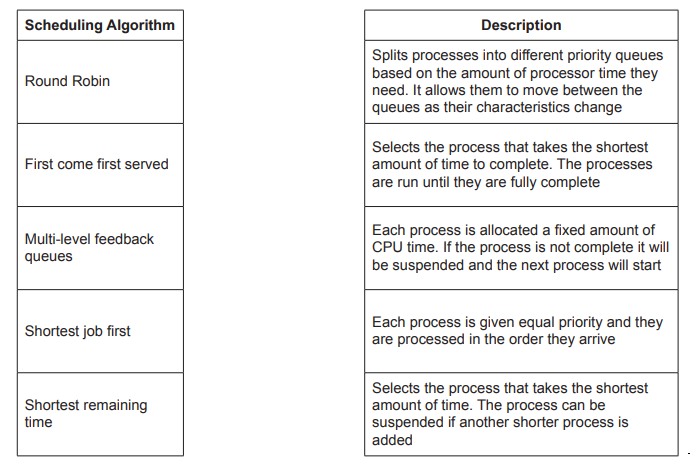
Draw a line to match each scheduling algorithm to the correct description

Table showing scheduling algorithms with descriptions, including Round Robin, First come first served, Multi-level feedback queues, Shortest job first, and Shortest remaining time.
5
6 marks

A software development house is using a single high-specification server to run five different virtual machines (VMs) to test a new resource-intensive database application across multiple operating systems simultaneously.

Evaluate the use of virtual machines in this scenario. Your answer should discuss the role of the Hypervisor and the potential impact on the host system’s physical hardware resources.

6
5 marks

A computer system is running a user application when an input device generates an interrupt.

Explain the sequence of events that occurs from the interrupt being generated to the program resuming execution.

7
4 marks

A multi-user operating system must allow several applications to run apparently at the same time.

Explain how CPU scheduling helps maintain system responsiveness in this situation.

8
6 marks

An operating system is used to run interactive applications, such as word processors and web browsers.

Evaluate why pre-emptive scheduling is more suitable than non-pre-emptive scheduling for this type of system.

9
5 marks

A computer system is running multiple user applications at the same time.

Explain how the operating system manages system resources to allow this to happen efficiently.

10
4 marks

A computer system crashes when two applications attempt to access the same hardware device at the same time.

Explain how the operating system helps prevent this situation.

11
5 marks

A computer system is running several large applications and physical RAM becomes full.

Explain how virtual memory allows the system to continue running.