Current Debates & Interpretations (Edexcel A Level Politics): Revision Note

Exam code: 9PL0

Sarra Jenkins

Written by: Sarra Jenkins

Reviewed by: Steve Vorster

Updated on

Interpretations and debates of the US Constitution

  • The US Constitution is a short and vague document

  • As a result, there is significant debate over how it should be interpreted and applied in modern America

Debate: Democracy within the US Constitution

  • The US Constitution aims to uphold democracy by ensuring popular participation, accountability and rights protection

    • Critics argue that its structure increasingly limits democratic outcomes

Arguments about how democratic the US Constitution is

Effective at upholding democracy

Not effective at upholding democracy

  • Protects individual rights through the Bill of Rights

    • First Amendment protects protest, including BLM (2020) and No Kings protests (2025)

  • The Electoral College undermines popular sovereignty

    • In 2016 and 2000, the popular vote winner lost the presidency

  • Regular elections ensure accountability

    • The 2020 election removed an incumbent president despite political unrest

  • The Senate is unrepresentative

    • California has nearly 40 million people and Wyoming around 600,000, yet both have two senators

  • Checks and balances prevent tyranny

    • Department of Commerce v New York (2019) protected fair representation

  • The amendment process is too rigid

    • Only 27 amendments since 1789 despite public support for reform

  • Federalism allows policy diversity

    • Marijuana and abortion laws vary across states

  • States have passed laws accused of voter suppression

    • Georgia’s Election Integrity Act (2021) was criticised as “Jim Crow in the 21st Century”
  • Judicial independence protects minority rights

    • Obergefell v Hodges (2015) protected same-sex marriage

  • Unelected judges can overturn democratic laws

    • Citizens United v FEC (2010) overturned legislation passed by Congress

  • Provides a stable constitutional framework

    • The peaceful transfer of power after the 2020 election demonstrated constitutional resilience despite political unrest

Case Study

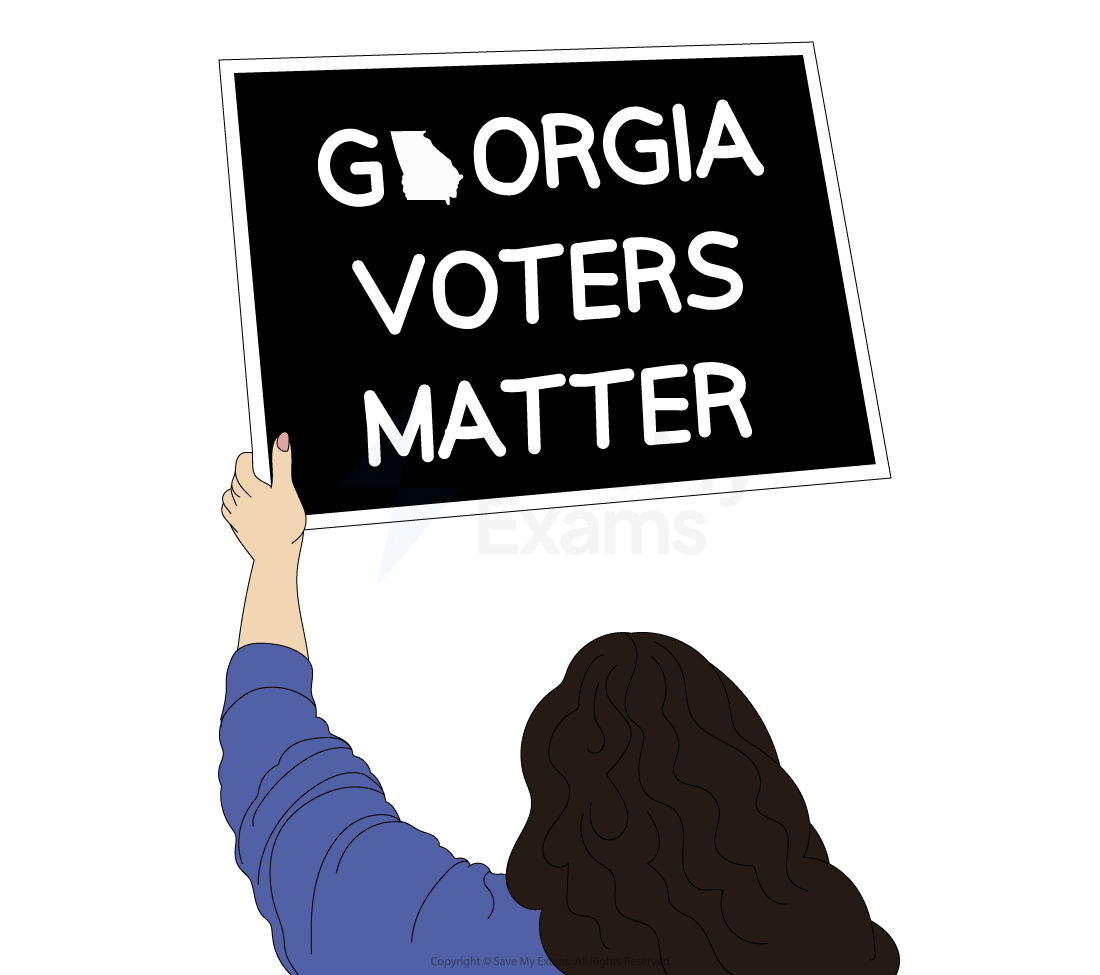
Georgia’s Election Integrity Act (2021)

Person holds a sign reading "Georgia Voters Matter" in front of a historic building with a golden dome against a clear blue sky.
  • In March 2021, Georgia passed the Election Integrity Act following the high turnout and Democratic victories in the 2020 presidential and Senate elections

  • Republicans argued the law was needed to restore trust in electoral integrity

Key provisions of the Act

  • Stricter voter ID requirements for absentee (postal) ballots

  • Reduced availability of ballot drop boxes

  • Limits on early voting hours in some counties

  • It became illegal to give food or water to voters waiting in line

  • Greater powers for the Republican-controlled state legislature to intervene in local election administration

Why it was compared to ‘Jim Crow’

  • Civil rights groups argued the measures disproportionately affected African American and low-income voters, who are more likely to use early voting and postal ballots

  • Long queues are more common in predominantly Black urban areas, making the ban on providing water particularly controversial

  • Critics, including President Biden and Stacey Abrams, claimed the law echoed historic Jim Crow-era tactics that restricted Black voter participation through legal but discriminatory means

Supporters’ arguments

  • Republicans claimed the law improved election security and consistency

  • They argued ID requirements increased confidence in democracy and applied equally to all voters

Strengths and weaknesses of the US Constitution

  • The US Constitution was written in 1789 and is therefore almost 250 years old

  • Whilst it has demonstrated significant strengths during this time, it can also be argued that it increasingly struggles to meet the needs of a modern democracy

  • The Constitution tries to balance liberty and stability, but can struggle with democratic legitimacy

Strengths and weaknesses of the US Constitution in practice

Strengths of the US Constitution

Weaknesses of the US Constitution

  • Provides a consistent and clear framework for government, outlining the roles and responsibilities of federal and state governments

  • Due to its codified nature, the Constitution contains outdated features

  • Prevents sudden change or tyranny of one branch of government

    • Constitutional stability was shown during the 2020 presidential election, where despite political unrest including the 6 January 2021 insurrection, procedures ensured a peaceful transfer of power

  • The Electoral College undermines democratic equality by over-representing smaller states

    • In 2000 and 2016, the candidate who won the popular vote lost the presidency due to the Electoral College

  • Strongly protects individual rights through the Bill of Rights

    • The First Amendment protects freedom of speech and protest, seen in Black Lives Matter protests (2020) and the No Kings protests (2025)

  • The Senate is unrepresentative and gives disproportionate power to smaller states

    • California has a larger population than the 21 smallest states combined, yet they all have equal Senate representation

    • This over-representation can also allow one political party to be overrepresented

  • The system of checks and balances limits government power

    • The Supreme Court blocked parts of Trump’s immigration policies in Department of Homeland Security v Regents (2020)

    • Congress prevented funding for the US–Mexico wall through the National Defense Authorization Act (2021)

  • The amendment process is too rigid and difficult to achieve

    • There have only been 27 amendments, despite nearly 12,000 proposals since 1789

  • Federalism allows policy diversity and more effective representation

    • Differences in gun laws between California and Texas reflect local preferences

  • Constitutional ambiguity has allowed the judiciary to become politicised

    • In 2024–25, only 42% of Supreme Court decisions were unanimous

  • Judicial review enables protection of minority rights

    • Obergefell v Hodges (2015) guaranteed same-sex marriage nationwide

  • Rights protection depends heavily on judicial interpretation, creating uncertainty

    • Rights have been created and reversed, such as abortion in Roe v Wade (1973) and Dobbs v Jackson (2022)

The impact of the Constitution on the US today

  • The US Constitution continues to shape government in the US by outlining the power of each branch of government, limiting authority and influencing policy outcomes across government institutions

  • Not all of these influences are positive

Impact on government structure and decision-making

  • The Constitution enforces separation of powers, which often leads to divided government today

    • President Biden faced a Republican-controlled House after the 2022 midterm elections, limiting his legislative agenda and reinforcing constitutional checks

  • The Constitution empowers the Supreme Court through the power of judicial review

    • Decisions such as Dobbs v Jackson (2022) fundamentally reshaped individuals’ rights by removing national abortion protections and returning authority to the states

Impact on presidential power

  • Constitutional constraints have a substantial impact on executive power, as presidents increasingly rely on executive orders due to congressional gridlock and hyperpartisanship

  • Biden’s climate and student loan policies were introduced through executive orders

    • Several of these were later blocked by the courts in Biden v Nebraska (2023)

Impact on federalism and state–federal relations

  • Federalism continues to influence government by enabling legal challenges between states and the federal government

  • Republican-led states successfully challenged Biden’s vaccine mandates in NFIB v Department of Labor (2022)

    • This reinforced constitutional limits on federal authority

Impact on policy-making and rights

  • Constitutional rights shape policy limits and policy-making

  • The Second Amendment restricts gun control legislation despite public support

    • This limits federal responses to mass shootings

Debate: To what extent is the USA federal today?

  • The US Constitution establishes federalism, but there is debate over whether the balance of power still reflects a genuinely federal system today

To what extent does the USA remain federal?

Arguments that the US remains federal

Arguments that the US is becoming more unitary

  • States retain significant power over key policy areas, and indeed have gained power over some areas in recent years

    • Following Dobbs v Jackson (2022), abortion law became wildly different between states of the US, a power that states gained for the first time since 1973 when Roe v Wade protected this right federally

  • Federal power has expanded significantly since the Constitution was written and is now much larger than the Founding Fathers envisaged

    • Fiscal federalism allows Washington to influence state policy through conditional grants, such as COVID-19 funding in the American Rescue Plan (2021)

    • President Trump’s administration halted more than $10bn of funding for childcare and family assistance in California, Colorado, Illinois, Minnesota and New York amid claims of fraud

  • States control election administration which has a substantial impact on elections to federal office

  • During and after Covid-19, there have been considerable varying alterations to voting made by states

    • Georgia’s Election Integrity Act (2021) altered voting access despite federal criticism from President Biden as it reduced the amount of time people had to request absentee ballots and made it a crime for groups to hand out free water or food to those queuing to vote

  • National crises allow for the centralisation of power in federal government, challenging state power

    • President Trump’s claims of an immigration crisis was the basis for his deployment of Immigration and Customs Enforcement (ICE) and Customs and Border Protection (CBP) officers in US states to carrying out immigration raids

  • States frequently challenge federal government actions in court

    • In Biden v Nebraska (2023), states blocked federal student loan forgiveness

    • In Vasquez Perdomo v Noem (2025) challenged President Trump’s use of Immigration and Customs Enforcement (ICE) officers in states, although the Supreme Court ultimately reversed a lower court decision to stop the use of ICE in this way

  • Supreme Court rulings increasingly nationalise policy outcomes, even when Supreme Court rulings reinforce state power (such as Dobbs, 2022) it is notable that state power is being protected by a federal branch of government

    • Rulings such as Obergefell v Hodges (2015) create national policy regardless of state law, in this case guaranteeing marriage for same-sex couples

  • States retain their individual taxation powers, allowing variation in income and sales taxes across the country

    • Following deployment of ICE officers in California, Governor Gavin Newsom threatened to withhold federal tax payments (2025)

  • Federal regulation dominates economic and environmental policy

    • A water project in Colorado was vetoed by President Trump in 2026, and a veto override failed to overturn it in Congress

  • The Tenth Amendment remains constitutionally protected, reinforcing reserved powers of the states

    • There are substantial differences in gun control, marijuana and abortion legislation across the states of the US

  • Presidential power has expanded through executive orders; whilst these are not ‘new law’, they can increasingly appear that way

    • President Trump passed more executive orders in his first year of his second term than any recent president has in the entirety of a four-year term, and more than any president did in their first year since President Roosevelt in 1941

Unlock more, it's free!

Join the 100,000+ Students that ❤️ Save My Exams

the (exam) results speak for themselves:

Sarra Jenkins

Author: Sarra Jenkins

Expertise: Content Writer

Sarra is a highly experienced A-Level Politics educator with over two decades of teaching and examining experience. She was part of the team that wrote the Edexcel 2017 Politics Specification and currently works as a Senior Examiner. A published author of 14 textbooks and revision guides, her expertise lies in UK and US politics, exam skills, and career guidance. She continues to teach, driven by her passion for this "evolving and dynamic subject".

Steve Vorster

Reviewer: Steve Vorster

Expertise: Economics & Business Subject Lead

Steve has taught A Level, GCSE, IGCSE Business and Economics - as well as IBDP Economics and Business Management. He is an IBDP Examiner and IGCSE textbook author. His students regularly achieve 90-100% in their final exams. Steve has been the Assistant Head of Sixth Form for a school in Devon, and Head of Economics at the world's largest International school in Singapore. He loves to create resources which speed up student learning and are easily accessible by all.