The Nature of the US Constitution (Edexcel A Level Politics): Revision Note
Exam code: 9PL0

Optional unit
Examiner Tips and Tricks
For Component 3, students only study ONE route: USA Politics (3A) or Global Politics (3B)
The vagueness of the US Constitution
The US Constitution uses vague language that requires interpretation to be understood and to be kept relevant
This allows flexibility over time, but also leads to disagreement over the limits of government power
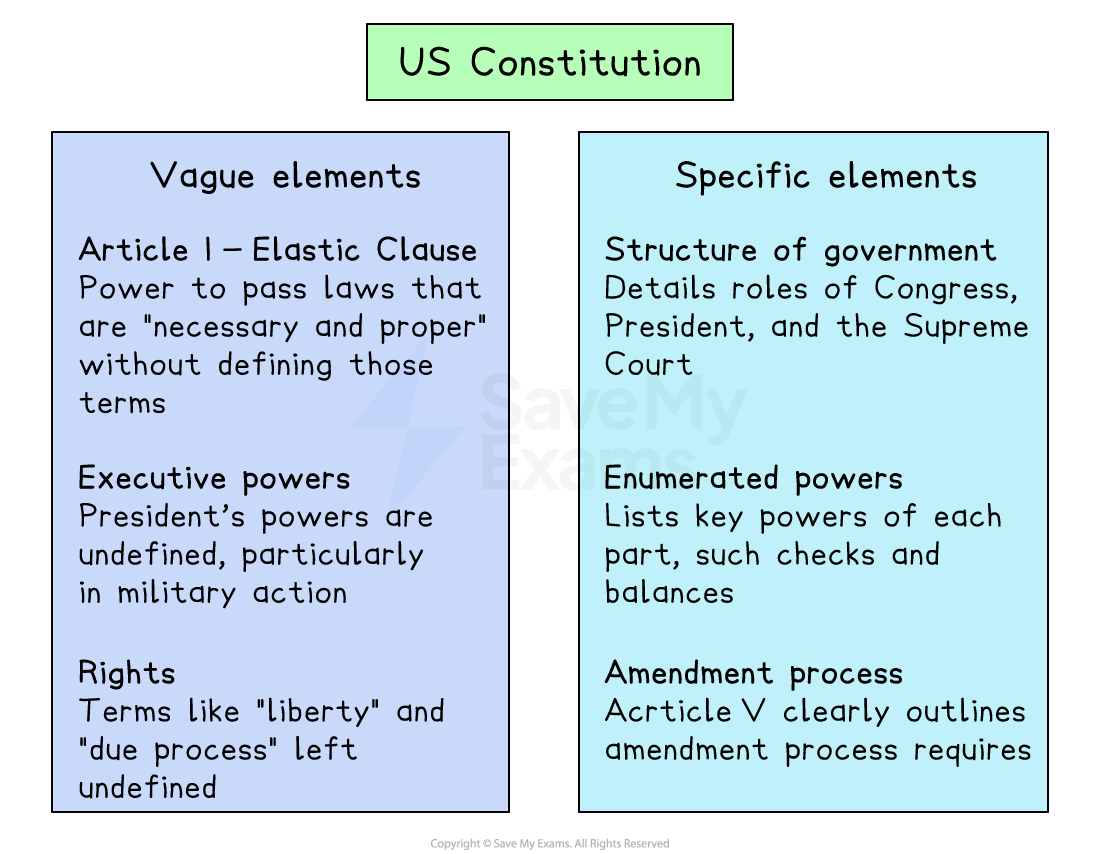
Ways in which the Constitution can be seen as vague
1. Article I – the Elastic Clause
Congress may pass laws that are “necessary and proper” to carry out its powers
There is no definition of what counts as ‘necessary and proper’, which has allowed the growth of the power of the federal government
The Affordable Care Act (2010) was justified under the Commerce Clause, despite healthcare not being explicitly mentioned
2. Undefined executive powers
The President is Commander-in-Chief, but the Constitution does not clearly outline the limits of military action
Presidents have therefore authorised military strikes without congressional approval
Biden’s 2024 strikes against Iranian-backed militias in Syria
Trump’s 2025 actions in Venezuela
3. Ambiguous language over the rights of citizens
Terms such as “liberty” and “due process” are not defined
This has allowed the Supreme Court to interpret rights differently over time
Dobbs v Jackson (2022) overturned Roe v Wade by arguing abortion was not explicitly protected
Why the Constitution can be seen as specific
Despite areas of vagueness, the US Constitution can also be seen as specific, as it clearly outlines how government should operate
1. Clear structure of federal government
Articles I–III clearly outline the roles of:
Congress
the President
the Supreme Court
Each branch is separate, known as separation of powers
President Obama, Vice President Biden and Secretary of State Clinton all had to give up their Senate seats in 2008 to take up roles in the executive branch
2. Enumerated powers
The Constitution gives each branch specific powers, including the power to check the other branches (known as checks and balances)
Congress’s powers to tax, spend and regulate interstate commerce are clearly listed and were used to pass the Inflation Reduction Act (2022)
The President is given the power of Commander-in-Chief, whilst Congress is given the power to declare war
3. Clearly defined amendment process
Article V clearly sets out how the amendment process works, even if the process is difficult
Any amendment requires approval of ⅔ of both Houses of Congress
It also requires agreement of ¾ of US states
How is the federal government organised in the US?
The US Constitution allocates specific powers to each of the three branches of government in the US to try and prevent tyranny and ensure accountability
Each branch of government in this system runs differently
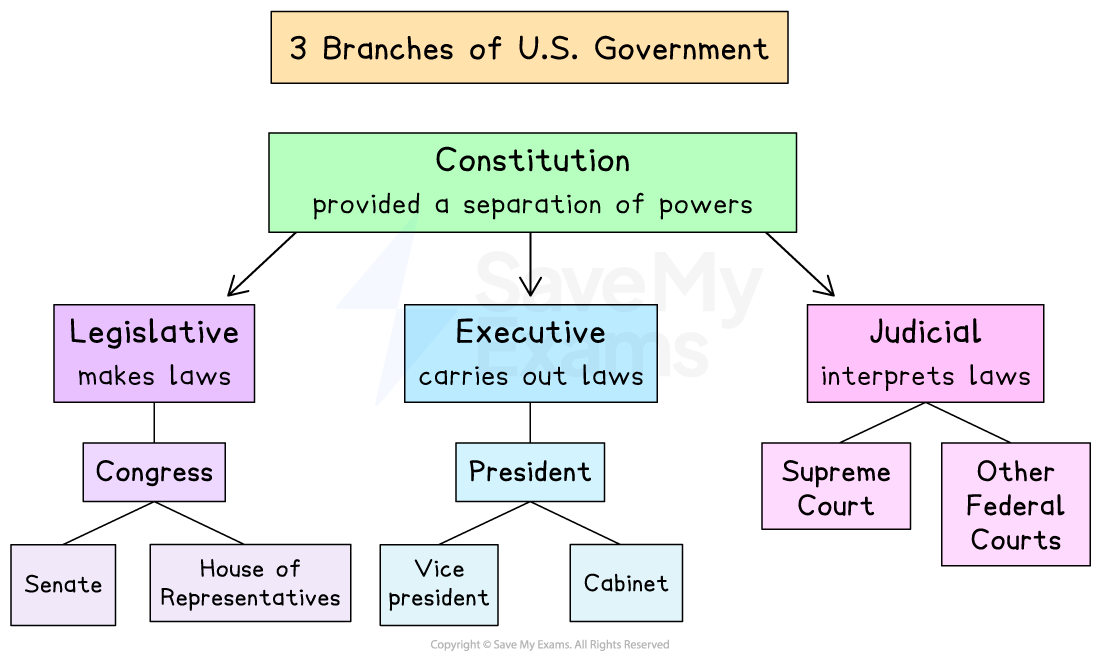
Congress (legislative)
Congress is the legislative branch of the federal government and is responsible for making laws
This power is outlined in Article I of the Constitution
1. House of Representatives
Made up of 435 members, each of whom represents a congressional district of roughly equal population
Every state must have at least one member
Members are elected every two years within their congressional district
2. Senate
Made up of 100 members, with every state having two senators
Representation is equal regardless of the population of the state
One-third of the Senate is elected every two years
Each senator serves a six-year term
President
The executive power in the US rests in the President alone
Unlike the UK, where power is collectively exercised by the Prime Minister and cabinet, Article II of the Constitution begins by stating:
“The executive Power shall be vested in a President of the United States of America”
The President is elected every four years
Each state is allocated a number of electors
These electors represent the state’s wishes in the Electoral College to elect a president
Supreme Court
The Supreme Court is the judicial branch and interprets the US Constitution
It is made up of nine justices
Justices serve to interpret the US Constitution when cases concerning its meaning are brought to them
Justices are nominated by the President when vacancies arise
Nominees must then be ratified by the Senate
The powers of each branch
1. Powers of Congress (legislative branch)
Congress exercises legislative power and holds the executive to account
Power | Explanation |
|---|---|
The power to make laws |
|
Power of the purse |
|
Oversight and impeachment |
|
Powers of the President (executive branch)
The President enforces laws and directs the executive branch
Enforcement of laws
The presidency is responsible for enforcing laws passed by Congress
This is often done using:
the federal bureaucracy
cabinet departments
executive orders
President Trump’s travel ban executive actions were interpretations of the Immigration and Nationality Act (1952)
Commander-in-Chief
The President controls the armed forces, including the army, air force and navy
Powers of the Supreme Court (judicial branch)
The Supreme Court exercises judicial power by interpreting the Constitution and ruling on constitutionality
Judicial review
The Court has the power to declare laws or actions of the federal and state governments unconstitutional
Case Study
Obergefell v Hodges (2015): Same-Sex Marriage and the US Supreme Court
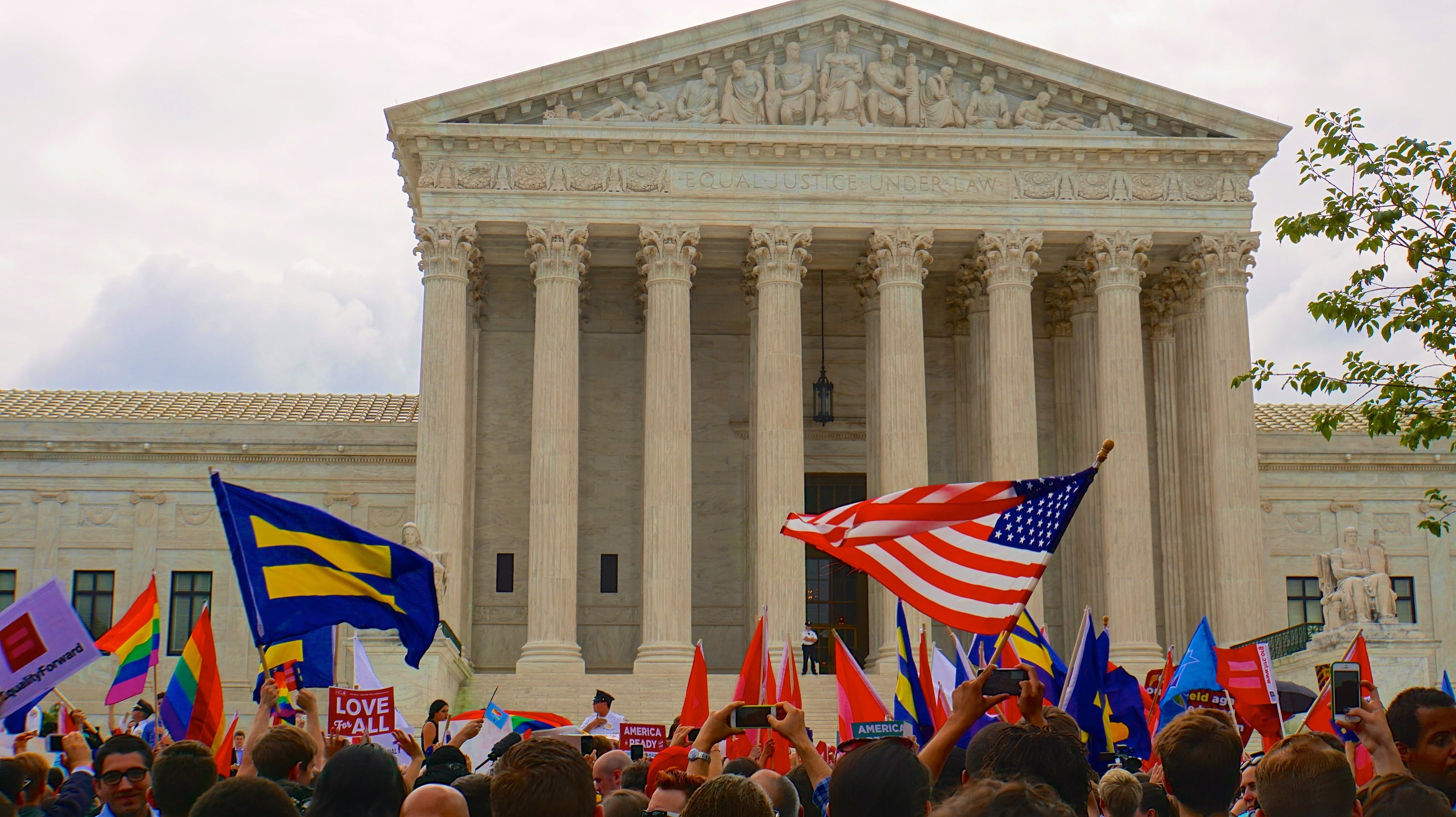
Before 2015, marriage law varied by state
While some states allowed same-sex marriage, others banned it, relying on parts of the Defense of Marriage Act (DOMA) 1996 and state-level prohibitions
This created unequal civil rights for same-sex couples across the USA
The case
James Obergefell challenged Ohio’s refusal to recognise his same-sex marriage
He argued that state bans violated the 14th Amendment, particularly the right to equal protection and due process under the law
The ruling
In a 5–4 decision, the US Supreme Court ruled that same-sex marriage is a constitutional right
States were required both to allow same-sex marriages and to recognise those performed elsewhere
The significance
Effectively overturned the remaining impact of DOMA
Legalised same-sex marriage in all 50 states
Demonstrated judicial activism and the Court’s role in protecting civil rights
Strengthened the Supreme Court’s position as a key policy-maker in US politics

Unlock more, it's free!
Join the 100,000+ Students that ❤️ Save My Exams
the (exam) results speak for themselves:

Was this revision note helpful?