US Federalism (Edexcel A Level Politics): Revision Note
Exam code: 9PL0

The federal system of government
Federalism refers to the system of shared sovereignty in the USA, where power is divided between the federal (national) government and state governments, with each having authority over different policy areas
The federal government refers to the three branches of national government:
Congress
the President
the Supreme Court
Examiner Tips and Tricks
Federalism should not be confused with the federal government
Federalism describes the relationship between national and state governments
Constitutional basis of federalism
The powers of the federal government are enumerated in Articles I–III of the US Constitution
The powers of the states are protected by Amendment X, which states:
“The powers not delegated to the United States by the Constitution, nor prohibited by it to the States, are reserved to the States respectively, or to the people.”
This creates a system in which:
both federal and state governments possess sovereignty
neither level can simply abolish the other
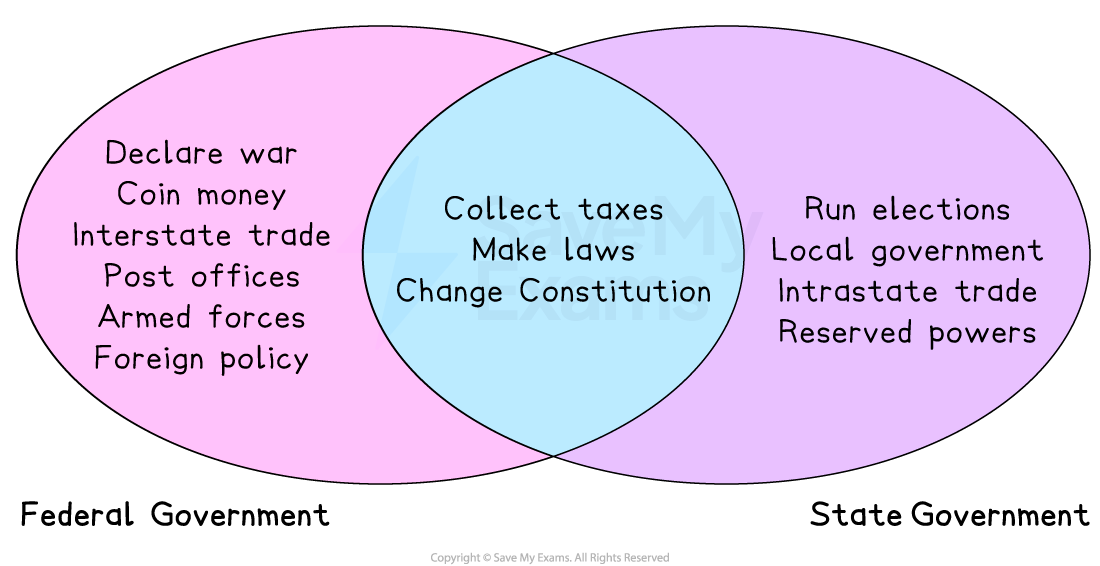
Federal government and the US states
Whilst federalism shares power between the federal and state governments, the vague nature of the US Constitution has resulted in disputes over where power should lie
Federal vs state power in practice
How the federal government has more power | How state governments have more power |
|---|---|
|
|
|
|
|
|
|
|
|
|
Overall evaluation of federalism
Federalism can be considered effective because:
it allows states to reflect local values
it limits the concentration of power at the national level
However, federalism can also be considered ineffective because:
it creates inequality between states
citizens’ rights can vary significantly depending on where they live
Although the federal government dominates funding and is constitutionally supreme in law (Article VI):
states retain significant autonomy
state powers are protected by Amendment X

Unlock more, it's free!
Join the 100,000+ Students that ❤️ Save My Exams
the (exam) results speak for themselves:

Was this revision note helpful?