Economic: WTO, G7, G8 & G20 (Edexcel A Level Politics): Revision Note
Exam code: 9PL0

The role and significance of the World Trade Organisation (WTO)
The World Trade Organisation is an intergovernmental organisation that focuses on improving the global economy
Its aim is to strengthen global economic development by promoting stronger trade relations between states
The WTO was established in 1995, following earlier international organisations that focused on trade, including the General Agreement on Tariffs and Trade (GATT)
It negotiates trade agreements covering goods, services, and intellectual property
The WTO strongly advocates free trade between states
It provides a formal platform for settling trade disputes between states
Most states in the world are members of the WTO or are in the process of joining
Current accession states include Sudan, Uzbekistan, and Bosnia and Herzegovina
Evaluation of the World Trade Organisation
Strengths | Weaknesses |
|---|---|
|
|
The G7 and G8
This intergovernmental organisation was established in 1975 by a group of highly established, economically-developed nations
Leaders of these countries meet each year to discuss economic, political and security issues
The Managing Director of the IMF usually also attends
By 1976 the group included
The United States
The United Kingdom
France
Germany
Italy
Japan
Canada
The 8th state is Russia which joined in 1998-2014; this is why the group is sometimes referred to as G8
Evaluation of the G7/G8
Strengths | Weaknesses |
|---|---|
|
|
The G20
This intergovernmental organisation was established in 1999 following the global financial crisis of 2008
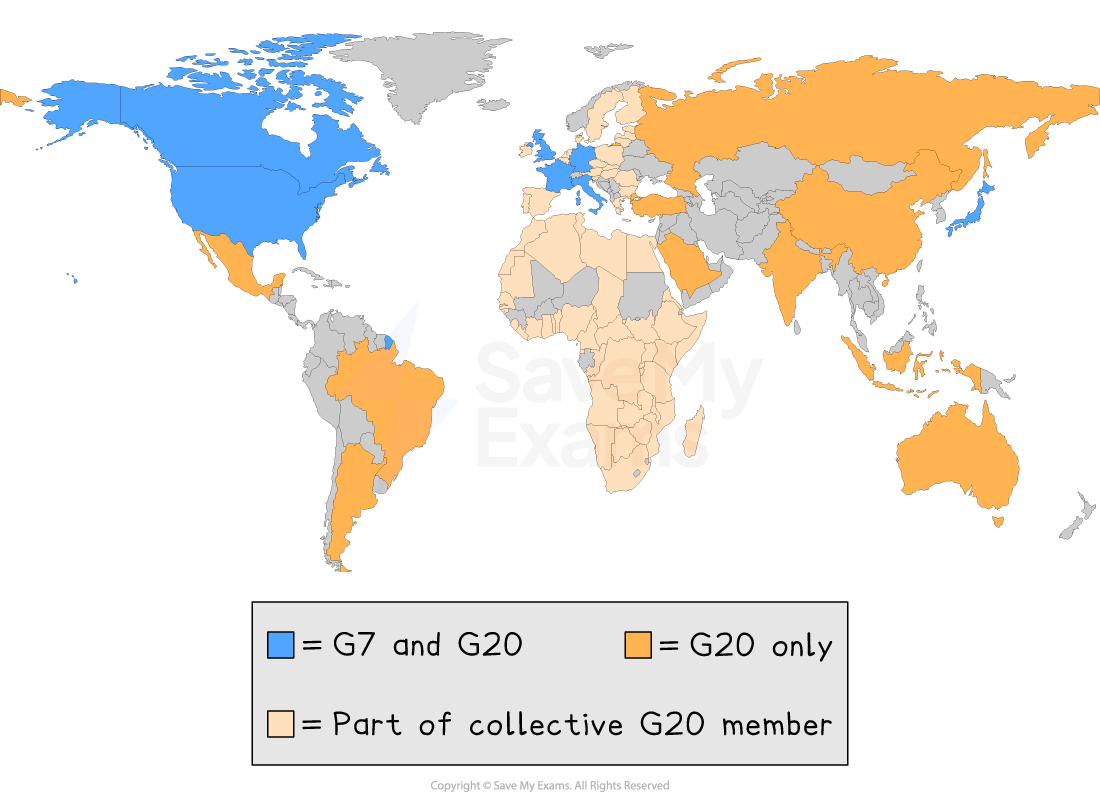
Its aim is to bring together leaders and finance ministers from both economically-developed and emerging economies to strengthen economic policies and reform financial institutions
The President of the World Bank and Managing Director of the the IMF also attend these meetings
Evaluation of the G20
Strengths | Weaknesses |
|---|---|
|
|

Unlock more, it's free!
Join the 100,000+ Students that ❤️ Save My Exams
the (exam) results speak for themselves:

Was this revision note helpful?