Obstacles & Effectiveness (Edexcel A Level Politics): Revision Note
Exam code: 9PL0

Obstacles to international co-operation
There are many obstacles to international cooperation
Realists might argue that states will always prioritise their own interests and sovereignty
Any form of international cooperation is superficial
Liberals might argue that because climate change is a global political challenge which affects all
States must find a way to overcome obstacles and co-operate
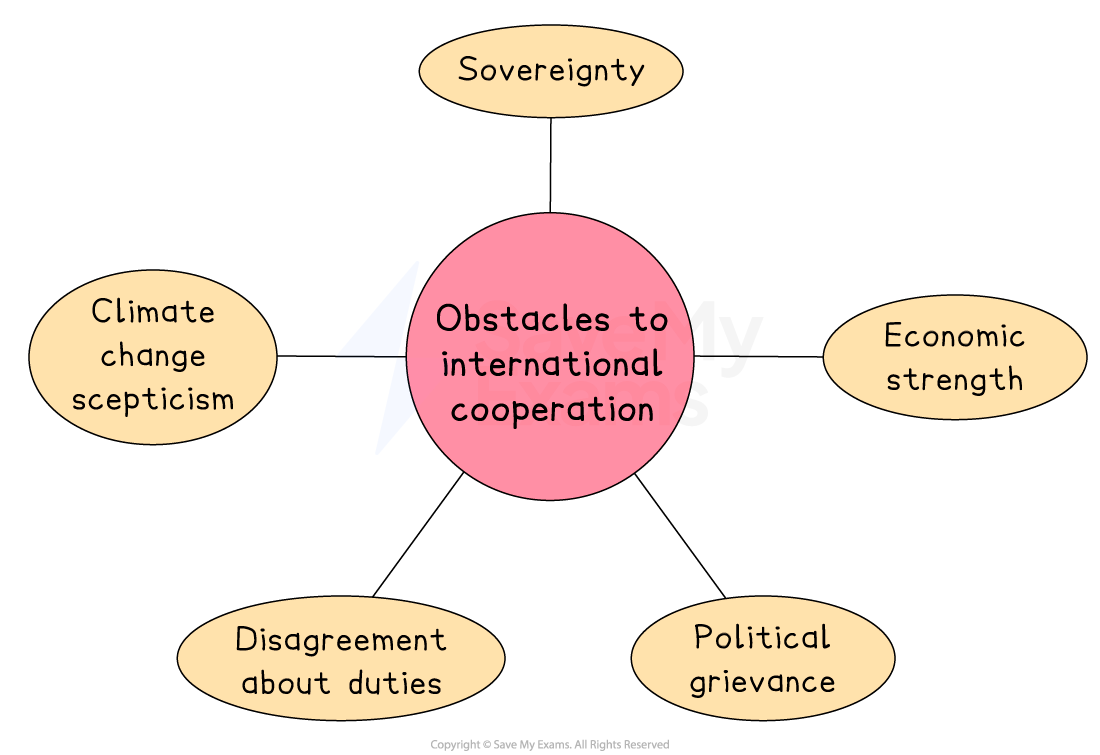
1. Sovereignty
Sovereignty means states have the right to govern themselves without outside interference
States may resist international rules if they limit domestic control
For example, China and India argue that climate targets threaten their right to develop
Some states reject human rights interventions, claiming they are internal matters (e.g. Myanmar)
2. Economic strength
Wealthier states can afford environmental protection and poverty reduction more easily
Poorer states often prioritise economic growth over climate or labour standards
For example, least developed countries produce under 1% of global emissions, but suffer most from climate change
Rich states are criticised for failing to meet the UN target of 0.7% of GNI on foreign aid (few consistently do)
3. Political grievances
Past conflicts, colonialism or mistrust reduce willingness to cooperate
Some developing states argue that Western countries caused most historical emissions
This creates tension in climate talks, such as at COP summits
Political rivalries (e.g. USA–China) can block cooperation on global issues
4. Disagreements about duties and responsibilities
States disagree over who should do more to tackle global problems
The principle of common but differentiated responsibilities recognises unequal blame and capacity
Developed states produced around 70% of historical CO₂ emissions but argue they should have lighter obligations
5. Scepticism regarding climate change
Some leaders and the public question the existence or severity of climate change
This reduces support for international agreements
For example, Donald Trump withdrew the USA from the Paris Agreement in 2017 (rejoined in 2021)
Climate scepticism weakens domestic and international commitment
Global civil society and non-state actors and contemporary global issues
1. Human rights
Many non-state actors are specifically committed to monitoring and protecting human rights
There are countless groups and individuals addressing human rights at all levels of global politics, from local to international
Non-governmental organisations (NGOs)
Amnesty International | Human Rights Watch |
|---|---|
|
|
Social movements
Black Lives Matter | #MeToo |
|---|---|
|
|
Global civil society
With globalisation and improvements in transportation and communication technologies, ideas about human rights are widely shared
This has led to a greater global awareness of such issues as LGBTQ+ rights and gender equality
2. Environmental Issues
There's also a range of non-state actors focused on environmental issues
Non-governmental organisations (NGOs)
Greenpeace | Climate Action Network |
|---|---|
|
|
Social movements
School Strike for Climate | Extinction Rebellion |
|---|---|
|
|
Global civil society
As with human rights a greater global awareness of environmental concerns has spread through social media and travel, such as
A greater awareness of the significance of deforestation and climate change
Evaluation
The role and significance of these civil society organisations and non-state actors in addressing these challenges is difficult to measure
Ultimately, human rights and climate action need to be protected and enforced by law
In democratic states citizens can demand government action be taken
Without the support of state government, laws will not be changed
Some argue that civil society and non-state actors use soft power to try to affect change
Although this can be effective it is the power of the state to enforce and protect human rights and the environment

Unlock more, it's free!
Join the 100,000+ Students that ❤️ Save My Exams
the (exam) results speak for themselves:

Was this revision note helpful?
