Unit, Job & Batch Costing (Cambridge (CIE) AS Accounting): Revision Note
Exam code: 9706

Unit costing
What is unit costing?
Unit costing is where the cost of producing a single unit of product or service is calculated
It is used when production is continuous and identical products are produced
format('truetype')%3Bfont-weight%3Anormal%3Bfont-style%3Anormal%3B%7D%3C%2Fstyle%3E%3C%2Fdefs%3E%3Ctext%20font-family%3D%22Times%20New%20Roman%22%20font-size%3D%2218%22%20text-anchor%3D%22middle%22%20x%3D%2216.5%22%20y%3D%2230%22%3EUnit%3C%2Ftext%3E%3Ctext%20font-family%3D%22Times%20New%20Roman%22%20font-size%3D%2218%22%20text-anchor%3D%22middle%22%20x%3D%2250.5%22%20y%3D%2230%22%3Ecost%3C%2Ftext%3E%3Ctext%20font-family%3D%22math17f39f8317fbdb1988ef4c628eb%22%20font-size%3D%2216%22%20text-anchor%3D%22middle%22%20x%3D%2277.5%22%20y%3D%2230%22%3E%3D%3C%2Ftext%3E%3Cline%20stroke%3D%22%23000000%22%20stroke-linecap%3D%22square%22%20stroke-width%3D%221%22%20x1%3D%2292.5%22%20x2%3D%22283.5%22%20y1%3D%2223.5%22%20y2%3D%2223.5%22%2F%3E%3Ctext%20font-family%3D%22Times%20New%20Roman%22%20font-size%3D%2218%22%20text-anchor%3D%22middle%22%20x%3D%22131.5%22%20y%3D%2216%22%3ETotal%3C%2Ftext%3E%3Ctext%20font-family%3D%22Times%20New%20Roman%22%20font-size%3D%2218%22%20text-anchor%3D%22middle%22%20x%3D%22193.5%22%20y%3D%2216%22%3Eproduction%3C%2Ftext%3E%3Ctext%20font-family%3D%22Times%20New%20Roman%22%20font-size%3D%2218%22%20text-anchor%3D%22middle%22%20x%3D%22250.5%22%20y%3D%2216%22%3Ecost%3C%2Ftext%3E%3Ctext%20font-family%3D%22Times%20New%20Roman%22%20font-size%3D%2218%22%20text-anchor%3D%22middle%22%20x%3D%22123.5%22%20y%3D%2241%22%3ENumber%3C%2Ftext%3E%3Ctext%20font-family%3D%22Times%20New%20Roman%22%20font-size%3D%2218%22%20text-anchor%3D%22middle%22%20x%3D%22164.5%22%20y%3D%2241%22%3Eof%3C%2Ftext%3E%3Ctext%20font-family%3D%22Times%20New%20Roman%22%20font-size%3D%2218%22%20text-anchor%3D%22middle%22%20x%3D%22193.5%22%20y%3D%2241%22%3Eunits%3C%2Ftext%3E%3Ctext%20font-family%3D%22Times%20New%20Roman%22%20font-size%3D%2218%22%20text-anchor%3D%22middle%22%20x%3D%22248.5%22%20y%3D%2241%22%3Eproduced%3C%2Ftext%3E%3C%2Fsvg%3E)
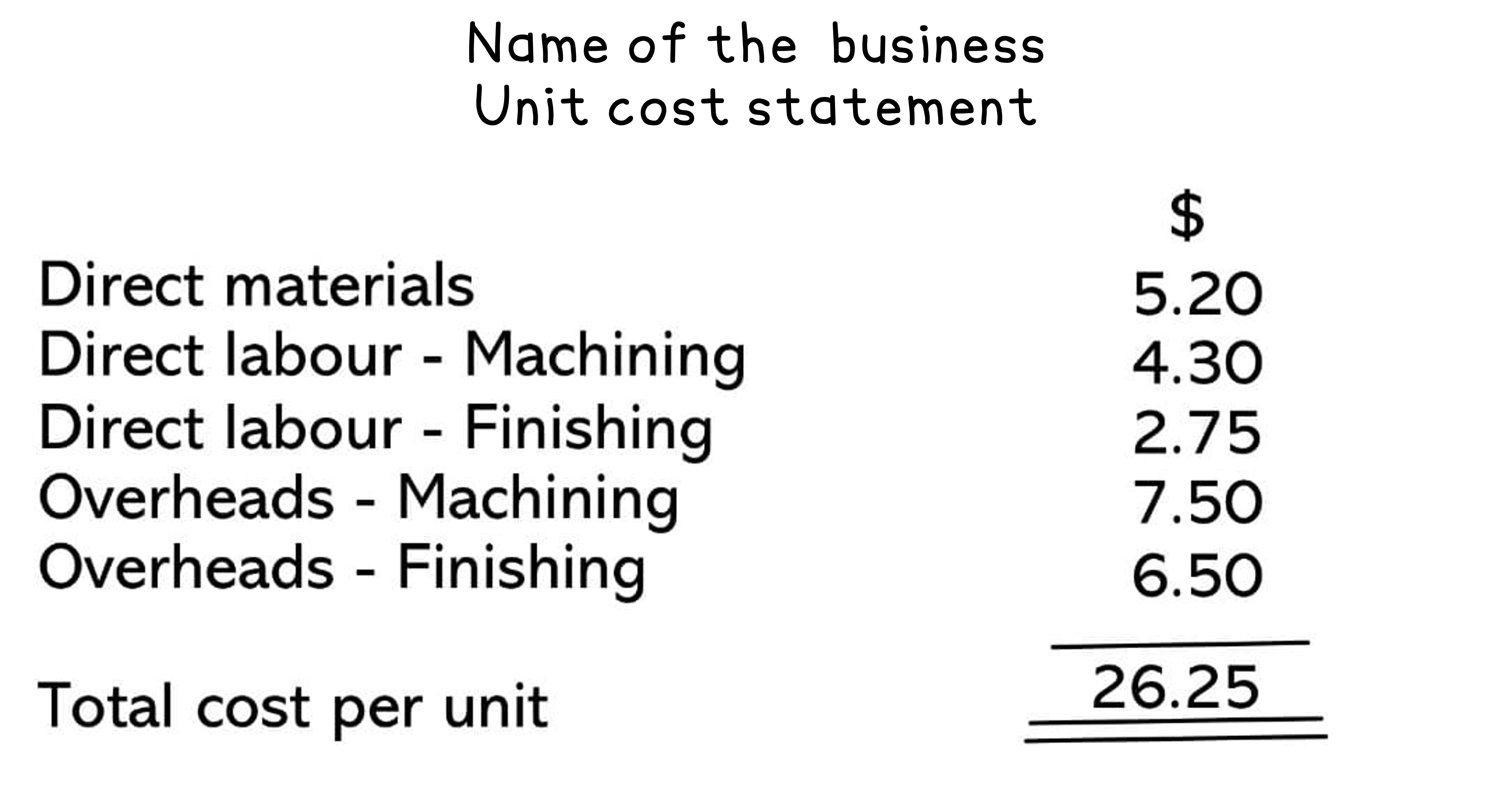
How do I prepare a costing statement for a unit?
STEP 1
Calculate the direct materials cost per unit
Multiply the cost per direct material unit (e.g. cost per metre) by the amount of direct materials used per unit
STEP 2
Calculate the direct labour cost per unit
Multiply the hourly rate by the hours spent per unit
These may have different hourly rates for each department
E.g. machining department, assembly department
STEP 3
Calculate overheads per unit
Multiply the overhead absorption rate by machine hours or labour hours used per unit
Machine hours for machine-intensive departments
Labour hours for labour-intensive departments
Examiner Tips and Tricks
For service businesses, there is no direct material cost or factory overheads.
Worked Example
Company X manufactures tables.
The following data is available per unit for the year ended 31 December 2020.
Direct materials | 5kg at $2.50 per kg |
Direct labour | |
Machining department | 4 hours at $10.75 per hour |
Finishing department | 2 hours at $8.50 per hour |
Machine hours | |
Machining department | 2.5 hours |
Finishing department | 1.5 hours |
Overhead absorption rates | $5.50 per labour hour $6.20 per machine hour |
Calculate the cost of producing one table.
Answer:
Use machine hours for machining department overheads
Use labour hours for finishing department overheads
Unit cost statement: | $ | |
|---|---|---|
Direct materials | 5 × $2.50 | 12.50 |
Direct labour | ||
Machining department | 4 × $10.75 | 43.00 |
Finishing department | 2 × $8.50 | 17.00 |
Overheads | ||
Machining department | 2.5 × $6.20 | 15.50 |
Finishing department | 2 × $5.50 | 11.00 |
Total cost per unit | 99.00 |
Cost per unit is $104.50
Job costing
What is job costing?
Job costing is where the cost of a special order is calculated
It is used when each job is customised or made to order
How can I prepare a costing statement using job costing?
A cost statement using job costing is prepared to determine the total cost and cost per job
STEP 1
Calculate the direct materials cost
STEP 2
Calculate direct labour cost
STEP 3
Calculate manufacturing overheads
Add to direct costs to get total production cost
STEP 4
Calculate administrative and selling and distribution overheads
Add to total production cost to get total cost of job

Examiner Tips and Tricks
Most exam questions only include production costs. However, there has been a question where you needed to find the factory cost and then apply a percentage to it to find the selling and distribution overheads.
Worked Example
Company Y produces boats. A customer places a special order for a custom boat.
The following budgeted data is available for the year ended 31 December 2024.
Direct materials | $15 000 |
Direct labour | |
Assembling | $5 000 |
Painting | $6 500 |
Overhead absorption rates | $5.00 per labour hour $4.50 per machine hours |
Overheads - Assembling | 500 labour hours 3 500 machine hours |
Overheads - Painting | 6 000 labour hours 250 machine hours |
Administrative overheads | $500 |
Selling and distribution overheads | $200 |
Prepare a job cost statement and calculate the total cost for the customer's order.
Answer:
Use machine hours for assembling department overheads
Use labour hours for painting department overheads
$ | ||
|---|---|---|
Direct materials | 15 000 | |
Direct labour | ||
Assembling | 5 000 | |
Painting | 6 500 | |
Overheads | ||
Assembling | 3 500 × $4.50 | 15 750 |
Painting | 6 000 × $5.00 | 30 000 |
Factory cost | 72 250 | |
Administrative overheads | 500 | |
Selling and distribution overheads | 200 | |
Total cost of job | 72 950 |
Cost of job is $72 950
Batch costing
What is batch costing?
Batch costing is where the cost of producing a batch of identical products is calculated
It is used when products are produced in batches rather than individually or continuously
format('truetype')%3Bfont-weight%3Anormal%3Bfont-style%3Anormal%3B%7D%3C%2Fstyle%3E%3C%2Fdefs%3E%3Ctext%20font-family%3D%22Times%20New%20Roman%22%20font-size%3D%2218%22%20text-anchor%3D%22middle%22%20x%3D%2216.5%22%20y%3D%2230%22%3ECost%3C%2Ftext%3E%3Ctext%20font-family%3D%22Times%20New%20Roman%22%20font-size%3D%2218%22%20text-anchor%3D%22middle%22%20x%3D%2248.5%22%20y%3D%2230%22%3Eper%3C%2Ftext%3E%3Ctext%20font-family%3D%22Times%20New%20Roman%22%20font-size%3D%2218%22%20text-anchor%3D%22middle%22%20x%3D%2278.5%22%20y%3D%2230%22%3Eunit%3C%2Ftext%3E%3Ctext%20font-family%3D%22math17f39f8317fbdb1988ef4c628eb%22%20font-size%3D%2216%22%20text-anchor%3D%22middle%22%20x%3D%22104.5%22%20y%3D%2230%22%3E%3D%3C%2Ftext%3E%3Cline%20stroke%3D%22%23000000%22%20stroke-linecap%3D%22square%22%20stroke-width%3D%221%22%20x1%3D%22119.5%22%20x2%3D%22326.5%22%20y1%3D%2223.5%22%20y2%3D%2223.5%22%2F%3E%3Ctext%20font-family%3D%22Times%20New%20Roman%22%20font-size%3D%2218%22%20text-anchor%3D%22middle%22%20x%3D%22176.5%22%20y%3D%2216%22%3ETotal%3C%2Ftext%3E%3Ctext%20font-family%3D%22Times%20New%20Roman%22%20font-size%3D%2218%22%20text-anchor%3D%22middle%22%20x%3D%22213.5%22%20y%3D%2216%22%3Ecost%3C%2Ftext%3E%3Ctext%20font-family%3D%22Times%20New%20Roman%22%20font-size%3D%2218%22%20text-anchor%3D%22middle%22%20x%3D%22239.5%22%20y%3D%2216%22%3Eof%3C%2Ftext%3E%3Ctext%20font-family%3D%22Times%20New%20Roman%22%20font-size%3D%2218%22%20text-anchor%3D%22middle%22%20x%3D%22270.5%22%20y%3D%2216%22%3Ebatch%3C%2Ftext%3E%3Ctext%20font-family%3D%22Times%20New%20Roman%22%20font-size%3D%2218%22%20text-anchor%3D%22middle%22%20x%3D%22150.5%22%20y%3D%2241%22%3ENumber%3C%2Ftext%3E%3Ctext%20font-family%3D%22Times%20New%20Roman%22%20font-size%3D%2218%22%20text-anchor%3D%22middle%22%20x%3D%22191.5%22%20y%3D%2241%22%3Eof%3C%2Ftext%3E%3Ctext%20font-family%3D%22Times%20New%20Roman%22%20font-size%3D%2218%22%20text-anchor%3D%22middle%22%20x%3D%22220.5%22%20y%3D%2241%22%3Eunits%3C%2Ftext%3E%3Ctext%20font-family%3D%22Times%20New%20Roman%22%20font-size%3D%2218%22%20text-anchor%3D%22middle%22%20x%3D%22249.5%22%20y%3D%2241%22%3Ein%3C%2Ftext%3E%3Ctext%20font-family%3D%22Times%20New%20Roman%22%20font-size%3D%2218%22%20text-anchor%3D%22middle%22%20x%3D%22271.5%22%20y%3D%2241%22%3Ethe%3C%2Ftext%3E%3Ctext%20font-family%3D%22Times%20New%20Roman%22%20font-size%3D%2218%22%20text-anchor%3D%22middle%22%20x%3D%22305.5%22%20y%3D%2241%22%3Ebatch%3C%2Ftext%3E%3C%2Fsvg%3E)
How can I prepare a cost statement using batch costing?
STEP 1
Determine the batch size
Batch size = Total units produced in the batch
STEP 2
Calculate direct material cost
STEP 3
Calculate direct labour cost
STEP 4
Calculate factory overheads
STEP 5
Calculate total cost of batch
Add total direct costs and factory overheads

Worked Example
Company Z manufactures toys in batches.
The following budgeted data is available for the year ended 31 March 2023 for one batch.
Direct materials | $20 000 |
Direct labour | |
Assembling | $15 000 |
Colouring | $5 000 |
Overheads | |
Assembling | 2 000 labour hours 5 000 machine hours |
Colouring | 3 000 labour hours 2 000 machine hours |
Overhead absorption rates | $3.00 per labour hour $4.50 per machine hour |
Calculate the cost of the batch by preparing a batch cost statement.
Answer:
Use machine hours for assembling department overheads
Use labour hours for colouring department overheads
$ | ||
|---|---|---|
Direct materials | 20 000 | |
Direct labour | ||
Assembling | 15 000 | |
Colouring | 5 000 | |
Overheads | ||
Assembling | 5 000 × $4.50 | 22 500 |
Colouring | 3 000 × $3.00 | 9 000 |
Total cost | 71 500 |
Cost of the batch is $71 500

Unlock more, it's free!
Join the 100,000+ Students that ❤️ Save My Exams
the (exam) results speak for themselves:

Was this revision note helpful?
