Management Decision Making (AQA AS Business): Exam Questions

Exam code: 7131

1 hour9 questions
1
16 marks

Case Study

Refurb-iture Ltd

Veronica is CEO of Refurb-iture Ltd, which makes and sells luxury home furniture to high income groups. Currently all of its furniture is made from reclaimed and recycled materials. The business has grown rapidly in the last two years. The number of staff in the sales department has increased from 15 to 75. As a result, many staff are inexperienced. In the sales department, there are currently 5 managers and 10 deputy managers. Each deputy manager is in charge of 6 assistants.

Some new staff have reported they do not feel very well supported. There have been some complaints from customers about slow service times as staff check information with deputy managers. The business’ staffing costs are double that of its main competitor.

Veronica recognises that good customer service and eco-friendly products are the main reasons customers buy from Refurb-iture Ltd. The shareholders of Refurb-iture Ltd have set Veronica the following objectives:

  • expand the product portfolio from just home furniture to achieve rapid sales growth

  • maintain its exclusive and unique brand image

  • increase profitability in the long term.

Veronica is determined to meet these objectives by increasing the product portfolio with one new type of product. She has researched two options for the new type of product: garden furniture or office furniture. Her research is shown below.

Garden furniture option

Office furniture option

Market value in UK

£12 million

£650 million

Growth in the market in last 10 years

10%

25%

Average price per unit

£1500

£150

Initial investment cost for machinery

£2.5 million

£1.2 million

Variable cost per unit

£120

£22

Discounts offered by suppliers for bulk purchases

Not offered

15%

Materials used

100% eco-friendly

40% eco-friendly

Number of competitors with similar products

1

8

Recommend whether Refurb-iture Ltd should choose garden furniture or office furniture for its expansion.

Justify your answer.

2
9 marks

Read the source in the Insert

PE Ltd is deciding whether to enter a new market by targeting individual households directly.

Analyse how PE Ltd might benefit from using a decision tree when making this decision.

3
1 mark

A company decides to rely only on decision trees to decide whether to accept a project. If decisions are based on the financial outcome, what is the most important factor in these decisions?

  • Expected value

  • Initial cost

  • Net gain

  • Probability of success

4
20 marks

Read the source in the Insert.

‘For all businesses, external factors are more important than internal factors when setting marketing objectives.’

To what extent do you agree with this statement?

5
4 marks

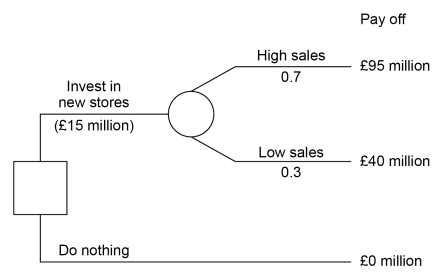
A business is deciding whether to expand through investing in new stores. The business produces the decision tree below.

Decision tree showing options: invest £15 million for high sales (£95m, 0.7 probability) or low sales (£40m, 0.3 probability), or do nothing (£0m).

Calculate the net gain to this business of investing in new stores.

6
1 mark

A manager uses decision trees to choose the best financial outcome from four different options. Results from these options are shown below.

Option

Result 1

Result 2

A

Expected value = +£2 million

Pay-off of best outcome = +£18 million

B

Net gain = +£3 million

Pay-off of best outcome = +£12 million

C

Net gain = +£2 million

Expected value = +£4 million

D

Net gain = +£1 million

Expected value = +£7 million

Which one of these options is most likely to be chosen by the manager?

  • Option A

  • Option B

  • Option C

  • Option D

7
9 marks

Read the source in the Insert.

The board of directors insisted on Lorna using scientific decision-making techniques before investing in ‘Our Place’.

Analyse why.

8
4 marks

A manager is considering whether to launch a new, innovative product.

Explain one limitation of using a decision tree to make this decision.

9
16 marks

Case Study

AdventureCamp

In 2015 Sam Turner decided to leave the army and set up his own business. He had always enjoyed being a risk taker. He spent nearly a year establishing AdventureCamp Ltd (AC Ltd) just outside London. At the camp Sam runs outdoor activities for adults such as zip wire and rope climbing challenges; it includes a café area. Sam is very ‘hands on’ and enjoys managing every aspect of the business. However, he has found it harder than he imagined negotiating with suppliers and banks; perhaps because the business is new and small.

Sam targets business customers who use his camp for team-building events. Sam designs specific activities for each business based around his specialist army training. He has offered very favourable trade credit terms and, in this first year, big discounts where necessary to win bookings. He believes that once organisations have used his services he will win their repeat business and their brand loyalty. He is well aware there are many other team-building companies that businesses could use.

For his first year Sam set two financial targets: to break even and to keep his short– term borrowings from the bank under £25 000. His mission is to create a number of AdventureCamps across the UK in the next few years.

Sam is now considering two options. He does not have the time to do both.

Option 1: Adding new facilities to the existing camp to provide some activities that are usable when the weather is bad. Sam has had to cancel bookings at the very last minute because of health and safety issues when there are high winds or heavy rain. This has led to complaints.

Option 2: Opening a brand new and much larger camp in Scotland with the aim of targeting families wanting outdoor activities (eg for birthday parties). A friend has told Sam of some land that is available near Edinburgh and, having asked a few local families, she thinks there is potential. She has put together some financial estimates based on this. Sam is very excited at the idea of a second camp.

Table 1: Financial extracts for AC Ltd on 31 December 2016

Item

Data

Receivables

90 days

Payables

21 days

Overdraft

£35 000

Debt

£100 000

Total long–term funds invested in the business (including debt)

£150 000

Average contribution per customer in 2016

£25

Total number of customers in 2016

8000

Fixed costs in 2016

£207 000

Interest rates on existing loan

5.5%

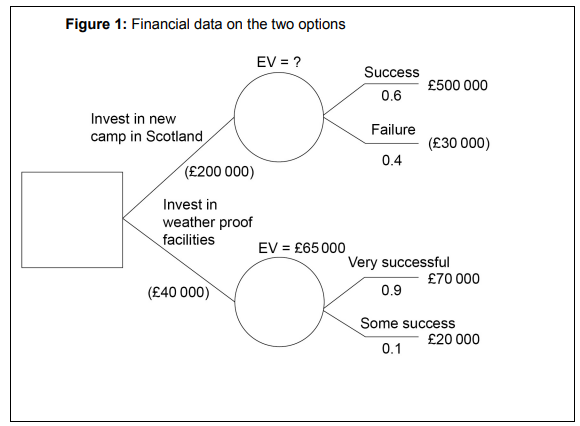
Decision tree showing investment options: a new camp in Scotland with £200k cost, 60% success (£500k), 40% failure (-£30k); weatherproof facilities (£40k), very successful (£70k) or some success (£20k).

Sam is trying to decide between two options. Which of the two would you choose? Justify your choice. You should support your answer with calculations using Figure 1.