Financial Performance (AQA AS Business): Exam Questions

Exam code: 7131

2 hours34 questions
1
1 mark

A business has an opening balance of £5000 on 1 July.

In the month of July, there is a cash outflow of £14 000. The net cash flow for July is £22 000.

The business’ closing balance on 31 July is:

  • –£9000

  • £8000

  • £13 000

  • £27 000

2
4 marks

The following data applies to a business.

Selling price per unit

£5

Output

9000 units

Variable cost of each unit

£2

Expenses

£20 000

Calculate the operating profit margin (profit from operations margin) for the business.

3
3 marks

Read the source in the Insert.

Using Figure 2, calculate the monthly margin of safety for PE Ltd in 2023.

4
16 marks

Read the source in the Insert

Using Figure 2 and the case study, evaluate whether the managers of PE Ltd should be concerned about its financial position.

5
1 mark

Statement 1: ‘Total revenue = Total costs + profit’

Statement 2: ‘Total contribution = (Contribution per unit × quantity) + fixed costs’

Read statements 1 and 2 and select the correct option from the following:

  • Statement 1 is true. Statement 2 is true.

  • Statement 1 is true. Statement 2 is false.

  • Statement 1 is false. Statement 2 is true.

  • Statement 1 is false. Statement 2 is false.

6
1 mark

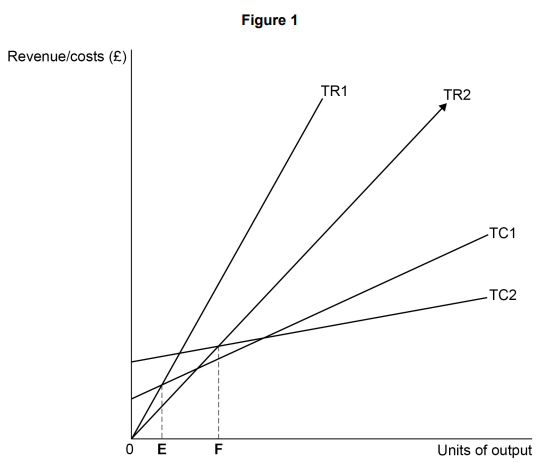
Figure 1 below shows a break -even chart.

Graph showing revenue and cost lines TR1, TR2, TC1, and TC2 against units of output, with intersections at points E and F on the horizontal axis.

Which of the following changes would lead to a change of break-even output from E to F?

  • An increase in price and an increase in fixed costs.

  • An increase in price, an increase in fixed costs and a decrease in variable costs per unit.

  • A decrease in price and a decrease in variable costs per unit.

  • A decrease in price, an increase in fixed costs and a decrease in variable costs per unit.

7
3 marks

The following data applies to a business.

Price of product

£5

Variable cost per unit

£3

Fixed costs

£30 000

Number of sales of product

22 000

Calculate the margin of safety for the business.

8
4 marks

Explain one benefit to a newly established business of producing a budget.

9
3 marks

Read the source in the Insert

Figure 2: BB financial data for 3000 units

3000 units sold

Total revenue

£105 000

Total fixed costs

£5 700

Total variable costs

£17 250

Using Figure 2, calculate the total contribution if BB only sells 1000 units.

10
9 marks

Read the source in the Insert.

Analyse the impact on BB’s financial performance if it decides to take the contract with the hotel.

11
1 mark

Statement 1: ‘Total contribution = (selling price per unit – variable costs per unit) × quantity’.

Statement 2: ‘Total revenue = Total contribution + Fixed costs’.

Read statements 1 and 2 and select the correct option from the following:

  • Statement 1 is true. Statement 2 is true.

  • Statement 1 is true. Statement 2 is false.

  • Statement 1 is false. Statement 2 is true.

  • Statement 1 is false. Statement 2 is false.

12
9 marks

Case Study

Rockall Ltd

Rockall Ltd is a family-owned business that has manufactured clothes for 30 years. The company has grown steadily without taking ‘excessive risks’. The business targets the 16–30 age segment of the clothes market where low prices are important to customers. Rockall is recognised in this market for its ‘good value’. To keep production costs low, basic materials and designs are used for all the products it makes. Rockall does not use advertising.

Table 1 Extracts from Rockall Ltd Income Statements 2019 and 2020

2020

2019

Revenue

£850 million

£650 million

Gross profit margin

80%

75%

Operating profit margin

38%

45%

2020 was a busy year for Rockall:

  • It doubled the size of its rented head office.

  • Several new retailers signed contracts to sell its products. This resulted in larger purchases of materials allowing it to negotiate considerable discounts.

  • It introduced lean production.

  • It introduced a new layer of management.

Rockall is thinking about the future. In the last couple of years it has launched two new product ranges: sports shoes and jewellery accessories. It has now decided that, in addition to its clothing, it will increase its investment in just one of these new product ranges. Recently, Rockall completed market research that showed:

  • total sales in the sports shoe market targeted by Rockall were double jewellery market sales last year

  • many customers in the sports shoe market are in the 16–30 age range

  • a number of large, well-known sports shoe brands dominate this market, spending several hundred million pounds on advertising

  • the sports shoe brands charge high prices and make high profit margins

  • its jewellery generally has a lower gross profit margin than its sports shoes

  • there are many relatively small producers in the jewellery market.

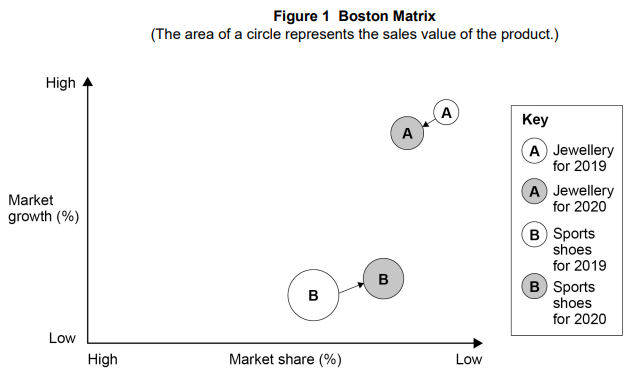
Following its research , Rockall produced the Boston Matrix below relating to its existing products in the sports shoe and jewellery markets in 2019 and 2020:

Boston Matrix chart showing market growth vs. market share for jewellery and sports shoes in 2019 and 2020, with circle size indicating sales value.

With reference to Table 1, analyse the causes of the changes in the profit margins for Rockall Ltd between 2019 and 2020.

13
3 marks

Read the source in the Insert.

Using the data in Figure 1, calculate VeganLife Ltd’s gross profit for 2020.

14
3 marks

Read the source in the Insert

VeganLife Ltd is considering launching a new range of products for men.

Using the information provided in Figure 2, calculate the break-even output for the proposed new shower gel.

15
1 mark

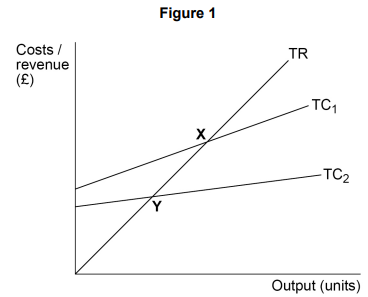
Figure 1 shows a situation in which there is a change in the break-even point of a product from point X to point Y.

Graph showing costs/revenue (£) versus output (units) with lines TR, TC1, TC2; intersect at points X and Y.

The change in break-even point from X to Y has been caused by

  • a fall in fixed costs and a fall in variable costs per unit.

  • a fall in fixed costs only.

  • a fall in the selling price and fall in fixed costs.

  • a fall in variable costs per unit only.

16
1 mark

The data below in Table 1 shows the weekly output and total costs of a business.

Table 1

Weekly output (units)

Total costs (£)

0

420

1

700

2

950

3

1320

4

1750

The total variable cost of producing three units of output is

  • £420

  • £440

  • £900

  • £1320

17
1 mark

Receivables are the value of

  • a business’s sales revenue.

  • inventory held by a business.

  • money owed to a business by its customers.

  • money owed to suppliers by a business.

18
3 marks

The following data applies to a business:

Fixed costs

£1.5 million

Total costs

£6 million

Output

2 million units

Profit

£3 million

Calculate the selling price per unit.

19
4 marks

A business budgeted its labour costs to be £4 million for 2019. It recorded an adverse variance of £2 million on this budget.

Explain one action the business managers might take in these circumstances.

20
1 mark

The data below is taken from the accounts of Abacus plc for 2018 – 2019.

Revenue £15 million
Cost of sales £7 million
Other expenses £9 million
Taxation £2 million

The gross profit for Abacus plc in £ (millions) is

  • 4

  • 6

  • 8

  • 13

21
4 marks

The following data applies to a business:

  • break-even output = 500 units

  • fixed costs = £30 000

  • variable cost per unit = £30.

The business is currently operating at its break-even output. Calculate its selling price. Show your workings.

22
4 marks

Read the source in the insert booklet.

The budgeted profit for Rana Fashion in 2018 was £2 946 000. Using the data below, calculate the profit variance for Rana Fashion in 2018. State whether it is adverse or favourable.

Actual

Sales revenue

£5 600 000

Costs:

Inventory

£2 300 000

Warehousing

£200 000

Distribution

£126 000

IT

£170 000

Other

£180 000

23
1 mark

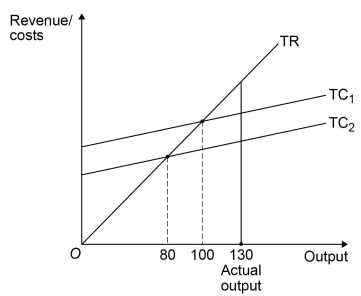
The break-even chart below shows the change in break-even output arising from a change in total costs from TC1 to TC2.

Graph showing revenue and costs with lines TR, TC1, and TC2. Axes labelled as Revenue/costs and Output. Vertical lines at outputs 80, 100, and 130.

In the diagram, the margin of safety has

  • fallen by 30 units as a result of a fall in fixed costs.

  • fallen by 20 units as a result of a fall in variable costs.

  • risen by 20 units as a result of a fall in fixed costs.

  • risen by 30 units as a result of a fall in variable costs.

24
1 mark

Budget £000

Actual £000

Revenue

26

28

Material costs

8

9

Labour costs

12

10

With reference to the table above which of the following statements is true?

  • The revenue has an adverse variance.

  • The material costs have a favourable variance.

  • The profits have a favourable variance.

  • The difference between the budgeted and actual profit is £15 000.

25
3 marks

Shown below is a cash flow forecast for a business.

2018 £

2019 £

Opening balance

(50 000)

Cash inflows

80 000

120 000

Cash outflows

70 000

180 000

Closing balance

(40 000)

Calculate the closing balance of the business in 2019.

26
16 marks

Case Study

Zoo

Sue is managing director and the sole owner of Zoo Ltd, a luxury fashion handbag business. Sue has helped the company to grow over the last forty years, taking responsibility for the key decisions for the business as a whole. She does, however, think carefully about the design of her employees’ jobs. She delegates many tasks to her team in areas such as marketing and operations and is good at praising her employees for their achievements. Zoo sells through independent fashion retailers in the UK. The average price of its handbags to all UK retailers is £250.

Last year Sue’s son Mike joined the business. Sue wants him to take over the company in the future. Mike had just finished his business degree at university and is eager to prove himself. Mike wants to increase the annual profits of the business by at least 60% in the next few years and make returns on all future investments of at least 25%. Until now, sales of the business have typically grown by 2% a year.

Mike has been negotiating on his own to win a contract with a very large fashion retailer, Nexia, to sell Zoo handbags. Nexia has stores in the UK and throughout Europe. Nexia has told Mike that it refuses to discuss the contract further unless Zoo has the ability to produce on a much larger scale.

For Zoo this means it would need to invest £1 500 000 in new production capacity. This would increase fixed costs by £160 000 a year but would not affect its variable costs per unit.

Mike has told Sue that there is an 80% chance that the contract will go ahead if Zoo invests in more capacity. The decision whether to invest in more capacity remains with Sue.

The bags for Nexia will be produced in addition to its current output. If Nexia is happy with sales in the first few years, bigger contracts may follow.

Appendix A: The terms of the potential contract

  • Nexia will pay Zoo £200 per handbag

  • Nexia would buy 10 000 handbags a year

Appendix B: Other Zoo production and finance data

  • Current output of Zoo: 12 000 bags a year

  • Variable costs of producing a Zoo bag: £130

  • Current annual fixed costs: £660 000

Appendix C: Zoo human resource performance data 2017–2018
  • Labour retention rate (% of staff staying with the business more than 5 years): 85%. Industry average: 64%.

  • Labour productivity index 120. Industry average 100.

Do you think Sue should go ahead with the investment in the new production capacity? Justify your answer using quantitative and qualitative information.

27
3 marks

Read the case study in the insert booklet.

Use Figure 2 to calculate how many overnight stays were required for HS to breakeven in 2017.

28
3 marks

Read the case study in the insert booklet.

Use Figure 2 to calculate the profit made by HS from hostels in 2017.

29
1 mark

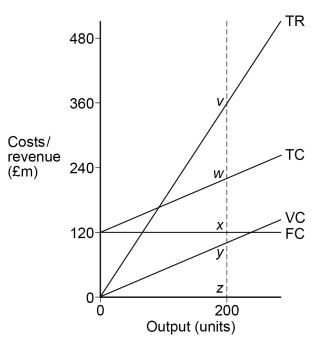
The break-even chart below shows details of costs and revenue for a business.

Graph showing costs and revenue against output in units, with lines for total revenue (TR), total cost (TC), variable cost (VC), and fixed cost (FC).

At 200 units of output, profit is shown by the distance:

  • vw

  • vx

  • vy

  • vz

30
1 mark

The following data relates to the financial position of Whittaker plc for the 2015–2016 financial year.

  • Revenue: £25 750 million

  • Dividends paid: £2 655 million

  • Gross profit margin: 24.5%

  • Net profit margin: 5.6%

Whittaker plc’s gross profit for the 2015–2016 financial year was:

  • £1 442.00 million

  • £148.68 million

  • £650.48 million

  • £6 308.75 million

31
4 marks

Calculate the operating profit variance and state whether it is adverse or favourable.

Budget (£m)

Actual (£m)

Sales revenue

3.5

2.3

Cost of sales

1.3

1.2

Expenses

1.4

1.5

Operating profit/loss

32
9 marks

Case Study

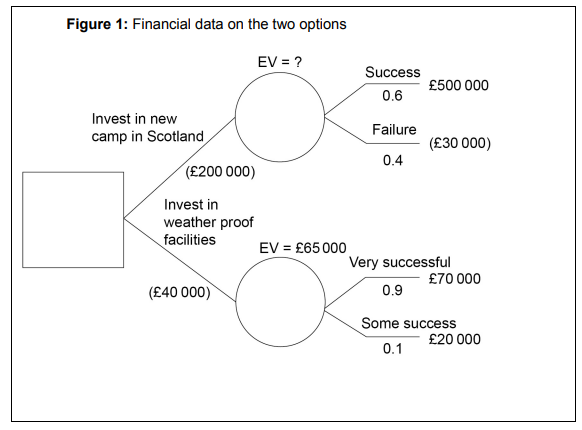
AdventureCamp

In 2015 Sam Turner decided to leave the army and set up his own business. He had always enjoyed being a risk taker. He spent nearly a year establishing AdventureCamp Ltd (AC Ltd) just outside London. At the camp Sam runs outdoor activities for adults such as zip wire and rope climbing challenges; it includes a café area. Sam is very ‘hands on’ and enjoys managing every aspect of the business. However, he has found it harder than he imagined negotiating with suppliers and banks; perhaps because the business is new and small.

Sam targets business customers who use his camp for team-building events. Sam designs specific activities for each business based around his specialist army training. He has offered very favourable trade credit terms and, in this first year, big discounts where necessary to win bookings. He believes that once organisations have used his services he will win their repeat business and their brand loyalty. He is well aware there are many other team-building companies that businesses could use.

For his first year Sam set two financial targets: to break even and to keep his short– term borrowings from the bank under £25 000. His mission is to create a number of AdventureCamps across the UK in the next few years.

Sam is now considering two options. He does not have the time to do both.

Option 1: Adding new facilities to the existing camp to provide some activities that are usable when the weather is bad. Sam has had to cancel bookings at the very last minute because of health and safety issues when there are high winds or heavy rain. This has led to complaints.

Option 2: Opening a brand new and much larger camp in Scotland with the aim of targeting families wanting outdoor activities (eg for birthday parties). A friend has told Sam of some land that is available near Edinburgh and, having asked a few local families, she thinks there is potential. She has put together some financial estimates based on this. Sam is very excited at the idea of a second camp.

Table 1: Financial extracts for AC Ltd on 31 December 2016

Item

Data

Receivables

90 days

Payables

21 days

Overdraft

£35 000

Debt

£100 000

Total long–term funds invested in the business (including debt)

£150 000

Average contribution per customer in 2016

£25

Total number of customers in 2016

8000

Fixed costs in 2016

£207 000

Interest rates on existing loan

5.5%

Decision tree showing financial options: invest in a new camp with possible outcomes or invest in weatherproof facilities with expected values and success probabilities.

Use Table 1 to analyse the weaknesses of AC Ltd’s financial position on 31 December 2016.

33
2 marks

Read the case study in the insert booklet.

Calculate the Gross Profit Margin for G-Free Ltd in 2016.

34
4 marks

Read the case study in the insert booklet.

The Operating Profit Margin for G-Free Ltd is forecast to increase much more than the Gross Profit Margin between 2017 and 2019.

Explain why this may be the case.