Organisational Design (AQA AS Business): Exam Questions

Exam code: 7131

50 mins7 questions
1
9 marks

Case Study

Refurb-iture Ltd

Veronica is CEO of Refurb-iture Ltd, which makes and sells luxury home furniture to high income groups. Currently all of its furniture is made from reclaimed and recycled materials. The business has grown rapidly in the last two years. The number of staff in the sales department has increased from 15 to 75. As a result, many staff are inexperienced. In the sales department, there are currently 5 managers and 10 deputy managers. Each deputy manager is in charge of 6 assistants.

Some new staff have reported they do not feel very well supported. There have been some complaints from customers about slow service times as staff check information with deputy managers. The business’ staffing costs are double that of its main competitor.

Veronica recognises that good customer service and eco-friendly products are the main reasons customers buy from Refurb-iture Ltd. The shareholders of Refurb-iture Ltd have set Veronica the following objectives:

  • expand the product portfolio from just home furniture to achieve rapid sales growth

  • maintain its exclusive and unique brand image

  • increase profitability in the long term.

Veronica is determined to meet these objectives by increasing the product portfolio with one new type of product. She has researched two options for the new type of product: garden furniture or office furniture. Her research is shown below.

Garden furniture option

Office furniture option

Market value in UK

£12 million

£650 million

Growth in the market in last 10 years

10%

25%

Average price per unit

£1500

£150

Initial investment cost for machinery

£2.5 million

£1.2 million

Variable cost per unit

£120

£22

Discounts offered by suppliers for bulk purchases

Not offered

15%

Materials used

100% eco-friendly

40% eco-friendly

Number of competitors with similar products

1

8

Veronica has decided to make the deputy managers redundant.

Analyse the possible impact of this decision on Refurb-iture Ltd’s performance.

2
1 mark

Statement 1: ‘Delegation can improve efficiency because it may allow decisions to be taken by the employee with the most relevant skills.’

Statement 2: ‘Delegation helps to identify employees with the potential for promotion.’

Read statements 1 and 2 and select the correct option from the following:

  • Statement 1 is true. Statement 2 is true.

  • Statement 1 is true. Statement 2 is false.

  • Statement 1 is false. Statement 2 is true.

  • Statement 1 is false. Statement 2 is false.

3
5 marks

A restaurant chain decentralises marketing decisions to individual store managers.

Analyse one way in which this change may increase the sales revenue of the business

4
16 marks

Case Study

Horizons Ltd

In 2010, Yusuf set up his own accountancy business, Horizons Ltd. Yusuf had previously been a successful manager in a large accountancy company.

Currently, Yusuf has 18 employees, all of whom report directly to him. Yusuf tells his staff to check all important decisions with him; he says this is because one wrong decision could be costly for the business both financially and in terms of its reputation.

As the business has grown, Yusuf has had to work longer hours. He is finding this workload a strain and recently had time off with stress. This delayed the completion of some jobs and Horizons Ltd had to charge some of its clients less for this accounting work as a result.

To try to increase revenue, Yusuf has recently decreased prices. Horizons Ltd now charges around 10% less than rivals. The business also spent £45 000 for the year on the promotional mix; £35 000 of this was on print advertising such as newspapers and £10 000 a year on social media advertising.

Yusuf’s team is made up of newly qualified accountants. Staff morale is very low. The productivity of the staff is lower than at several rival businesses despite the fact that they are paid 8% more than the industry average. Many staff feel they are unable to use their initiative and that they have little responsibility. Labour turnover is high at the business.

Yusuf has recently hired a management consultant to look at how he can improve the performance at Horizons Ltd.

The consultant:

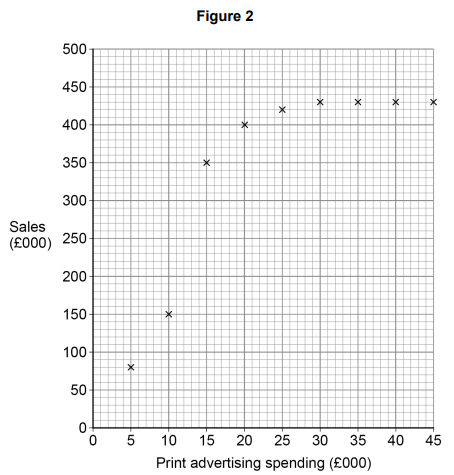
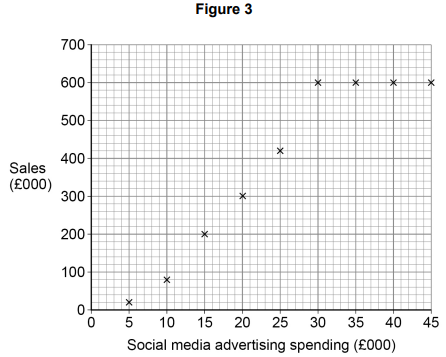
  • has produced some analysis of the forecasted effectiveness of print and social media advertising for Horizons Ltd (see Figure 2 and Figure 3)

  • has estimated that the price elasticity of demand for Horizons Ltd work is –0.3.

The consultant has also produced a plan for a new organisational design in which she recommends that Yusuf:

a) recruits three new managers from outside of the business to manage six staff each
b) delegates to these new managers much of his day-to-day work.

Scatter plot titled 'Figure 2', showing correlation between print advertising spending (£000) and sales (£000), with data points forming an upward trend.
Scatter plot showing sales in £000s versus social media advertising spending in £000s, with data points mostly increasing as spending rises.

Yusuf is considering the consultant’s plan for a new organisational design at Horizons Ltd. Do you think it would be a good idea for Yusuf to adopt this plan? Justify your answer.

5
9 marks

Case Study

Charlotte’s Sculptures

Charlotte is passionate about art and design. In 2014 she began producing and selling unique art sculptures. She was an art college student at the time with no business qualifications but did win a national art award. In 2016, Charlotte was offered a large contract from a national high street department store called Doyles. Charlotte has had to work long hours to meet the order but loves making the art. All of her sculptures are sold under the Doyles brand name.

To agree the contract, Charlotte met with a senior buyer from Doyles’ head office. Doyles centralises all its decisions about purchases, prices and inventory. The company has 3000 employees and 52 stores in the UK, based in many locations from wealthy large cities to smaller market towns.

The contract that Charlotte has means that she must sell her pieces exclusively to Doyles. She only receives her payments once the sale occurs in store.

At the end of this year the contract between Doyles and Charlotte must be renewed or terminated. Doyles’ senior management team is keen to renew on the same terms. The market for art sculptures is growing rapidly. Charlotte thinks there may be more money to be made by selling her products herself online. She has completed some estimates below:

Current net profit margin %

Selling price £

Sales forecast per week for 2020 (units)

Selling to Doyles

10

200

40

Selling online

40

160

18

As part of her research, Charlotte spoke to a jewellery business who started selling independently in 2015 after cancelling a contract with Doyles. After the conversation Charlotte noted the following points from the jeweller:

  • online advertising costs are rising rapidly

  • social media pages help advertising if they engage audiences with content daily

  • strong branding is important; the jeweller had a campaign backed by a celebrity which boosted sales in one year by 300%

  • the jeweller’s sales forecasts for the first year were far too optimistic

  • four years later the jeweller’s sales are higher than they were under the Doyles contract.

The jewellery business owner had a degree in marketing and assistance from friends.

The decision-making at Doyles is centralised.

Analyse two possible effects on Doyles of the centralisation of its decision-making.

6
1 mark

Statement 1: ‘In a very centralised retail organisation, local shop managers decide on the store design.’

Statement 2: ‘In a decentralised retail organisation, local shop managers decide on the items of inventory to be held.’

Read statements 1 and 2 and select the correct option from the following options:

  • Statement 1 is true. Statement 2 is true.

  • Statement 1 is true. Statement 2 is false.

  • Statement 1 is false. Statement 2 is true.

  • Statement 1 is false. Statement 2 is false.

7
9 marks

Case Study

Zoo

Sue is managing director and the sole owner of Zoo Ltd, a luxury fashion handbag business. Sue has helped the company to grow over the last forty years, taking responsibility for the key decisions for the business as a whole. She does, however, think carefully about the design of her employees’ jobs. She delegates many tasks to her team in areas such as marketing and operations and is good at praising her employees for their achievements. Zoo sells through independent fashion retailers in the UK. The average price of its handbags to all UK retailers is £250.

Last year Sue’s son Mike joined the business. Sue wants him to take over the company in the future. Mike had just finished his business degree at university and is eager to prove himself. Mike wants to increase the annual profits of the business by at least 60% in the next few years and make returns on all future investments of at least 25%. Until now, sales of the business have typically grown by 2% a year.

Mike has been negotiating on his own to win a contract with a very large fashion retailer, Nexia, to sell Zoo handbags. Nexia has stores in the UK and throughout Europe. Nexia has told Mike that it refuses to discuss the contract further unless Zoo has the ability to produce on a much larger scale.

For Zoo this means it would need to invest £1 500 000 in new production capacity. This would increase fixed costs by £160 000 a year but would not affect its variable costs per unit.

Mike has told Sue that there is an 80% chance that the contract will go ahead if Zoo invests in more capacity. The decision whether to invest in more capacity remains with Sue.

The bags for Nexia will be produced in addition to its current output. If Nexia is happy with sales in the first few years, bigger contracts may follow.

Appendix A: The terms of the potential contract

  • Nexia will pay Zoo £200 per handbag

  • Nexia would buy 10 000 handbags a year

Appendix B: Other Zoo production and finance data

  • Current output of Zoo: 12 000 bags a year

  • Variable costs of producing a Zoo bag: £130

  • Current annual fixed costs: £660 000

Appendix C: Zoo human resource performance data 2017–2018

  • Labour retention rate (% of staff staying with the business more than 5 years): 85%. Industry average: 64%.

  • Labour productivity index 120. Industry average 100.

Analyse how Sue’s approach to job design might have affected Zoo’s human resource performance as shown in Appendix C. Your answer should refer to two aspects of job design in Hackman and Oldham’s model.