The Water Cycle (AQA AS Geography): Exam Questions

Exam code: 7036

2 hours21 questions
1
1 mark

Which sentence describes one impact of climate change upon global precipitation rates?

  • Increased cloud cover will mean lower temperatures and less evaporation, leading to less rainfall, falling in shorter bursts.

  • Temperatures will rise leading to increased evaporation and higher amounts of rainfall in many places, with more intense bursts.

  • Temperatures will rise leading to increased evaporation and lower amounts of more intermittent rainfall.

  • The higher temperatures will cause the ice caps to melt putting more water into the oceans. Sea levels will rise and hurricanes will be more likely.

2
3 marks

Outline potential impacts of farming practices upon the water cycle.

3
9 marks

Evaluate the view that human activity is having a greater impact than natural factors on the water cycle.

4
1 mark

Which of the following describes a cause of precipitation?

  • As air rises from the Earth’s surface due to convection, it warms as it gets higher and changes state from liquid to ice.

  • At a cold front, warmer, less dense air is forced to sink under denser, colder air leading to cloud formation along the front.

  • When air is forced to rise over hills it cools, water vapour condenses forming clouds and water then falls to the surface of the Earth.

  • When the humidity of the air decreases, it means more liquid water can change state and become water vapour.

5
6 marks

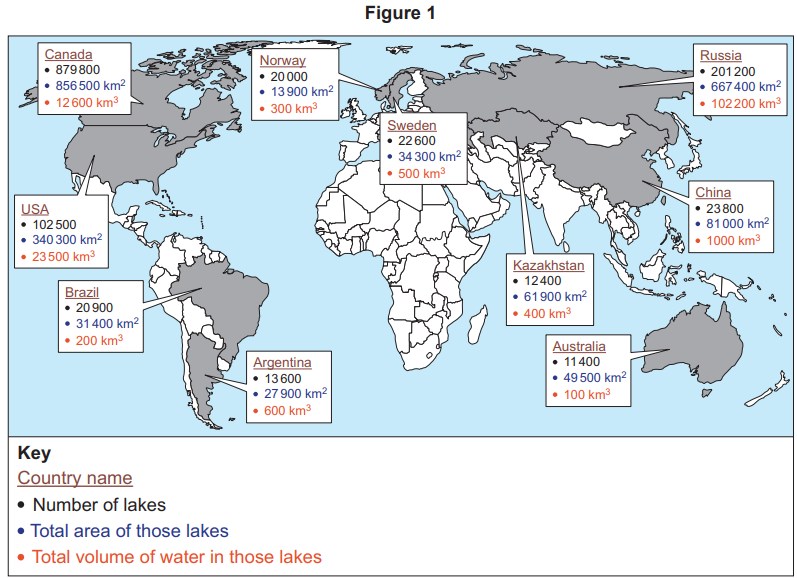
Figure 1 shows information about the ten countries with the largest number of lakes in the world.

World map with data on lakes in Canada, USA, Brazil, Argentina, Norway, Sweden, Kazakhstan, Russia, China, Australia, including quantity, area, volume.

Analyse the data shown in Figure 1.

6
9 marks

Assess potential impacts of climate change on a local river catchment you have studied.

7
1 mark

Which of the following describes the groundwater store?

  • Water flowing across the ground surface.

  • Water stored on the ground surface in lakes and ponds.

  • Water stored in the ground below the water table.

  • Water stored within vegetation growing on the ground.

8
1 mark

Which of the following are all natural drivers of change in the water cycle?

  • Causes of precipitation, cloud formation, seasonal changes

  • Causes of precipitation, land use changes, storm events

  • Condensation, cryospheric processes, farming practices

  • Evaporation, seasonal changes, water abstraction

9
3 marks

Outline the distribution of major stores of water.

10
20 marks

‘Climate change will significantly affect flooding and/or the potential for sustainable water supply.’

With reference to a local scale river catchment you have studied, how far do you agree with this statement?

11
1 mark

Which of the following describes the cryospheric store of water?

  • All water stored as liquid in the atmosphere.

  • All water stored as vapour in the atmosphere.

  • All water stored in its liquid state at the Earth’s surface.

  • All water stored in its solid state in glaciers, ice caps and sea ice.

12
1 mark

Which of the following outlines a positive feedback in the water cycle?

  • Increased CO2 in the atmosphere rightwards arrow warmer temperatures rightwards arrow plants grow quicker removing CO2 from the atmosphere by photosynthesis rightwards arrow levels of atmospheric CO2 reduced.

  • Increased CO2 in the atmosphere acts as a greenhouse gas rightwards arrow atmosphere warms up rightwards arrow methane released as permafrost melts rightwards arrowlevels of greenhouse gases increase.

  • Increased greenhouse gases in the atmosphere rightwards arrow atmospheric temperatures rise rightwards arrow increasing evaporation from the surface rightwards arrow water vapour condenses forming clouds rightwards arrow clouds reduce the warming effect.

  • Increased water vapour in the atmosphere acts as a greenhouse gas rightwards arrowatmosphere warms up rightwards arrow more water is evaporated from the oceans rightwards arrowvapour increases in the atmosphere.

13
3 marks

Outline features of a flood hydrograph.

14
20 marks

‘There is always a balance between the inputs and outputs of water in a drainage basin.’

To what extent do you agree with this statement?

15
1 mark

In systems in physical geography, which of the following correctly defines negative feedback?

  • Changes in a system amplify, or speed up, the impacts of an initial action.

  • Changes in a system decrease, or slow down, the impacts of an initial action.

  • When there is a balance between the inputs and outputs of a system.

  • When there is a transfer of energy beyond the boundary of the system.

16
6 marks

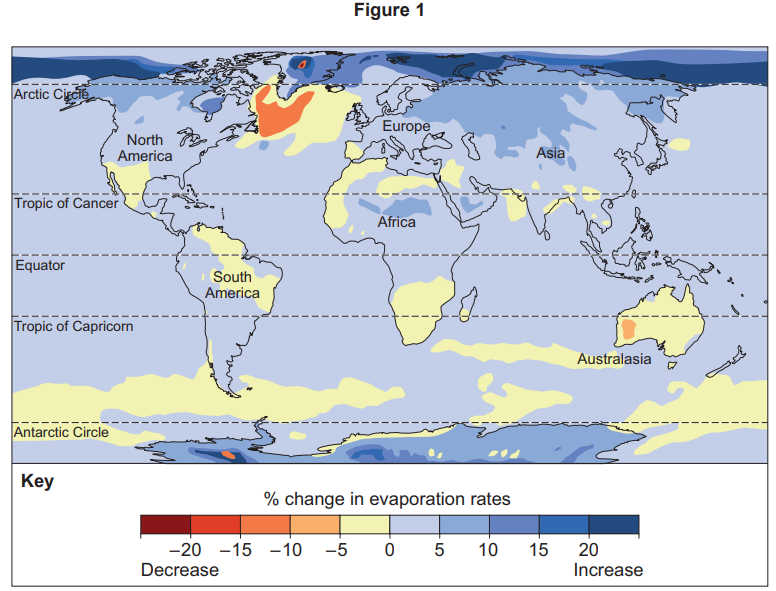
Figure 1 shows information about predicted changes to the annual rate of evaporation from the surface of the Earth between 2016 and 2035.

World map showing percentage change in evaporation rates with a colour scale. Varies from -20% (decrease, red) to 20% (increase, blue) across continents.

Analyse the information shown in Figure 1.

17
9 marks

Assess the possible impact of changing land use on the shape of a flood hydrograph.

18
1 mark

Which of the following are all stores of water in a drainage basin?

  • Channel flow, infiltration, runoff

  • Evaporation, interception, soil water

  • Ground water, soil water, surface water

  • Precipitation, runoff, soil water

19
1 mark

Which one of the following could be a natural cause of variation in the water cycle?

  • The rate of transfer of water from lithosphere stores to hydrosphere stores can be increased by urbanisation.

  • Hydrosphere stores of water can be reduced by abstraction of water for agriculture.

  • The amount of water stored in the biosphere could be reduced by deforestation.

  • Storm events transfer significant amounts of water from the atmosphere store to the hydrosphere and lithosphere stores.

20
3 marks

Outline an example of positive feedback in the water cycle.

21
20 marks

‘The size of major stores of water change over time more because of human activity than natural variation.’

To what extent do you agree with this statement?